


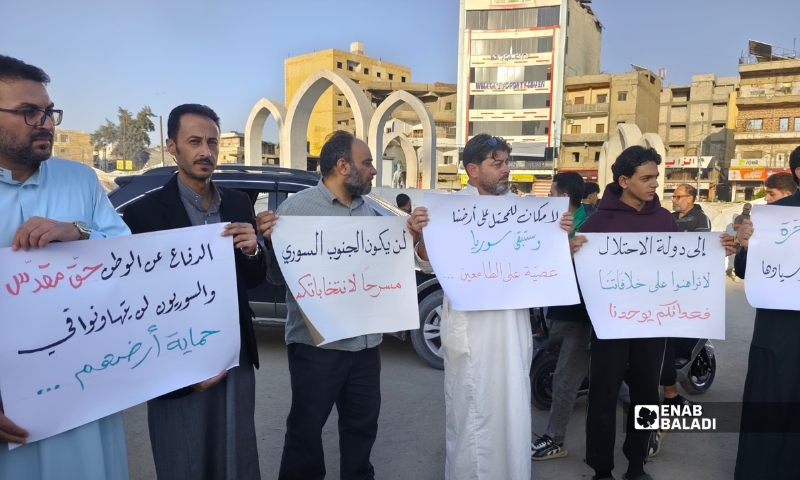
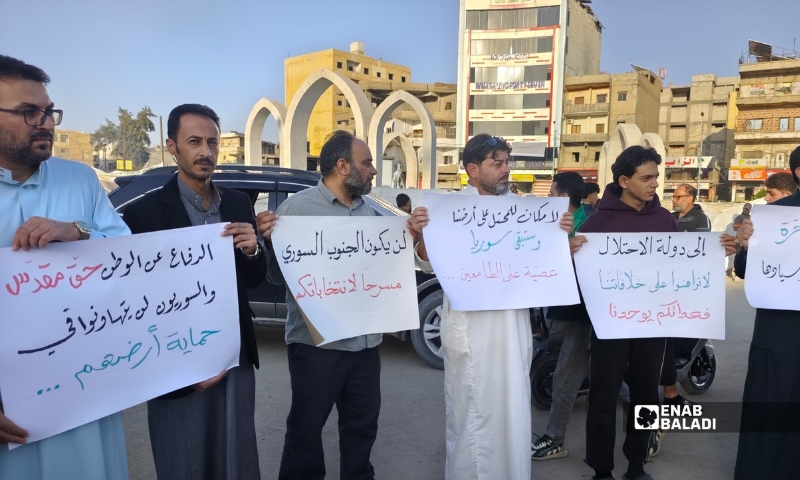
 A protest at al-Naim roundabout in Raqqa city condemns Israeli violations in southern Syria, October 23, 2026 (Enab Baladi/Ahmad al-Hamdi)
Enab Baladi, Rkkan al-Khder
Protests held across several Syrian regions and governorates in solidarity with Quneitra (southwestern Syria) and Daraa (southern Syria) against continuing Israeli violations have raised questions about their causes, motivations and political messages, as well as how they might develop.
They also raise questions about their potential impact on developments on the ground and the pressure they could place on Syrian and Israeli approaches to the situation in southern Syria. Tensions there appear to have escalated recently, particularly following two incidents in which the Israeli army killed young Syrian men last month.
On October 30, two protests took place in Jdeidet Artouz (western Damascus countryside, southwestern Syria) and Damascus’s Jobar neighborhood to condemn Israeli violations and actions in southern Syria. Participants chanted slogans and carried signs expressing their rejection of continuing Israeli attacks.
Protesters at both gatherings demanded information about the fate of people abducted and detained in Israeli prisons and called for their release. They also expressed a united public stance in defense of Syrian territorial sovereignty.
The gatherings followed similar protests across several Syrian regions and governorates on October 23, condemning Israeli incursions and responding to the killing and detention of Syrians, particularly after a young man with a disability was killed in Jamlah village in western Daraa governorate on October 22.
According to observations by Enab Baladi correspondents, demonstrations took place in several Syrian governorates, including Daraa, Quneitra, al-Hasakah (northeastern Syria) and Raqqa (northern Syria), as well as Salamiya in Hama governorate (central Syria).
Calls for protests were also reported in Homs (central Syria) and Masyaf in Hama governorate, alongside other locations in Damascus and its countryside.
Samir al-Abdullah, a senior researcher at the Arab Center for Contemporary Syrian Studies, believes that despite their small size and limited turnout, the demonstrations expressed growing anger and concern over Israeli policies in southern Syria. These include incursions, detentions and attempts to impose facts on the ground, particularly as Israeli actions have increasingly threatened Syrian sovereignty in the south, taking advantage of Syria’s weakness and its reluctance to escalate tensions with Israel.
Speaking to Enab Baladi, al-Abdullah said the demonstrations sent important political messages by expressing solidarity with southern Syria despite the divisions left by years of war. They demonstrated that Syrian society still has causes that unite it, foremost among them rejecting occupation and defending Syria’s territorial integrity. They also affirmed that Israeli military superiority does not mean Israel can impose a situation that enjoys public acceptance.
Ammar Jallo, a researcher at the Washington-based Dialogue Institute for Research and Studies (DIRS), believes the demonstrations stem from repeated Israeli provocations that have recently escalated in both their geographical reach and the nature of the violations. These violations increasingly affect people’s livelihoods, including livestock herding and farming. He identified the killing of the young man with a disability in Daraa governorate as the immediate trigger.
Speaking to Enab Baladi, Jallo said the demonstrations sent a clear message that Syrians would not give up any part of their territory, and that public action would not necessarily follow Damascus’s restrained approach and reliance on diplomacy.
He added that the public mobilization was no passing reaction. Opposition to the Israeli presence in southern Syria remains deeply rooted among Syrians, even if demonstrations have only emerged now. He suggested that the delay reflected the complexities of organizing protests and the pressure they could place on a government that is still building its institutions and lacks the military strength needed to confront Israeli incursions.
Jallo ruled out the possibility that the Syrian demonstrations would change Israeli actions on the ground, arguing that Israel neither responds to nor pays attention to civilian mobilization, whether in Syria or elsewhere. Damascus could, however, use these protests diplomatically and politically.
As for whether the protests could pressure Damascus to change its approach of pursuing diplomatic solutions, Jallo said the Syrian government lacked sufficient means to escalate tensions or engage in a military confrontation. Such a confrontation, he argued, could serve Israel’s aim of launching a forceful response that would consolidate its control over territory in the south or allow it to seize territory as a wartime gain.
Jallo nevertheless said the demonstrations could develop into popular resistance if continuing Israeli violations triggered an eruption of public anger. He also raised the possibility that other actors seeking to destabilize Syria, such as Iran and Hezbollah, could exploit current conditions to disrupt the situation and alter realities on the ground in their own interests.
For his part, al-Abdullah suggested that public mobilization could give the Syrian government additional leverage to strengthen its negotiating position and increase diplomatic pressure on Israel, without necessarily prompting Damascus to abandon its approach of avoiding direct military confrontation.
Regarding Israel’s position, al-Abdullah ruled out the possibility that demonstrations alone would change its strategy. However, they could raise the political cost of continuing incursions, particularly if they expanded and persisted.
Whether the protests develop into armed resistance will depend, according to al-Abdullah, on the extent of Israeli escalation, continuing attacks, the absence of political prospects and the Syrian government’s policy toward Israel. He expected protests to continue for now, with the possibility of limited local clashes.
Al-Abdullah explained that Israel could impose military realities by force, but could not necessarily compel Syrians to accept them. Continuing incursions and attacks, he said, would increase the likelihood of public opposition developing into a more organized and sustained national movement, creating growing political and security challenges for both Damascus and Israel.
The Sijil Center documented 395 Israeli violations in Syria during October, the highest monthly total recorded in 2026, exceeding March’s total of 321 violations.
According to the report, issued on November 2, violations averaged approximately 12.74 per day in October, followed by March, which averaged 10.35 violations per day.
With October’s figures added to those recorded since the beginning of the year, the cumulative number of violations rose to 2,427.
According to the Sijil Center, the violations recorded during the month included 126 incursions, 122 incidents of aircraft overflights, 44 checkpoints, 36 raids, 41 cases of detention and two killings.
Quneitra governorate recorded the highest number of violations, with 285, followed by Daraa with 74, Damascus countryside with 29 and Damascus with seven.
The Sijil Center documented two incidents in which Israeli occupation forces killed two Syrian civilians in October. It noted that these were the first such incidents since April, and the first time the Israeli army had killed more than one Syrian civilian in a single month since the Beit Jinn incident on November 28, 2025.
The center said the number of Syrian civilians killed by the Israeli army since December 8, 2024, had risen to at least 38.
Regarding detentions, the center recorded 30 cases in October, including 29 in Quneitra and one in Daraa. These included people detained during raids or at checkpoints, as well as shepherds targeted while on farmland and grazing land, particularly around Jubata al-Khashab in northern Quneitra governorate and Saida al-Hanout in southern Quneitra governorate.
Detention periods ranged from a few hours to approximately 48 hours before a number of those detained were released. Two detainees, however, remain unaccounted for.
According to the report, the cases included a woman who was detained and questioned for two hours before being released, the first incident of its kind documented by the center.
According to Sijil’s documentation, 287 people have been detained since December 8, 2024, of whom 36 remain in detention. Including five Syrians detained by Israeli forces before the fall of the Assad regime, the total number of Syrians held in Israeli prisons whose fate remains unknown stood at 41 at the end of October.
if you think the article contain wrong information or you have additional details Send Correction


 A
A
A


 More Politics