


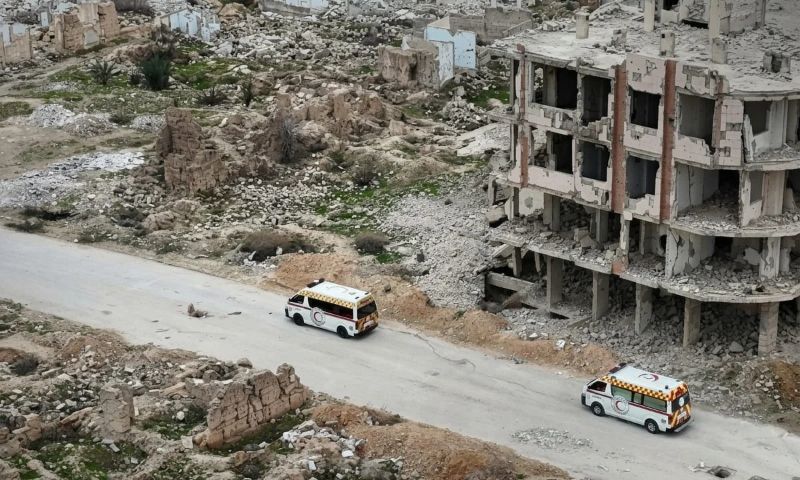
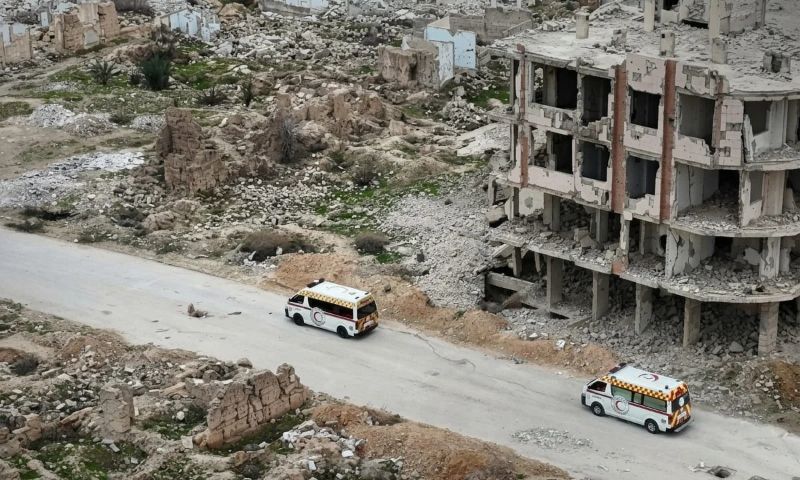
 Destroyed buildings in the Jobar neighborhood of Damascus, February 6, 2026 (SANA)
Enab Baladi, Wasim al-Adawi
Syria’s reconstruction faces a set of interlocking challenges. Legal and bureaucratic obstacles are holding back investment, while rebuilding must protect residents’ rights and preserve the identity of their neighborhoods.
In interviews with Enab Baladi on the sidelines of a November 21 discussion at the Makan workshop on reconstruction in Damascus, investors, lawmakers, and researchers offered their views on how to balance central planning with local participation and overcome legislative obstacles.
The World Bank’s rapid assessment of damage and reconstruction needs in Syria from 2011 to 2024, dated August 2025, estimates that rebuilding the country’s physical assets will cost about $216 billion, within an overall range of $140 billion to $345 billion.
Jobar and al-Qaboun, two neighborhoods in eastern Damascus, illustrate those challenges. Both are among the areas hit hardest by the war in Syria. World Bank teams visiting Syria estimated that more than 90% of Jobar had been destroyed. Human Rights Watch reported that large parts of al-Qaboun had been razed, with rubble and all traces of buildings cleared away.
Rebuilding these areas will require clearing millions of tons of war debris and rubble and dealing with extensive underground tunnel networks, estimated to run for more than 33 kilometers in Jobar alone. Residents also face the challenge of proving property ownership when official documents are missing and records have been destroyed.
Amer Zaidan, a representative of one of Jobar’s neighborhood committees, told Enab Baladi how planning and negotiations had progressed. Jobar’s local council was established in late 2012 and moved its headquarters back to Damascus when the Assad regime fell. It has an engineering committee of more than 70 engineers and a legal committee of more than 70 lawyers.
The engineering committee submitted its findings and zoning plans for rebuilding the neighborhood, but the authorities rejected the plans.
– First plan (amended 1994 plan): Damascus governorate rejected it on the grounds that it did not fit the vision for the new Syria.
– Second plan (2025 plan):The committee designed it to fit the governorate’s vision while protecting residents’ rights. The governorate also rejected it, citing a projected population density of 600 people per hectare.
As the local plans were being rejected, investment proposals emerged. Negotiations over those proposals lasted about eight months and led to the formation of joint planning committees.
Zaidan said the talks lacked transparency and clarity. Residents still had no written document or definitive official decision. There were also no precise, approved figures for the total area previously built up in Jobar or for its actual population, and the numbers and percentages kept changing.
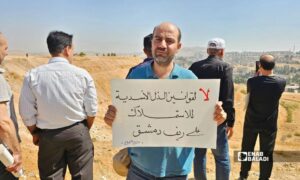
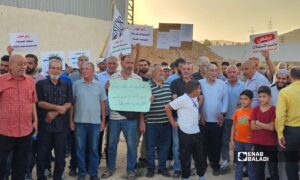
Jobar residents have called on Damascus governorate to clarify its reconstruction plans, as Enab Baladi has documented in several reports.
Zaidan said the central dispute was over the proposed investment arrangement for Jobar and al-Qaboun, as well as the Bab Sharqi project in Damascus. The initial offer allocated just 26% to residents and 74% to the investor, he said.
The residents’ share later rose to 35%, while the investor’s share stayed at 74%. Zaidan said the arrangement kept the investor’s share at that level by granting the investor one million square meters of land reserved by the governorate.
Zaidan attributed the imbalance to the state’s withdrawal from its direct financial responsibilities. He said reconstruction depends on three parties, “the people, the investor, and the government.” In this case, he said, the government was contributing no direct funding and was only relinquishing ownership of existing streets in the neighborhood.
Zaidan said a more serious problem was that residents and the investor were being asked to cover the cost of building public and service facilities, which are estimated to occupy about 800,000 square meters in Jobar. He said the relevant ministries and public bodies should bear those costs.
– The Ministry of Education should pay for schools.
– The Ministry of Health should pay for hospitals.
– The Ministry of Religious Endowments should pay for mosques.
– Damascus governorate and state institutions should pay for major infrastructure.
Zaidan said property owners should get back everything they were entitled to and receive more on top of that. He warned that unfair investment terms could turn reconstruction into what he called “forced displacement in disguise” through showcase developments that residents could not afford to live in.
Zaidan warned that treating reconstruction solely as a commercial undertaking risked creating a deep rift between the government and the local community, including those who took part in the revolution.
Most current property owners in Jobar fall into what Zaidan called “vulnerable groups,” given the high proportion of “widows and orphans of martyrs.”
Zaidan explained that a person in good health might find work and housing independently, but families who had lost their breadwinners could not afford high construction costs or manage complex financial settlements. He said the state had a moral and legal duty to protect their rights and make their return a priority.
Zaidan set out four conditions he considered nonnegotiable for any investment project or reconstruction plan in Jobar.
1-Room for everyone to return: Ensure that all Jobar residents can return to their neighborhood.
2-Preserving the neighborhood’s heritage: Protect Jobar’s historical and social identity, including the markets, mosques, and landmarks that hold meaning for residents.
3- A binding timeline: Set a clear deadline for construction so residents know when they will receive their homes, whether in five or 10 years, for example. Avoid open-ended promises that could stretch for decades.
4- Priority for residents: Give residents first access to housing and property ownership, including families who previously had no property registered in their names, before opening projects to outside investors or newcomers.
Jobar residents’ position is similar to that of al-Qaboun’s Board of Trustees on proposals to rebuild its own neighborhood. In September, the board said the proposals in their current form fell short of its standards and principles, particularly on property owners’ rights and preserving the neighborhood’s social fabric and the places that hold its collective memory.
The board said at the time that it had examined the latest offer from Damascus governorate on technical, legal, and economic grounds. Its main concern was how the project would divide the resulting property rights, a split the board said would seriously harm owners’ interests.
The board said the proposal would charge the project for public facilities and for infrastructure in areas that had already been zoned.
Syrian businessman Samer Shamsi Basha told Enab Baladi that the next phase of rebuilding devastated neighborhoods such as Jobar and al-Qaboun requires a “comprehensive national plan” covering all of Syria. He said decision-making should be centralized to coordinate efforts and collect accurate data on the extent of the damage, while local bodies should have the autonomy to carry out plans that reflect each area’s needs and circumstances.
Shamsi Basha said “people are at the heart of reconstruction.” That means involving residents in decisions about their neighborhoods’ future and protecting their private property rights, which are guaranteed by the Constitutional Declaration.
He said the state should act as a fair arbiter in disputes that may arise among residents. Rebuilding the physical environment, he added, lays the groundwork for rebuilding communities and reconnecting neighborhoods.
Shamsi Basha said the time needed to obtain investment permits varies. Commercial projects in areas free of disputes can secure approvals relatively easily. In damaged residential neighborhoods, overlapping rights held by owners, tenants, and heirs can complicate the process.
He described his own experience with the Syrian Investment Authority’s licensing process as “positive.” He praised its requirements for feasibility studies, proof of financial capacity, and scrutiny of business plans, saying they protect investors from poorly assessed risks in real estate and other sectors.
The Syrian Investment Authority recently issued a circular regulating events, exhibitions, and other activities that promote real estate development and investment projects. It told Enab Baladi at the time that the move responded to problems in real estate marketing that needed to be addressed.
Those practices included promoting properties and projects located abroad within Syria without enough reliable information to verify that the properties and projects were genuine, establish the status of the entities marketing them, or confirm the safeguards for reservations, contracts, and refunds.
The authority said citizens could end up transferring their savings to entities abroad that would be difficult to hold accountable or recover money from if buyers were misled or contractual obligations went unmet.
The demands of Jobar residents echo warnings from urban and spatial planning experts. They say that without public participation, investment projects geared only toward affluent buyers will leave the country’s large housing shortfall unresolved and perpetuate exclusion and unequal access to urban space.
Dr. Chaghaf Howayek, a researcher in urban and spatial sociology, told Enab Baladi that reconstruction raises social and legal questions, particularly in devastated areas such as Jobar, where residents are anxious and angry about the neighborhood’s future.
Howayek said new zoning plans were needed to avoid past mistakes and should be developed from the “bottom up.” She called for open discussions with residents, local councils, and merchants so the plans preserve the community’s identity and residents’ ties to the neighborhood.
She said the executive branch had shown limited willingness to hear their proposals on spatial and transitional justice, describing it as “listening a little.” The proposals aim to prevent forced displacement from recurring under the guise of investment.
Anas al-Abdah, a member of the Investment and Reconstruction Committee in the People’s Assembly, Syria’s parliament, acknowledged that the country has an estimated shortfall of 1.3 million homes.
Al-Abdah said the Assembly intends to review investment contracts signed during the transitional period and update laws to reduce bureaucratic barriers, particularly for Syrian investors at home and abroad. He said future legislation and budgets would put citizens’ interests and their right to a decent life first.
Asked about barriers to investing in devastated areas, al-Abdah told Enab Baladi that reconstruction brings together social, economic, and political efforts, with people at the center. He identified three areas of work.
1- Early recovery: The state bears primary responsibility.
2- Reconstruction: Use concessional loans, grants, and public-private partnerships.
3-Sustainable development: Protect the rights of future generations.
Al-Abdah said existing laws make it harder to serve citizens and attract capital. Investors currently have to wait months and go from office to office, sometimes dealing with dozens of them, to register a company. He said regional standards allow companies to be set up in a single day.
The Assembly’s Investment and Reconstruction Committee is working with the Syrian Investment Authority to examine 19 proposals to amend Decree No. 114, which amended Investment Law No. 18. The aim is for the amendment to become the first bill drafted and passed by the Assembly.
The proposed amendment would do two things.
– Give the Syrian Investment Authority broad authorization from all ministries to process applications for investments of $1 million or more within three to four days.
– Allow the authority to verify investors’ legal standing and financial capacity, screen out brokers and people posing as investors, and reserve the streamlined process for genuine investors.
Shamsi Basha agreed that the Investment Authority should focus on removing administrative hurdles and coordinating permits across ministries. He said technical decisions should stay with the authorities responsible for them.
To reduce rebuilding costs, construction materials expert Mohammed Taj al-Din Haj Hussein proposed recycling millions of tons of concrete and ceramic rubble from devastated areas and mixing it with volcanic pozzolan, a material found in abundance in Syria.
He said this method could produce low-cost, durable building materials and cut the reconstruction bill by billions of dollars.
Rebuilding devastated areas such as Jobar and al-Qaboun is a test of transitional justice and of whom development serves. A genuine partnership would require the state to meet its responsibilities and protect residents’ right to return. Without that partnership, redevelopment risks creating isolated projects that exclude the original landowners.
if you think the article contain wrong information or you have additional details Send Correction


 A
A
A


 More HLP