


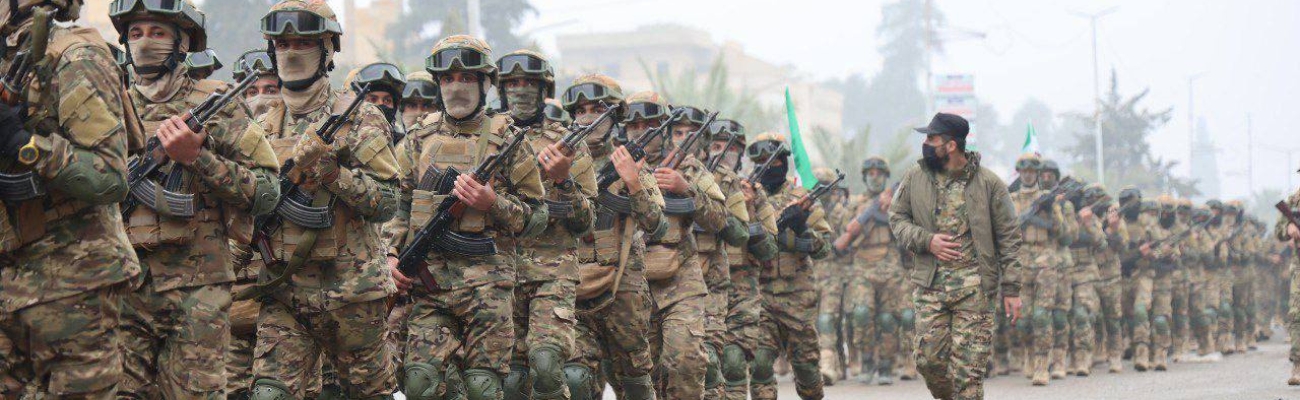
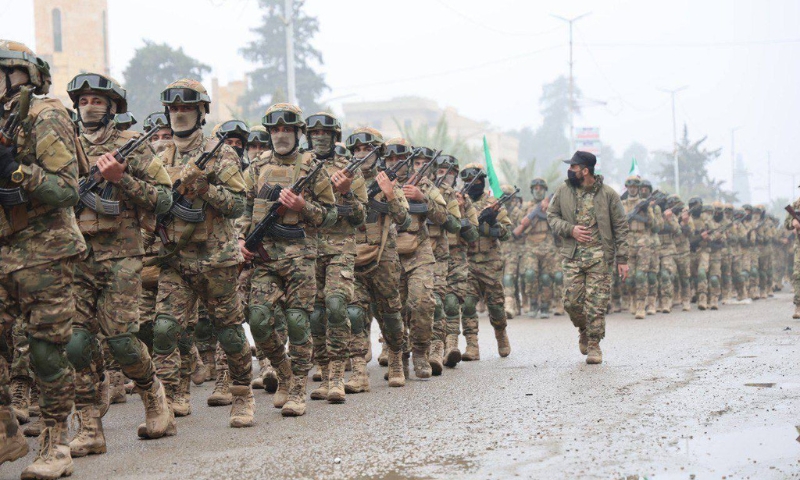
 A Syrian army military parade marking the first anniversary of the former regime’s fall, December 8, 2025 (Ministry of Defense)


 A
A
A
Mowaffak al-Khouja | Mohammad Deeb Bazzet | Odai al-Haj Hussin
Syria’s Ministry of Defense has begun a second phase of restructuring the army, nearly two years after the former Syrian regime’s fall. The force was assembled from factions that had previously fought one another, or groups whose ideologies, some fear, remain incompatible with a Syrian national outlook.
The first phase involved integrating factions of different orientations into the Ministry of Defense and bringing their weapons under a single command, after they relinquished their former names and personal and ideological allegiances.
The second phase involves eliminating remaining factional and ideological loyalties, as well as ethnic and religious affiliations, through reassignments and the redeployment of ground forces across Syria.
However, concerns persist about the army’s domination by Hayat Tahrir al-Sham (HTS), the core of Syria’s political and military leadership, raising the risk of new allegiances emerging within the military.
There are also fears that some groups could retain their own ideologies or ethnic affiliations, potentially affecting the performance of an army that is supposed to serve all Syrians.
These circumstances also raise questions about the army’s future, the military doctrine it should adopt, and its weapons and strength after years of war exhausted Syria’s military capabilities.
Defense Ministry Completes Faction Dissolution and Strengthens HTS Influence
The new Syrian army was formed from factions that joined the Ministry of Defense, headed by Murhaf Abu Qasra, a former HTS commander and one of the leaders of Operation Deterrence of Aggression, which ended with the overthrow of the former Syrian regime on December 8, 2024.
At the beginning of 2025, the Defense Ministry announced a series of organizational measures, including integrating armed factions under its authority and establishing a unified structure to restore the military as the backbone of national sovereignty.
On January 29, 2025, the Military Operations Administration, the umbrella body that brought opposition factions together during Operation Deterrence of Aggression, announced at the “Victory Conference” that military factions would be dissolved and integrated into a single structure under the Defense Ministry.
The ministry held meetings with more than 130 military units and factions, as well as senior committees responsible for organizing personnel data. It also worked on drafting new internal regulations to redefine the relationship between its administrative and military functions.
Following these meetings, the ministry abolished all former faction names and assigned their fighters and personnel to military divisions. Enab Baladi identified 21 divisions in an earlier report, while other media reports gave different figures, ranging from 20 to 25.
Alongside these measures, the ministry established administrative, advisory and academic bodies to provide personnel and expertise, including central recruitment offices, an advisory body comprising senior officers who had defected, and the National University for Defense Sciences.
On March 9, the ministry announced the start of a comprehensive officer assessment process. “Thousands of officers” in command positions and across different specialties were assessed as part of the army’s restructuring and the assignment of ranks.
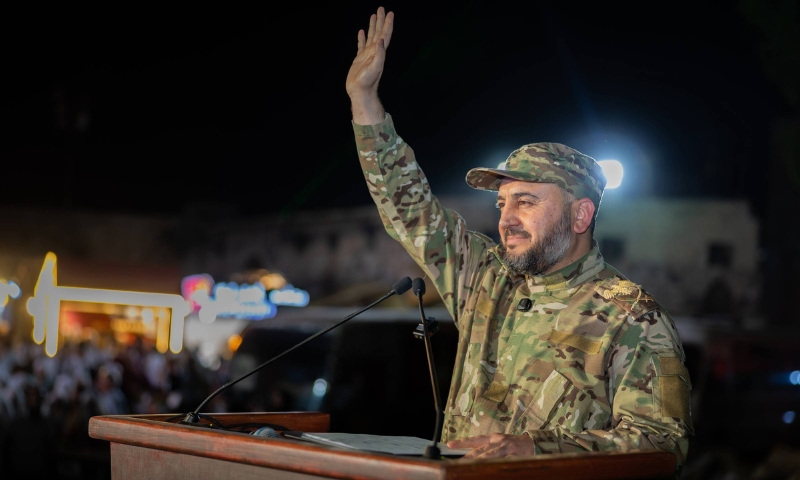
Syrian Defense Minister Murhaf Abu Qasra visits the Syria Summer Festival at the Damascus Citadel, August 16, 2026 (Ministry of Defense)
Reassigning Commanders and Establishing Corps
Following these measures, the Defense Ministry began restructuring through the reassignment of some commanders, a move understood as an attempt to end factionalism within the army. It also began forming army corps led by personnel from the dissolved HTS.
Despite losing their former names, most factions retained their structures as battalions, brigades and even divisions within the army, keeping their commanders and administrators.
In early August, the ministry began removing prominent commanders from divisional leadership positions. Among the most notable was Saif al-Din Bolad, known as Abu Bakr, who commanded the 76th Division in Aleppo (northern Syria). Brigadier General Mahmoud al-Hamidi, known as Abu Odai Saraya, replaced him, according to a division member who spoke to Enab Baladi.
Abu Bakr remains on the ministry’s personnel rolls, according to leaked information and accounts circulating among army members. Enab Baladi could not confirm whether he had received a new appointment, particularly following reports that he had decided to live in Turkey.
This was preceded by the transfer of Brigadier General Mohammed al-Jassem, known as Abu Amsha, from command of the 62nd Division, formed from members of his former Sultan Suleiman Shah faction, to an administrative position within an army corps.
The dissolutions and changes also affected entire divisions. A commander in the 40th Division, operating in Daraa governorate (southern Syria), told Enab Baladi that the division had been dissolved completely.
The commander, who requested anonymity, said some brigade and battalion commanders had been transferred to Damascus, while others remained at home with their future unclear. Others were assigned to the Border Guard forces.
Similar changes affected commanders in other brigades and divisions, according to Enab Baladi’s reporting.
More recently, activists and media outlets circulated reports that Brigadier General Jamil al-Saleh had been removed from command of the 74th Division without receiving another appointment.
Activists and media outlets also reported the removal of Brigadier General Fahim Issa, deputy defense minister for the northern region. However, people close to him denied this, and an Enab Baladi correspondent observed his attendance at a World Tourism Day event held in Aleppo on September 27.
These command changes coincided with reports of the establishment of army corps, with their number ranging from five to six depending on the media report.
The Defense Ministry declined to answer Enab Baladi’s questions about whether these commanders had been dismissed or resigned, or about the establishment of corps and the dissolution of some divisions.
Dissolving Factions and Rebuilding the Military
Moataz al-Sayyid, a researcher at the Syrian Center for Security and Defense Studies (MISDAD), believes these restructuring measures should be understood within the context of rebuilding Syria’s military from scratch, including its structure, doctrine and chain of command.
In the first phase, the priority was to absorb fighters into state institutions and prevent weapons from remaining outside state authority.
The current phase involves moving from absorbing former formations to reorganizing them and assigning fighters according to the military’s requirements, according to al-Sayyid.
Speaking to Enab Baladi, al-Sayyid said it was natural for this process to take time, particularly because initial integration largely proceeded through the existing formations that had fought in what were known as the “liberated areas,” despite their differing backgrounds and affiliations.
Reorganizing divisions, establishing corps and reassigning commanders could therefore be steps toward a more cohesive army, provided they are based on competence, experience and military need rather than factional loyalties.
Will These Measures End Factionalism?
Al-Sayyid believes these measures can help end factionalism, but cannot achieve that on their own.
Administrative integration does not necessarily mean previous loyalties have disappeared, he said. The real challenge is shifting allegiance from a faction or commander to the national military institution.
After absorbing fighters into the Defense Ministry, the next step is to redistribute them according to experience, competence and specialization, taking their military backgrounds into account without turning those backgrounds into permanent privileges for particular factions.
Reassigning some commanders may also help weaken units’ ties to particular individuals, according to al-Sayyid.
The real test, however, is the extent to which units answer to a unified central command and appointments, promotions and accountability follow clear institutional rules.
How Did the Defense Ministry Dissolve the Factions?
According to a paper by researcher Jérôme Drevon published on the Social Science Research Network (SSRN), Syria’s new authorities refused to make political concessions to other groups, particularly former factions. Since taking control of Damascus, they have treated army building as a purely bureaucratic process.
This approach has its roots in Idlib (northwestern Syria) and in the leadership’s own interpretation of failures elsewhere in the region, including Lebanon, Iraq and, above all, Libya. These experiences had featured in its internal discussions long before 2024.
“The strategy pursued after 2025 was merely the final stage of a process that had begun years earlier under the wartime system of governance in northwestern Syria, before being applied to postwar state building.”
Jérôme Drevon, researcher, in a paper published on SSRN
According to Drevon, the HTS leadership believed sharing the state with armed factions would paralyze it.
From a more pragmatic perspective, this argument also served HTS’s own interests, since it had little desire to make concessions to other parties. Every decision was therefore framed as a technical matter, in Drevon’s assessment.
Does HTS Monopolize Army Leadership?
Alongside the dissolution of factions, suspicions persist that HTS is consolidating its influence over the army by placing its commanders in sensitive leadership positions while excluding commanders from other factions.
Al-Sayyid believes claims that HTS monopolizes influence require evidence beyond the backgrounds of some commanders.
The appointment of several HTS commanders to leadership roles in the new military can be explained partly by the group’s organizational capabilities and experience managing military formations.
However, this does not necessarily indicate a policy aimed at reserving influence for HTS alone, al-Sayyid believes.
He noted that senior commanders include figures who were not part of HTS, alongside the ongoing process of integrating the Syrian Democratic Forces (SDF), suggesting that military institution building extends beyond a single faction.
“Successive changes are normal in a newly established institution and are not, in themselves, cause for concern. Their success, however, depends on their actual results.”
Moataz al-Sayyid, researcher at the Syrian Center for Security and Defense Studies (MISDAD)
Most important, in al-Sayyid’s view, is ensuring that appointments are based on competence and experience, and that command positions are open to different officers under uniform criteria rather than previous affiliation.
Asked whether these measures contradicted the ministry’s stated aim of dissolving factions, al-Sayyid said changing commanders and redistributing units could be part of ending factionalism. However, if these measures are understood as excluding some formations in favor of others, they could reproduce previous loyalties within the institution rather than overcome them.
“Syria’s transition took place without any of the institutional mechanisms conventionally associated with political settlements. There was no comprehensive settlement, no disarmament, demobilization and reintegration program (DDR), and no international monitors.”
Jérôme Drevon, researcher, in a paper published on SSRN
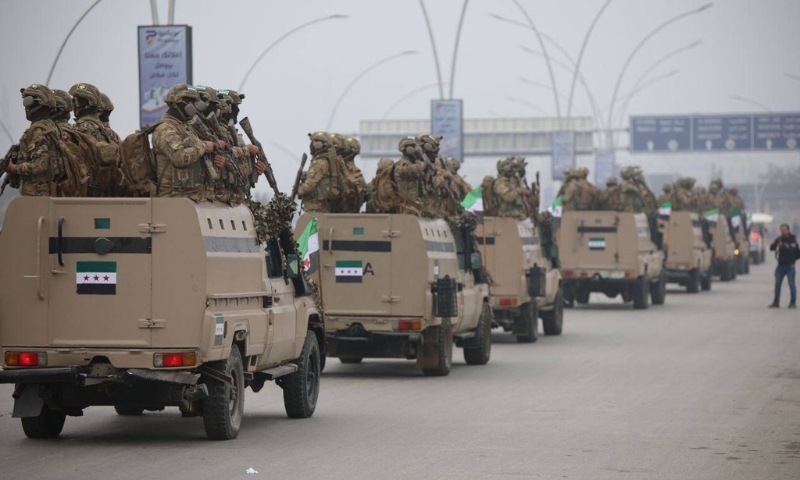
A Syrian army military parade marking the first anniversary of the former regime’s fall, December 8, 2025 (Ministry of Defense)
The SDF and Foreign Fighters: A Different Context
Integrating the SDF and foreign fighters into the military raises questions about the future army’s structure and its ability to unify military decision-making and prevent independent centers of influence from emerging within it.
The context differs from the integration of other factions. Despite their previous infighting, those factions had been regarded as part of the same broad camp through Operation Deterrence of Aggression because they shared one objective: overthrowing the regime.
Disagreement Over Integration and Command
Colonel Khaled al-Mutlaq, a military expert, described the integration of the SDF into the Syrian army as a complex process, noting that political agreements and announcements do not necessarily amount to actual military integration.
According to al-Mutlaq, the process is affected by several factors, including regional pressure, particularly from Turkey, disagreements over decentralization, and ideological considerations and foreign interventions that he believes do not support Syria’s unification.
Speaking to Enab Baladi, al-Mutlaq consequently questioned whether full integration could be achieved while these disagreements persist.
One central obstacle is disagreement over the form integration should take. According to al-Mutlaq, the Syrian government favors integrating SDF fighters individually and distributing them among army formations, while the SDF leadership insists on retaining cohesive military formations with a local character, particularly in Kurdish-majority areas.
This divergence raises a fundamental question about the army after integration: Will former forces become part of units under central command, or retain their own organizational and command structures within the military?
The disagreement also extends beyond unit structures to the chain of command and control, and the authority to which the forces would actually report. Would that be the Defense Ministry’s central command in Damascus, or would a joint command arrangement emerge?
Al-Mutlaq believes resolving these questions is essential before one can speak of a unified army. Announcing integration is insufficient if the mechanisms for issuing orders, assigning responsibilities and enforcing military discipline remain disputed.
“The SDF’s women’s units and their specific formations also raise questions about how they would be accommodated within the new military, given the ideological and social differences among its components.”
Khaled al-Mutlaq, military expert
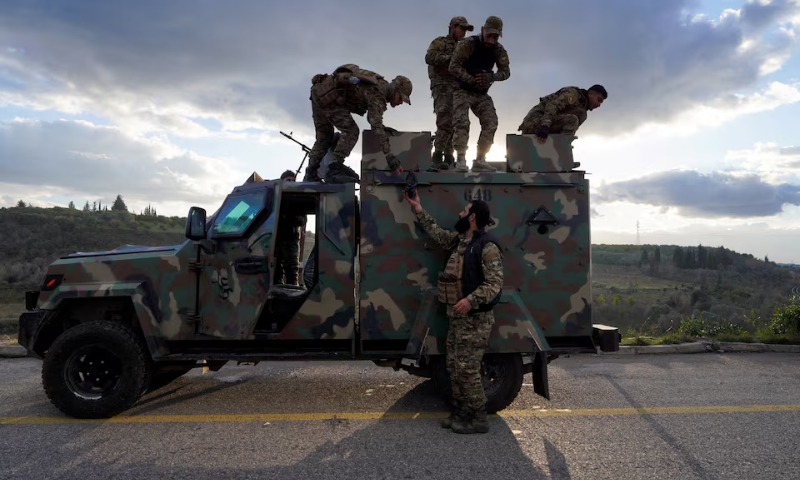
Syrian army personnel in Latakia city (western Syria), January 14, 2026 (Reuters)
Limited Options for Foreign Fighters
The Syrian army includes approximately 5,000 foreign fighters, most of them ethnic Uyghurs affiliated with the Turkistan Islamic Party. They are concentrated primarily in the 84th Division, with others serving in additional divisions.
These fighters have posed a challenge domestically and internationally, raising concerns among sections of Syrian society, particularly religious and sectarian minorities, because of their hardline religious backgrounds.
Other sections of society support their presence on religious grounds or as a matter of “honoring a commitment,” because they fought alongside Syrians against the regime.
International actors, including the United States and European countries on one side and China on the other, pressed for these fighters to be sidelined and kept away from decision-making positions. That pressure subsequently eased.
According to Drevon, the Syrian government dealt with foreign fighters using the same administrative approach it applied to the factions, adapting it to each group’s organizational characteristics.
He identified the Turkistan Islamic Party as the most prominent case. The group, which comprised approximately 3,200 fighters, was integrated into the army as a separate division, the 84th Division, under one of its own members. Drevon attributed this to its “high cohesion, discipline and firm loyalty to HTS.”
Smaller groups, each numbering no more than a few hundred members, were too weak to form independent divisions. Their separate organizations were therefore dissolved, and their members redistributed among larger divisions, often at brigade level, according to Drevon.
Drevon believes one reason for this relative success was that foreign fighters themselves had undergone “forced depoliticization” between 2020 and 2024, when HTS carried out intensive campaigns targeting Islamic State and al-Qaeda loyalists in Idlib.
Those who remained in northwestern Syria did not join transnational jihadists. Instead, they subordinated their agendas entirely to HTS’s, although some retained extremist tendencies, according to Drevon.
These foreign fighters had few options. Their countries of origin generally refused to take them back, leaving them little choice but to recognize HTS’s authority as the local government and refrain from public criticism in exchange for guarantees of their safety.
In his SSRN paper, Drevon argued that the main problems concern small groups that continue to pursue political agendas opposed to HTS.
Uzbek fighters, for example, are more extremist and lack strong organizational cohesion, he said. They have caused problems that led to clashes and arrests.
Developing the Army: Equipment and Training
Syria’s military faces severe shortages of weapons and equipment across its ground, air and naval forces, following their depletion during the years of the Syrian revolution.
Enab Baladi therefore examines the army’s ability to defend the country and develop its weapons to confront internal or external threats.
Priority for Ground Forces and Command Systems
Military researcher Rashid Hourani described armies’ traditional role around the world as supporting security in cooperation with Interior Ministry agencies. He said the security threats facing the Syrian state, which he described as military actors that had previously supported the former regime, including Iranian militias and Islamic State, had compelled the army to prioritize developing and strengthening its ground forces and their command systems.
Speaking to Enab Baladi, Hourani said stronger command systems would reduce the activities of the remnants of these security threat networks.
He said this process could have proceeded alongside efforts to strengthen air defense and air force capabilities, ensuring that no service was neglected. Nevertheless, ground forces remained the priority because of the nature of domestic and border threats.
Distinguishing the Air Force From Air Defense
Hourani stressed the need to distinguish between the air force, meaning military aviation, and air defense, which is responsible for protecting the country’s airspace against penetration by hostile actors. The importance of either cannot be assessed outside its context, he argued.
He explained that the need for an air force and air defense is determined by political understandings before any other consideration.
He cited Turkey, which, despite its powerful military, faced shortcomings in air defense and asked the United States in 2020 to deploy Patriot missiles to protect its airspace against potential Russian attacks.
Countries have sought to obtain what they need from manufacturers abroad or through domestic production to address shortcomings in particular services, he said. During Operation Deterrence of Aggression, for example, drones performed the role of an air force, striking enemy targets to clear the way for ground forces to advance.
Control of Airspace Depends on Political Decisions
Speaking to Enab Baladi about sovereignty over Syria’s airspace, Hourani said the issue fundamentally depended on political understandings, particularly with Israel. An agreement with Israel, in whatever form, would set limits on its operations in Syrian airspace.
He explained that Syria’s air defense and air force capabilities currently include equipment inherited from the former army, such as helicopters and some military aircraft, and that understandings reached with Russia included operating the remaining systems.
“Sovereignty over airspace has been linked primarily to political decisions, because the military position is shaped by political positions and decisions. Any discussion of developing air defense or the air force cannot be separated from the course of a regional political settlement.”
Rashid Hourani, military and security affairs researcher
Restoring Defense Capabilities in the Face of Israel
Alongside domestic challenges, Israeli pressure is an influential factor in Syria’s ability to restore its defense capabilities and determine its army’s future.
Al-Mutlaq considers Israeli strikes and incursions into Syrian territory among the principal strategic obstacles to rebuilding the army.
He said attacks on military facilities, radar and air defense systems, and communications networks limit the military’s ability to restore its defensive infrastructure. They also affect its ability to develop systems capable of monitoring airspace and responding to threats.
Israeli operations in the south also place pressure on Syrian troop deployments and their ability to establish military positions, at a time when the state is seeking to reorganize its deployments and secure its borders.
In al-Mutlaq’s assessment, these pressures extend beyond the battlefield into the political and international arenas, potentially obstructing Syria’s access to modern defense technology.
Restoring defense capabilities, particularly air defense, involves more than buying weapons, al-Mutlaq said. It requires an integrated system encompassing command and control, communications, and professional personnel capable of managing military operations.
He linked the prospects for restoring these capabilities to the Syrian authorities’ ability to build regional and international relationships that provide access to the necessary equipment and expertise, and to present themselves as seeking stability without threatening neighboring countries.
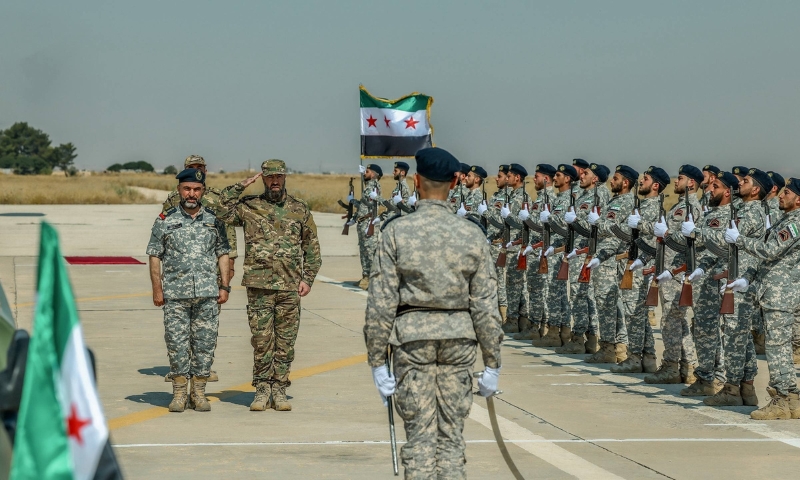
Syrian army personnel take the oath at a graduation ceremony for noncommissioned officers at the Air Force College, July 23, 2026 (Ministry of Defense)
From Fragmentation to a National Army: Beyond Bringing Factions Together
The Syrian army’s future depends on restructuring military formations and developing their capabilities. It also depends on the state’s success in building a unified national institution that transcends factional loyalties and answers to a single central command.
Speaking to Enab Baladi, al-Mutlaq said the “transition from factional fragmentation” to a unified national army required structural and political conditions, foremost among them bringing all armed forces under the Defense Ministry’s authority and dismantling factions’ independent organizational and financial structures.
Unifying the military cannot be achieved simply by bringing formations under one administrative umbrella, al-Mutlaq said. It requires moving from command arrangements based on personal and factional influence to a professional military hierarchy founded on competence and specialization, and reorganizing staff structures according to professional criteria rather than loyalty.
He considered the army’s financial and logistical independence from factions essential to the process. Military salaries, arms procurement budgets and military expenditure must become state responsibilities, limiting the influence of foreign funding sources or private financial interests over military decisions.
However, according to al-Mutlaq, these requirements face obstacles stemming from the balance of influence within the new institution. He believes the dominance of HTS personnel and commanders in key state ministries could raise fears among Syrian communities and other factions that the army is becoming an expanded extension of HTS rather than an inclusive national institution.
He warned that these fears could encourage some formations to resist integration to preserve their influence and gains. He also cited what he described as networks of economic interests developed by some factions over recent years, which could obstruct the dismantling of their independent structures.
According to al-Mutlaq, this is also connected to the issue of foreign fighters, whose status poses a security and political challenge to building the new military, while affecting its prospects for international recognition.
A Military Doctrine Representing State and Society
Building a national army requires more than unifying command and weapons, according to al-Mutlaq. The military must reflect Syrian society’s diversity, with recruitment and enlistment based on citizenship and legal criteria, without exclusion on sectarian, ethnic or ideological grounds.
He stressed the need to separate military service from political and party activity, preventing the military from becoming an arena for political competition or a means of protecting a particular ideological project or faction.
“Building a national army requires placing it under civilian authority and defining its role as a state defense institution rather than a body that shapes domestic politics. It also requires incorporating human rights, international humanitarian law and civilian protection into military college and training center curricula.”
Khaled al-Mutlaq, military expert
Who Is the Enemy?
Al-Mutlaq posed a question at the heart of military doctrine: “Whom does the army defend, and against whom?” He argued that this question should be answered before a new doctrine is formulated, with the answer grounded in protecting the country’s borders, sovereignty and social stability rather than the authorities or a particular ideology.
Hourani also identified several factors shaping this process.
He believes the greatest challenge is intellectual rather than technical, involving the definition of the army’s doctrine and its enemy, a question made particularly sensitive by policies supporting Israel.
Doctrine Before Equipment
Hourani considered defining the army’s doctrine the first condition for any meaningful development, because doctrine determines weapons procurement, training and alliances.
The challenge is not abstract, he said. It is linked to a complex regional and international environment in which answering “Who is the enemy?” requires the Syrian army to take positions that may conflict with major powers’ calculations, making the definition of doctrine particularly sensitive.
“The greatest challenge is intellectual rather than technical: defining the army’s doctrine, ‘Who is the enemy?’ Doctrine determines weapons procurement, training and alliances. Without it, any development remains merely an accumulation of equipment.”
Rashid Hourani, military and security affairs researcher
Hourani said choosing the military school on which to build the army, whether Russia’s Eastern approach or the Western approach of European Union countries and the United States, was not a standalone decision. It depended on the vision of those establishing the army and their efforts to ensure integration among its services.
Ground equipment could, for example, be Eastern while air force equipment is Western, he said, citing Egypt’s military, which combines weapons from both.
From Factionalism to Discipline
Regarding the transition from factional command and irregular forces to the doctrine of a regular national army, Hourani said the first major factor was the awareness of Syrians generally, and of faction commanders and fighters who agreed unconditionally to join the emerging army, enabling the distribution of duties and responsibilities.
He also pointed to the Defense Ministry’s early implementation of army-wide guidance and discipline programs, followed by significant attention to military colleges and the opening of admissions to train specialized, disciplined military personnel.
He believes these steps established a foundation for replacing factional rivalries with military discipline through institutional education and training rather than reliance on previous loyalties.
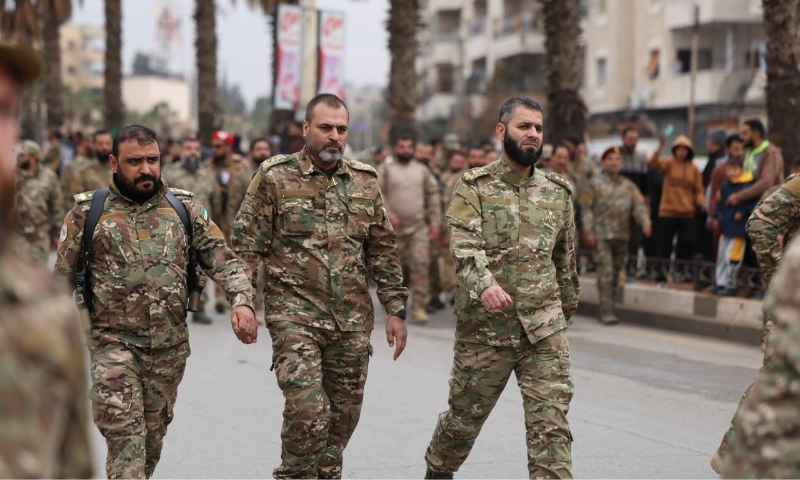
Syrian army officers during a military parade marking the first anniversary of the former regime’s fall, December 8, 2025 (Ministry of Defense)
Signs of Regional and International Confidence
Despite the challenges, Hourani believes the Syrian experience closely resembles Rwanda’s, while stressing that each has its own context.
He viewed developments in the Syrian army, nearly two years after its establishment began, as positive, pointing to Syria’s accession to the international counterterrorism coalition and the army’s participation in the EFES military exercises in Turkey.
He argued that these indicators demonstrated regional and international confidence in the Syrian army’s ability to develop its capabilities for domestic missions and others affecting regional security. This reflected a gradual shift in external actors’ perceptions of Syria’s military, although it remained contingent on the development of doctrine, armaments and sovereignty over its airspace.
Three Scenarios for the Army’s Future
Al-Mutlaq outlined three possible scenarios for the Syrian army’s future, each depending on the authorities’ ability to address the challenges of unifying factions and integrating the SDF and other formations.
The first involves absorbing forces and restructuring the military institutionally, gradually dismantling factional structures and integrating military and professional personnel into Defense Ministry brigades and formations on the basis of the national interest.
Achieving this requires political reform that guarantees the rights of Syria’s different communities, alongside regional and international support.
The second scenario involves nominal integration while multiple centers of influence persist. Factions and the SDF would declare their affiliation with the Defense Ministry while retaining their influence and independent decision-making within their areas.
This would produce a weak army unable to confront external threats or fully enforce state authority, while remaining vulnerable to tensions during political crises.
The third scenario is ideological domination and security fragmentation, which al-Mutlaq considers the most dangerous. Under this scenario, the army’s command doctrine would be based on a particular factional or ideological orientation, potentially intensifying confrontation with Syrian communities, especially in the east, south and coastal region.
This could lead to international isolation, limit the military’s access to modern weapons and training, and leave Syrian sovereignty incomplete.
if you think the article contain wrong information or you have additional details Send Correction
النسخة العربية من المقال
-
Follow us :



 More In-Depth
Most viewed
- French Diplomat to Enab Baladi: Surcouf Visit Marks a Step in Syria-France Military Cooperation
- Syrian Forces Enter Roj Camp Ahead of Foreign Repatriations
- Suwayda: Security Forces and National Guard Exchange Fire
- Olabi: Israeli Violations Undermine De-escalation in Syria
- Aleppo Protesters Demand Accountability and Justice