
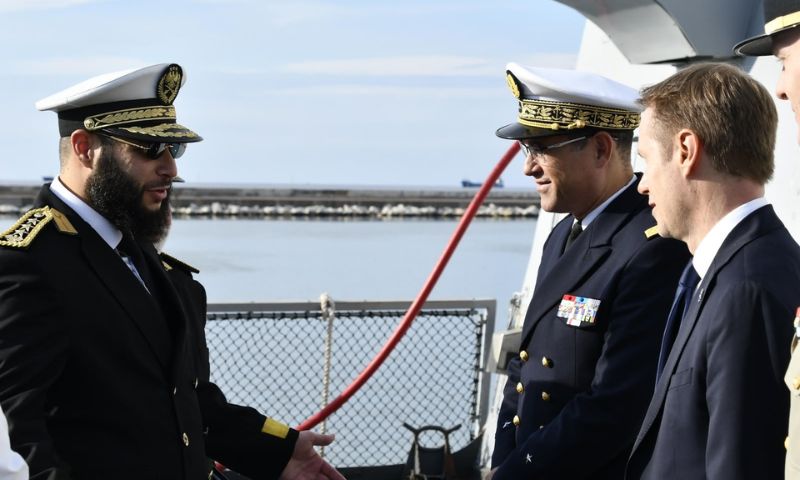

The French frigate Surcouf visited the port of Latakia (western Syria) on Wednesday, November 11, marking the first visit by a French military vessel to Syria. The visit is part of growing military ties between Damascus and Paris, following the signing of a framework cooperation agreement during French President Emmanuel Macron’s visit to Damascus last July.
France’s chargé d’affaires in Syria, Jean-Baptiste Faivre, said the visit reflected France’s support for Syria’s stability and sovereignty. He praised the quality of discussions between the frigate’s crew and Syrian naval forces, aimed at laying the groundwork for naval cooperation between the two sides.
A French diplomat told Enab Baladi that this was the first visit of its kind by a French military vessel to Syria. It follows the signing of the bilateral framework agreement during Macron’s visit to Damascus last July, which provides for developing military cooperation between the two countries, particularly in training and capacity building.
The diplomat added that Surcouf’s visit represented the first step in this process by opening the way for cooperation between the Syrian and French navies. He said this cooperation aimed to strengthen stability and security in Syria.
According to the diplomat, France seeks to support Syria during the current period and assist its efforts to achieve stability. He said Syria’s success in this process would have a positive impact on security across the region.
Surcouf, a Multipurpose Frigate
The French frigate Surcouf is a French Navy warship belonging to the La Fayette class of light multipurpose frigates. These vessels were designed to operate in different maritime regions, carry out surveillance, patrol and naval escort missions, and participate in international operations and crisis management missions.
The frigate bears the hull number F711 and entered service with the French Navy on February 7, 1997, according to the French Ministry of the Armed Forces.
It was named after the French seafarer Robert Surcouf, who lived from 1773 to 1827 and became known for his maritime activities during the late 18th and early 19th centuries.
The frigate is approximately 125 meters long and 15.4 meters wide, with a displacement of around 3,700 tonnes and a maximum speed of 25 knots. It has a crew of about 150 sailors, according to official specifications for its class.
La Fayette-class vessels can perform a wide range of missions. According to the French Ministry of the Armed Forces, they were originally designed to protect French interests in maritime areas beyond French territory and help respond to crises outside Europe. This includes supporting forces deployed on operations, protecting maritime trade and participating in humanitarian operations.
These frigates’ missions include maritime surveillance and intelligence gathering, patrols and vessel escorts, and participation in operations against illegal activities at sea. They can also operate within international naval groups or participate in crisis response missions.
The nature of these missions allows the frigate to operate in different maritime environments and cooperate with other naval forces. This helps explain the importance of military port visits in establishing communication channels and exchanging expertise between navies, alongside their diplomatic role.
A French Naval Presence in the Mediterranean
Surcouf’s visit to the port of Latakia comes within the context of France’s interest in the Mediterranean, an important area for trade and shipping where maritime security and regional cooperation intersect.
The visit takes on added significance as the first by a French military vessel to Syria, as the French diplomat confirmed to Enab Baladi. It opens the way for direct contact between the two countries’ naval forces following years of severed official ties with Bashar al-Assad’s regime.
France severed official contacts with the Assad regime in 2012 and closed its embassy in Damascus in March of that year.
As the transition has progressed, political contacts between Paris and Damascus have resumed, with visits and meetings at various official levels.
In this context, French President Emmanuel Macron visited Damascus on July 6 and 7, 2026, on an official visit that marked a milestone in the development of bilateral relations, according to the French Foreign Ministry.
The framework agreement on military cooperation cited by the French diplomat forms part of a broader effort to develop relations between the two countries, with a focus on training and capacity building. The frigate’s visit to Latakia shows this process extending into the naval sphere through direct meetings between representatives of the Syrian and French navies.