


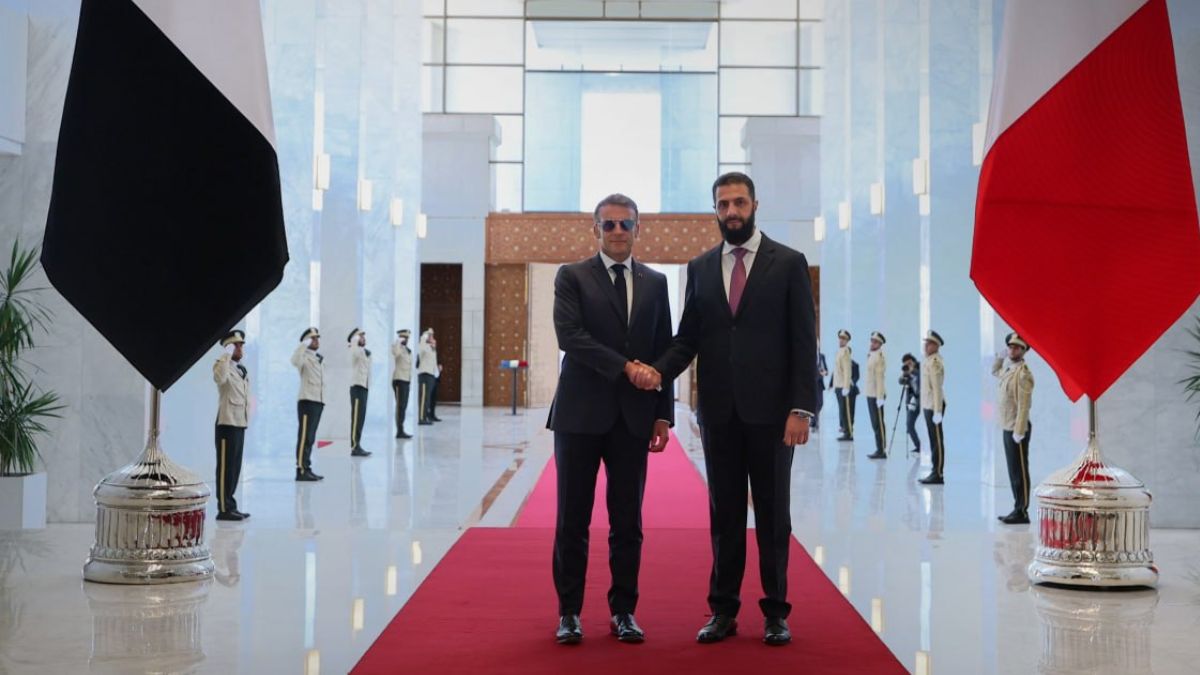
 Syrian President Ahmed al-Sharaa receives French President Emmanuel Macron at the People’s Palace in Damascus, July 7, 2026 (SANA)
Syrian President Ahmed al-Sharaa receives French President Emmanuel Macron at the People’s Palace in Damascus, July 7, 2026 (SANA)
Syrian President Ahmed al-Sharaa received French President Emmanuel Macron at the People’s Palace in Damascus on Tuesday, July 7, for talks focused on strengthening Syrian and French cooperation.
The meeting saw the two sides sign a number of agreements and memoranda of understanding in several investment fields.
The announced agreements included the signing of a declaration of intent between Foreign Ministers Asaad al-Shaibani and Jean-Noël Barrot regarding funds looted by Rifaat al-Assad, in addition to a comprehensive cooperation framework to strengthen relations between the two countries in several fields.
The Élysée said France had begun the process of returning 51 million euros to Damascus from assets confiscated from the Assad family.
The agreements also included the announcement of a strategic partnership in several fields, focused on maritime and air transport and logistics services. The agreement was signed by Qutayba Ahmed Badawi, head of the General Authority for Crossings and Customs, and Rodolphe Saadé, CEO of the CMA CGM Group.
The two sides signed a declaration of intent in civil aviation, as well as a protocol agreement on managing air cargo handling and marketing air freight services.
Syria signed an agreement with the French Development Agency and Expertise France. The agreements also included a protocol agreement on cooperation in modular water treatment and energy solutions in Homs (central Syria).
A memorandum of understanding was also signed for cooperation in the health sector, in addition to another memorandum of understanding to develop Syrian university hospitals between Syria’s Ministry of Higher Education and the French company Ellipse Projects SAS.
Another memorandum was signed to strengthen economic cooperation and develop trade relations, along with a memorandum of understanding for cooperation in institutional strengthening, technical support, and capacity building for the Central Bank of Syria.
Syrian President Ahmed al-Sharaa welcomed French President Emmanuel Macron and his accompanying delegation, noting that the Syrian and French meeting was attended by leading figures in industry and the economy, including those who manage global shipping fleets, manufacture aircraft, operate airports, and extend energy and water networks.
He added that the meeting represents an opportunity for the French delegation to see a country that has decided to rise and open space for those who wish to build with it.
Al-Sharaa said Syria has a strategic location linking the Mediterranean to the Gulf and Iraq, and is a few maritime hours from Marseille. He noted that the Strait of Hormuz crisis made the world realize the value of safe and stable corridors in Syria.
He also underlined the importance of Syrian geography, which he said has today regained its vital role as an indispensable connecting point in the global corridors market.
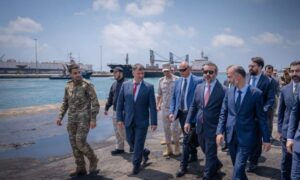
Al-Sharaa said the French CMA CGM Group had decided to inject an additional 200 million euros to raise the capacity of Latakia port (western Syria), 14 months after signing a contract to develop the port with an investment of 230 million euros.
He said Syrian industrial cities are ready to become a launchpad for French factories, based on a modern investment environment governed by laws and institutions.
Al-Sharaa said the strategic partnership Syria seeks with France focuses on building a model relationship with Europe and the world, one based on interests that serve the Syrian and French peoples, not on slogans.
For his part, French President Emmanuel Macron said expanded joint economic committees will work to support reconstruction in Syria, and that there will be a partnership with Gulf states.
Macron affirmed France’s readiness to build trust with Syria in several fields, including energy and the banking sector, noting that the major challenges facing the Syrian side do not cancel out the opportunities for partnership between the two sides.
French President Emmanuel Macron arrived in the Syrian capital, Damascus, on Monday evening, July 6.
The Syrian government channel al-Ikhbariya reported that Syrian Foreign Minister Asaad al-Shaibani received the French president at Damascus Airport.
The French president’s visit is the first by a Western head of state to Syria since the fall of the Assad regime in late 2024, and the first by a French president since former President Nicolas Sarkozy’s last visit in 2009.
French diplomatic sources told Enab Baladi that Macron’s visit would take place on July 6 and 7.
Syrian President Ahmed al-Sharaa said in an interview with the French channel BFMTV that Macron’s visit to Syria represents an important development in relations between the two countries.
He added that agreements would be signed during Macron’s visit to Syria, noting that France would work in infrastructure and the financial sector, in addition to many other sectors in which it can operate.
For his part, Macron said his visit to Damascus “confirms France’s commitment to standing alongside the Syrian people for a sovereign, united Syria, with its pluralism, that enjoys peace with its neighbors.”
In a post on X, he called for opening a new page of stability and peace.
French diplomatic sources told Enab Baladi that Macron’s visit carries major symbolic significance and reflects the important role France plays alongside the new Syria, especially through its active opposition to the repression practiced by the Assad regime since the 2011 revolution.
The sources added that France aims to make Syria a center of regional stability by acting as a mediator with the Kurds, facilitating dialogue with Lebanon, and contributing to counterterrorism, to help Syria’s economic recovery and contribute to reconciliation among Syrian parties after years of civil war and tensions.
At the regional level, France also aims to contribute to repositioning Syria as a trade and energy hub between Europe and Asia.
if you think the article contain wrong information or you have additional details Send Correction


 A
A
A
A
A
A


 More Politics