


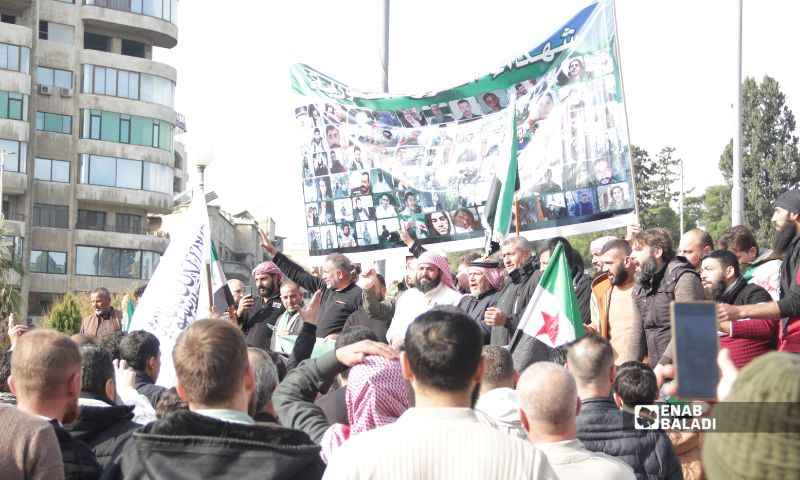
 *Protesters in Aleppo demand accountability for figures linked to the former Syrian regime, November 13, 2026 (Enab Baladi/Mowaffaq al-Khouja)*
Dozens of protesters demonstrated in Aleppo (northern Syria) on Friday, November 13, demanding accountability for figures associated with the former Syrian regime, following remarks by Raqqa Governor Abdulrahman Salama about the former commander of Liwa al-Baqir, an auxiliary militia of the now-disbanded Syrian army.
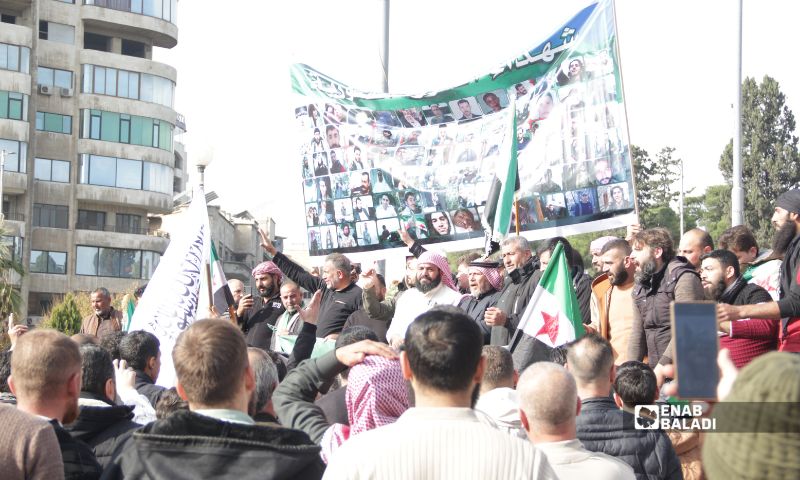
Protesters in the city’s Saadallah al-Jabri Square carried signs demanding accountability for “shabiha,” or pro-regime militiamen, justice and disclosure of the truth, according to Enab Baladi’s correspondent.
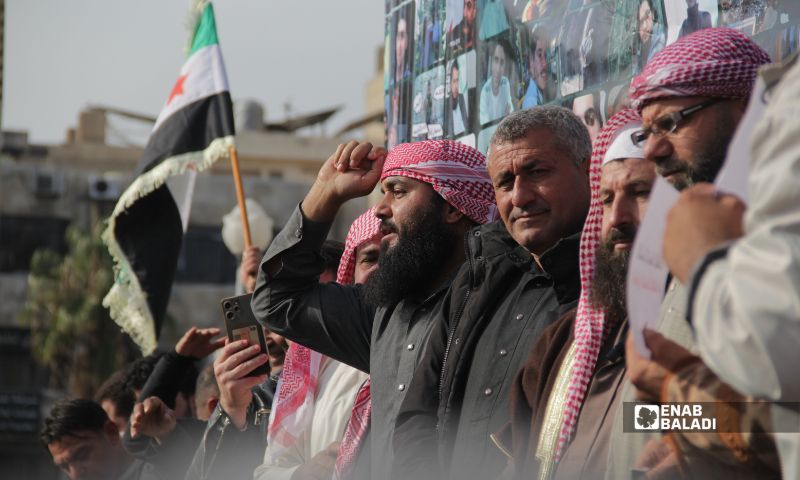
Protesters in Aleppo demand accountability for figures linked to the former Syrian regime, November 13, 2026 (Enab Baladi/Mowaffaq al-Khouja)
The protesters also rejected what their signs described as “whitewashing criminals,” calling it “another betrayal of victims’ families.”
Protesters interviewed by Enab Baladi condemned what they called the “rehabilitation of shabiha” and attempts to improve their public image. They criticized Syrian President Ahmed al-Sharaa for meeting with a person accused of “war crimes.”
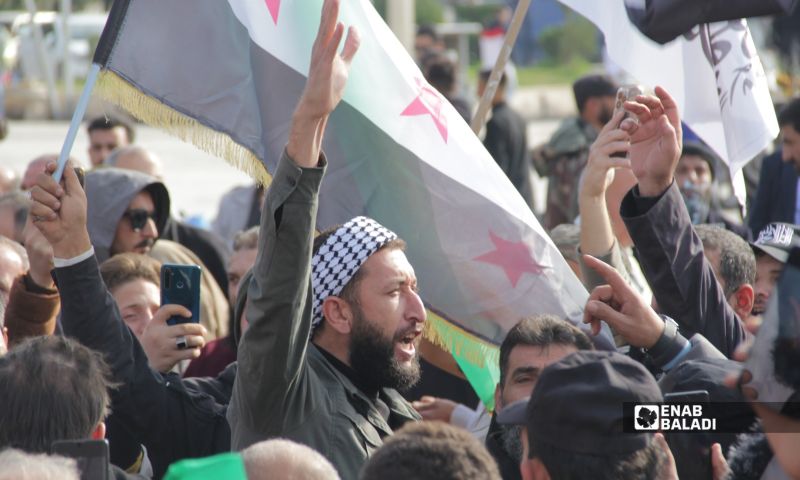
Protesters in Aleppo demand accountability for figures linked to the former Syrian regime, November 13, 2026 (Enab Baladi/Mowaffaq al-Khouja)
They accused Liwa al-Baqir of committing crimes against civilians in Aleppo because of their identities and dumping their bodies in acts of revenge targeting members of particular families and tribes.
Protests over the same issue had previously taken place in Aleppo’s al-Marjeh neighborhood, a former Liwa al-Baqir stronghold, and al-Sukkari neighborhood, as well as in Anadan (Aleppo governorate), the hometown of Raqqa Governor Abdulrahman Salama.
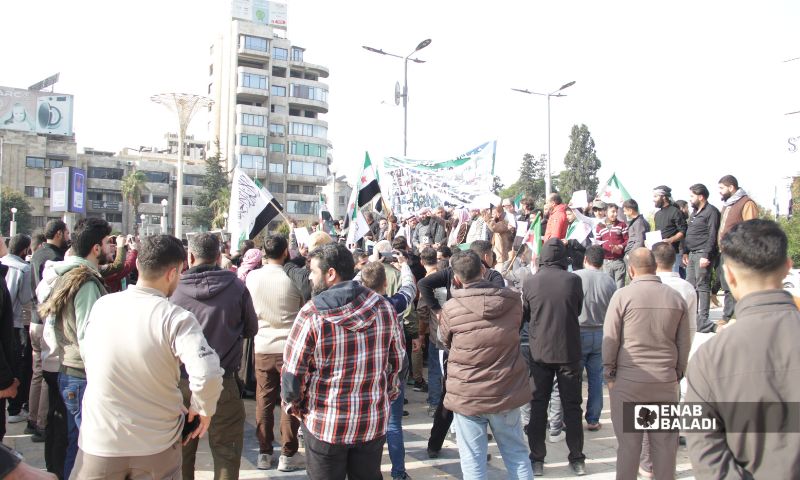
Protesters in Aleppo demand accountability for figures linked to the former Syrian regime, November 13, 2026 (Enab Baladi/Mowaffaq al-Khouja)
The protests followed remarks by Raqqa Governor Abdulrahman Salama, also known as Abu Ibrahim, during podcast episodes in which he discussed meeting Khaled al-Mar’i without identifying his role.
In an episode of “Damascus Time” on Mazeej, a platform affiliated with Al Arabiya, Salama said he first met al-Mar’i in the early days of the armed struggle, when al-Mar’i was being held prisoner by Jabhat al-Nusra, the former name of Hayat Tahrir al-Sham (HTS).
According to Salama, al-Mar’i surrendered without resistance after opposition factions stormed al-Marjeh neighborhood, where his family lived. Jabhat al-Nusra subsequently pardoned him after “establishing that he had not been involved.”
A few days after the regime’s fall, Salama met al-Mar’i at the Presidential Palace, where al-Mar’i also met Syrian President al-Sharaa. Salama referred to coordination between himself and Liwa al-Baqir before Operation Deterrence of Aggression, the offensive that toppled Assad’s rule.
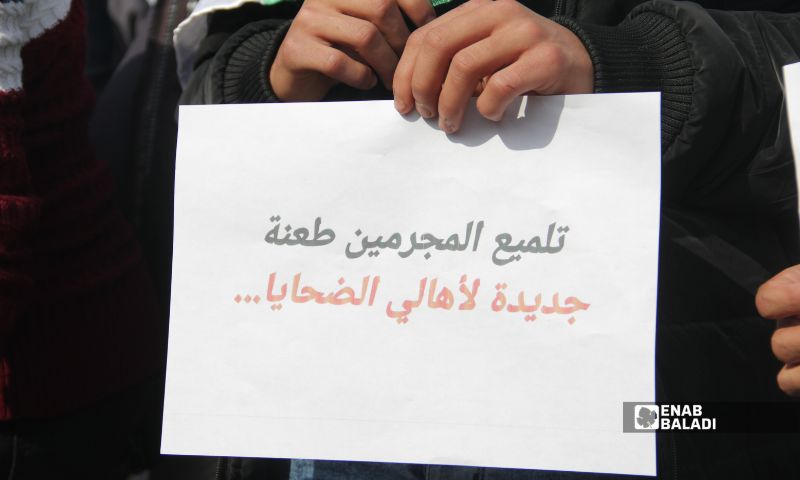
A protester holds a sign in Aleppo demanding accountability for figures linked to the former Syrian regime, November 13, 2026 (Enab Baladi/Mowaffaq al-Khouja)
Protesters considered Salama’s remarks a “provocation” against the families of victims and fallen opposition fighters, and an attempt to “whitewash” al-Mar’i’s image.
For his part, Salama met a group of activists and local notables in Aleppo and denied that his remarks were an attempt to “whitewash” al-Mar’i or Liwa al-Baqir, saying he had been recounting his own life story.
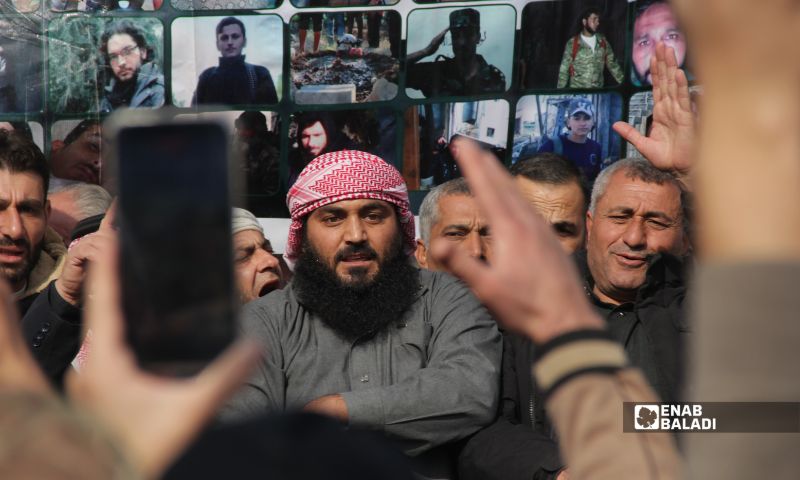
Protesters in Aleppo demand accountability for figures linked to the former Syrian regime, November 13, 2026 (Enab Baladi/Mowaffaq al-Khouja)
Khaled al-Hassan, also known as Khaled al-Mar’i, is the commander of Liwa al-Baqir, one of the auxiliary factions that supported the former regime’s army. The group received direct support from Iran’s Islamic Revolutionary Guard Corps.
After the regime’s fall, photographs showing al-Mar’i standing in front of Syria’s new green flag prompted widespread condemnation among supporters of the revolution.
His brother, Hamza al-Mar’i, also appeared in a photograph with Interior Ministry spokesperson Nour al-Din al-Baba. The authorities issued no clarification about the photograph.
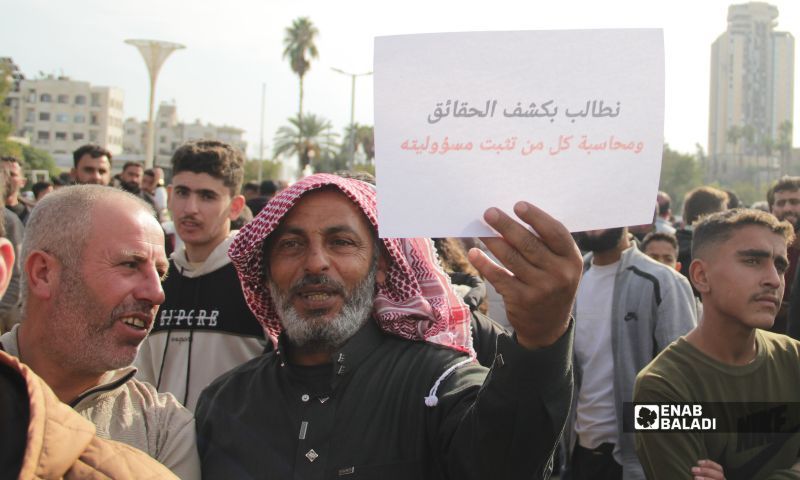
A protester holds a sign in Aleppo demanding accountability for figures linked to the former Syrian regime, November 13, 2026 (Enab Baladi/Mowaffaq al-Khouja)
Al-Mar’i fought opposition factions alongside the regime and factions with a sectarian character supported by Irans and Lebanon’s Hezbollah.
Although the faction’s members are Sunni Muslims, they have been accused of “spreading Shiism” after members converted to Shia Islam.
The brigade’s members belong to the Baggara tribe, one of Syria’s largest tribes. However, the tribe did not share a single political orientation, and many of its members joined opposition factions.
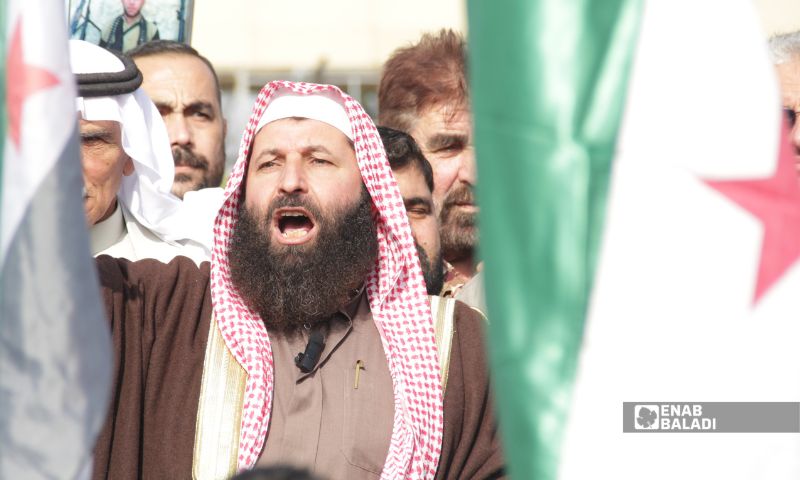
Protesters in Aleppo demand accountability for figures linked to the former Syrian regime, November 13, 2026 (Enab Baladi/Mowaffaq al-Khouja)
According to several reports, the brigade was formed in 2012 but took shape in 2014, starting in Aleppo before later extending its influence to Deir Ezzor (eastern Syria).
Reports have pointed to a role for Liwa al-Baqir in facilitating the entry of members of the “Red Bands,” a formation affiliated with HTS, which forms the core of Syria’s current leadership, into regime-held areas shortly before Operation Deterrence of Aggression.
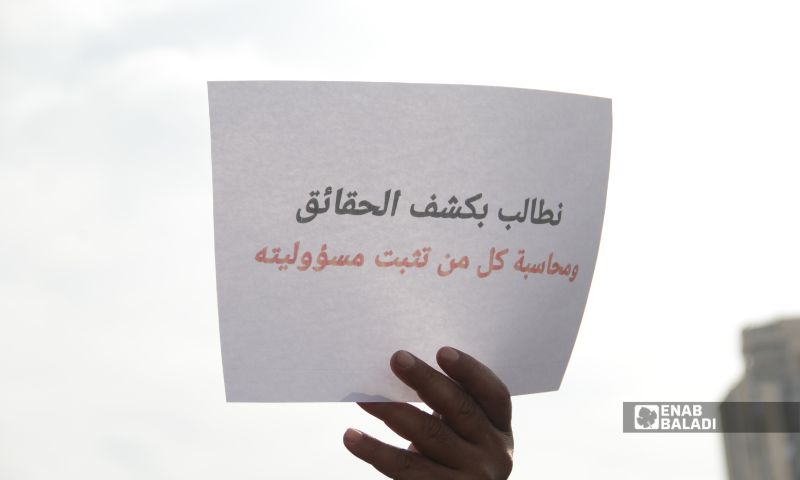
A protester holds a sign in Aleppo demanding accountability for figures linked to the former Syrian regime, November 13, 2026 (Enab Baladi/Mowaffaq al-Khouja)
These public protests come amid settlements the Syrian government has reached with figures linked to the former regime, without clear criteria.
The Syrian Network for Human Rights (SNHR) has issued a report on the legal standards, normative conditions and policy recommendations concerning settlements with those involved in political and economic crimes as part of Syria’s transitional justice process.
In its report, issued on November 10, the network identified the conditions settlements must meet to comply with international standards, including:
– Full and verifiable disclosure of the truth.
– Effective participation of victims at every stage.
– Exclusion of the most serious international crimes from eligibility, alongside graduated and proportionate penalties.
– Mandatory asset recovery and compensation.
– Transparency and independent oversight.
– Guarantees of non-recurrence.
– Consideration of gender dimensions.
if you think the article contain wrong information or you have additional details Send Correction


 A
A
A


 More Politics