


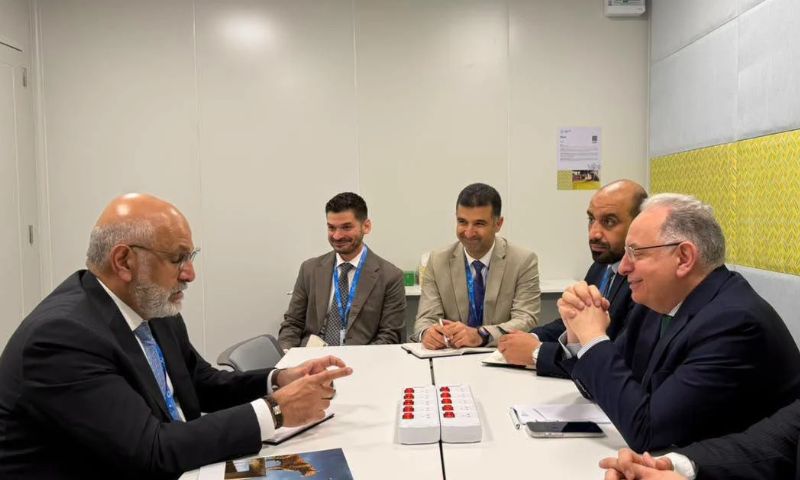
 Syria’s finance minister meets with the executive director representing the Arab group at the World Bank to discuss prospects for cooperation in Bangkok, October 17, 2026 (Ministry of Finance)
Syria’s Finance Ministry has officially announced that the country will return to the Arab constituency at the International Monetary Fund (IMF) on November 1, 2026, after belonging to the Russian Federation constituency since 2012.
Syria moved to the Russian Federation constituency in 2012 amid the Syrian crisis and international sanctions, which brought changes to representation and coordination arrangements within the IMF and took the country out of the Arab constituency.
Its return comes amid efforts to rebuild financial institutions and create the conditions for economic recovery, alongside preparations to resume Article IV consultations.
The significance of the move extends beyond Syria’s transfer between constituencies within the IMF. Its timing also matters, as it coincides with efforts to rebuild financial institutions and create the conditions for economic recovery, economist Yahya Sayed Omar told Enab Baladi.
He said the transfer would allow Syrian matters to be handled through the Arab constituency and broaden coordination with Arab and international institutions on reform priorities and technical assistance.
However, Sayed Omar said the move’s practical value would depend on the progress it produces in financial and banking reforms and in strengthening Syrian institutions’ ability to meet the economy’s needs after years of war.
Sayed Omar explained that Syria’s transfer to the Arab constituency does not mean it is joining the IMF anew, since it is already a member. Nor does the move automatically open access to financing.
The real benefit, he said, lies in using the move to establish a more effective economic relationship with international institutions, rather than simply changing the constituency through which Syria is represented. Such a relationship could help the country move from addressing urgent needs to building an economy capable of recovering and sustaining itself.
Sayed Omar said the move provides a different framework for representation and follow-up at a time when Syria needs broader coordination on reform programs and technical support, as well as clearer economic priorities.
He stressed, however, that engagement with international institutions does not guarantee funding unless viable projects and a suitable business environment are in place.
Sayed Omar said the move comes as Syria faces economic challenges identified by the IMF. In August 2026, the fund said gaps in the availability and quality of economic data continued to limit its ability to assess developments in the country in greater detail.
He noted that the IMF had agreed with the Syrian authorities on a technical assistance program covering public financial management, improvements to tax and customs revenue collection, public debt management, banking sector reform, and better statistics.
Sayed Omar said one of the main challenges goes beyond a shortage of resources. Syria also needs institutional tools that allow the state to assess the scale of its needs, set spending priorities, and make better-informed financial decisions.
He added that the greater challenge is translating technical cooperation into tangible economic results. Better budget management will not be enough without sustainable resources to finance basic services.
Banking reforms will also fail to support investment unless banks improve their ability to provide services and regain the confidence of customers and investors, he said.
Sayed Omar said preparations to resume Article IV consultations are particularly important because they provide a comprehensive assessment of a member country’s economic conditions and fiscal and monetary policies. They could offer a clearer basis for identifying weaknesses and the reforms needed.
Article IV consultations are periodic IMF reviews of member countries’ economic and financial conditions. They combine technical assessments, policy discussions, and recommendations concerning economic, monetary, and financial stability.
Sayed Omar said completing these consultations could mark a further step toward deeper engagement between Syria and the IMF. Resuming them, however, requires progress in providing the necessary economic data.
He cautioned against treating the consultations as a financing agreement or a guarantee of loans. Their value will depend on Syrian institutions’ ability to provide reliable information and implement the required reforms.
Concluding his remarks, Sayed Omar said Syria’s return to the Arab constituency offers an opportunity to improve coordination on its economic affairs and expand cooperation with the IMF, but does not provide a shortcut to recovery.
He added that the move’s significance would depend on Syria’s ability to build more efficient financial institutions, provide reliable data, and implement reforms that support production and investment.
The Syrian government and the World Bank Group announced in a joint press statement issued on Sunday, October 18, that they had agreed to establish the Syria Recovery and Reconstruction Trust Fund (START), a multi-donor mechanism to support economic recovery and reconstruction and encourage private investment.
The statement was issued on the sidelines of the 2026 Annual Meetings of the World Bank Group and the IMF in Bangkok, Thailand.
According to the statement, the fund aims to provide concessional financing, investment guarantees, technical assistance, and capacity-building support. These measures are intended to support the Syrian government’s economic recovery and sustainable development efforts and help attract financing for private investment.
if you think the article contain wrong information or you have additional details Send Correction


 A
A
A



 More Economic Reports