


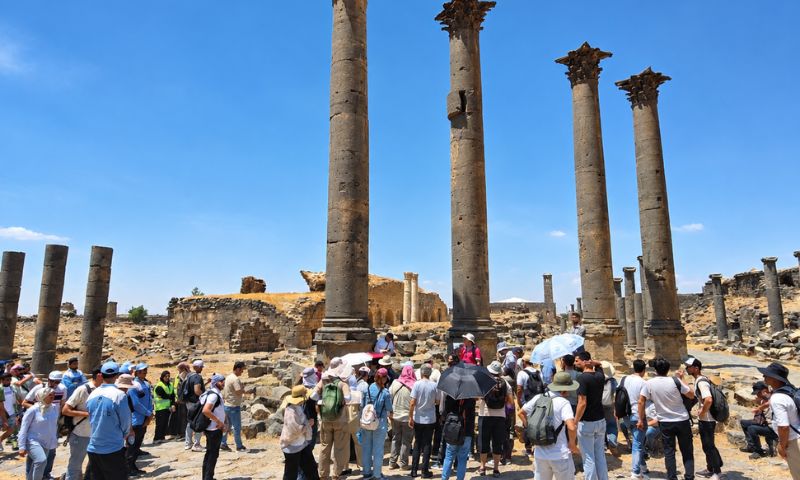
 Foreign tourists on a tour in Syria, June 24, 2026. (Ministry of Tourism)
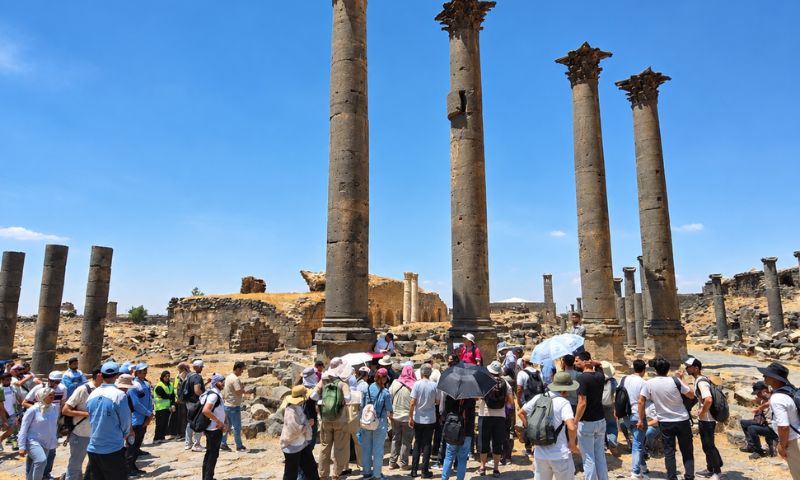
Foreign tourists on a tour in Syria, June 24, 2026. (Ministry of Tourism)
Syria’s Ministry of Foreign Affairs and Expatriates announced on Monday evening, October 12, that Syria had joined the International Code for the Protection of Tourists, developed by UN Tourism.
The announcement followed Syria’s receipt of an official cable from the organization’s General Secretariat confirming the completion of all accession procedures, according to Saad Baroud, director of the ministry’s International Organizations and Conferences Department.
In a statement to the Syrian Arab News Agency (SANA), Baroud said the step was significant because the code is a key international legal and standard-setting instrument that helps restore confidence in international travel and provides a comprehensive institutional framework to protect the rights of travelers and tourists as consumers.
He added that Syria’s accession strengthens the competitiveness of its tourism sector and improves its standing as a safe and reliable destination, supporting efforts to attract visitors and expand cooperation with specialized international organizations.
The code is an international legal and standard-setting instrument developed by UN Tourism and adopted under Resolution 732 at the organization’s 24th General Assembly session in Madrid in 2021.
The code aims to:
– Restore confidence in travel: Strengthen travelers’ sense of safety and restore confidence in global tourism following crises and widespread disruptions.
– Harmonize standards: Provide a unified framework establishing minimum standards for protecting tourists’ rights as consumers and clarifying the contractual relationship between tourism service providers and travelers.
– Support competitiveness: Help member states improve their standing as safe and reliable travel destinations and attract visitors more easily.
Its main components and areas of coverage include:
– Protection in contracts and digital environments: Requiring clear, transparent information to be provided to tourists before they enter into any contract, and defining consumer rights when services are not delivered.
– Assistance in emergencies: Establishing national plans and clear crisis management protocols, and coordinating rapid assistance to tourists, including consular support and help with evacuation or care when necessary.
– Financial guarantees and dispute resolution mechanisms: Providing alternative dispute resolution (ADR) mechanisms and financial guarantees to protect tourists’ rights.
The code is a nonbinding legal instrument intended to encourage governments and tourism stakeholders to adopt its principles and incorporate them into national legislation and policies.
Khaled Falyoun, director of Planning and Statistics at the Ministry of Tourism, previously told Enab Baladi that tourism in Syria had grown by 438%, which he described as the highest growth recorded by the ministry since its establishment.
Speaking on the sidelines of the Syria Travel Show in early October, Falyoun said preliminary statistics indicated that approximately five million visitors had arrived in Syria by the end of August.
He explained that Syrian visitors accounted for the largest share of arrivals, numbering more than 3.5 million, alongside Arab and other foreign visitors.
Turkey topped the list of countries from which visitors traveled to Syria, according to Falyoun. He also noted an increase in arrivals from Germany, Sweden, and the United States, adding that most of these visitors held Syrian citizenship.
Visitor numbers from some Arab countries, including Jordan, have also risen recently. However, most arrivals from neighboring countries visit Syria for just one day.
According to Falyoun, arrivals fall into several categories, including day visitors and those who stay for several days, depending on the purpose of their visit, whether for medical treatment, cultural tourism, shopping, or attending conferences.
The Ministry of Tourism expects arrivals in Syria over the next five years to reach 30 million visitors, including between 12 million and 15 million Syrians, according to Falyoun.
However, reaching this figure raises questions about the Syrian tourism sector’s capacity to accommodate so many visitors, given damage to some facilities, inadequate infrastructure and services at tourist sites, and the need to train tourism staff.
As part of efforts to diversify the purposes of visits, Falyoun discussed a proposal to cooperate with the Ministry of Health on launching a program called the “Medical Tourism Project,” alongside signing a memorandum of understanding with Turkey to exchange expertise in this field.
if you think the article contain wrong information or you have additional details Send Correction


 A
A
A
A
A
A





 More Economic Reports