


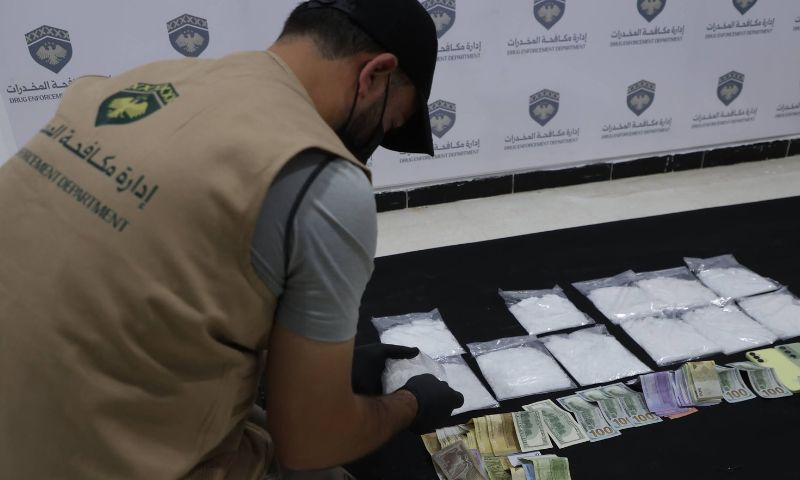
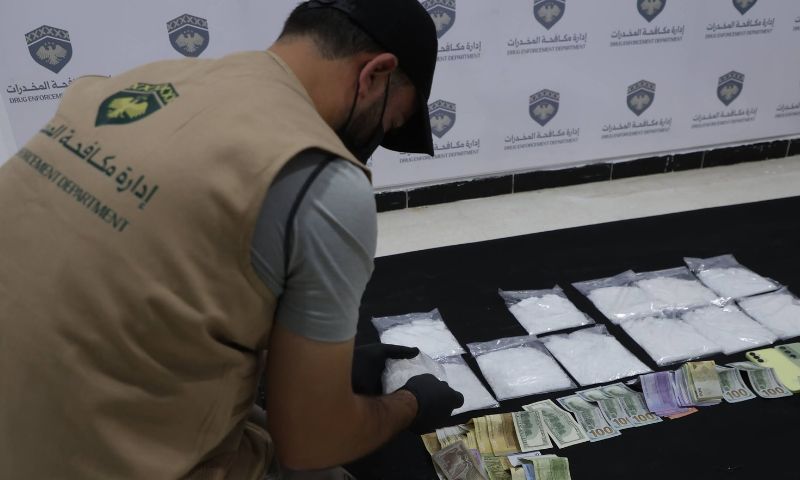
 Syria’s Anti-Narcotics Department announces the disruption of a drug smuggling network operating along the border with Iraq, October 10, 2026 (Anti-Narcotics Department/Facebook).
Syria’s Anti-Narcotics Department announces the disruption of a drug smuggling network operating along the border with Iraq, October 10, 2026 (Anti-Narcotics Department/Facebook).


 A
A
A
A
A
A
Syrian authorities have stepped up announcements in recent days about thwarting drug smuggling operations across the country’s borders with Jordan, Iraq, and Lebanon.
Syria’s Anti-Narcotics Department announced on Sunday, October 11, that it had foiled an attempt to smuggle more than 100,000 Captagon pills with assistance from canine units (K9).
The department said the shipment was concealed inside the spare tire of a refrigerated truck and was headed to Saudi Arabia through the Nasib border crossing (Daraa governorate, southern Syria), adding that K9 units participated in the operation.
According to the department, the operation resulted in the seizure of the shipment and the arrest of the person involved. The seized drugs were formally confiscated, and the detainee was referred to the relevant authorities for further legal proceedings.
Previously, on Saturday, October 10, the Anti-Narcotics Department in Deir Ezzor (eastern Syria), in coordination with internal security forces, announced two simultaneous security operations in Deir Ezzor and Hasakah (northeastern Syria). The operations targeted what it described as “one of the most dangerous drug smuggling networks, whose activities extend from the Iraqi border into the country.”
According to the department, the two operations resulted in the seizure of 2,500 grams of crystal methamphetamine, a highly dangerous drug known locally as “H-Bouz,” during an attempt to smuggle it into Syrian territory.
The department also arrested the alleged network leader, identified by the initials M. S., and three alleged members, identified as Z. M., A. M., and T. A. It formally confiscated the seized drugs and referred the detainees to the competent judicial authorities for further legal proceedings.
Customs authorities at the Jdeidet Yabous border crossing with Lebanon (Damascus countryside, southwestern Syria) announced on October 9 that they had thwarted an attempt to smuggle approximately 129,000 Captagon pills into Syria, the second such operation within 48 hours.
The operation followed the seizure of 395,000 Captagon pills on Thursday, October 8, bringing the total seized in the two operations to approximately 524,000 pills.
The General Authority for Ports and Customs said the operations were part of its efforts to combat drug smuggling and strengthen oversight at border crossings, helping prevent drugs from entering the country and protecting society from their dangers.
The US-based research organization New Lines Institute issued several recommendations for addressing Syria’s drug trade in a report published on February 10, 2026.
The institute’s recommendations included encouraging cooperation on counternarcotics and border security between the Syrian government, Jordan, and Lebanon. This would focus on exchanging intelligence and tips that could assist raids and seizures, conducting joint border surveillance training, and routinely carrying out forensic testing of seized drug shipments.
According to the institute, the United States and its regional partners should also pursue a security and political solution to the crisis in Suwayda (southern Syria) by securing an agreement between the factions controlling the governorate and the Syrian government. This would facilitate a stronger counternarcotics presence in southern Syria, helping intercept cross-border drug flows and reduce the need for direct Jordanian strikes on Syrian territory.
The institute urged the United States and its partners to encourage continued progress in combating organized crime in Lebanon and identify ways to invest in Lebanese security forces’ capabilities in this area.
This includes identifying tools to support intelligence collection and sharing, providing equipment such as night-vision goggles, and developing platforms for mapping organized crime networks.
The institute called on the US Congress to continue updating and adapting the interagency counter-Captagon task force established in 2023 under the Captagon Act. It also urged Congress to ensure that agencies expand their monitoring efforts to include actors in Lebanon, Turkey, Iraq, Jordan, and other regional locations vulnerable to the spread of Captagon-related activity.
if you think the article contain wrong information or you have additional details Send Correction







 More Politics