


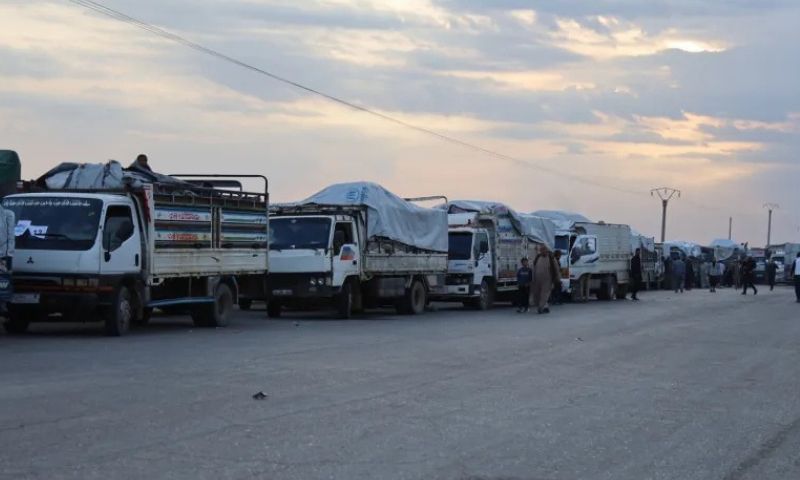
 The sixth convoy of displaced residents of Ras al-Ain leaves al-Hasakah for their home areas, October 21, 2026 (Hawar News Agency)
The sixth convoy of displaced residents of Ras al-Ain (al-Hasakah governorate, northeastern Syria) left al-Tuwayna and Newroz camps in al-Hasakah governorate on Wednesday morning, October 21, heading to the families’ home areas in the countryside around Ras al-Ain, Zarkan and Tal Tamr (northern al-Hasakah governorate). The convoy is part of efforts to return displaced residents to their home areas after years of displacement.
The convoy includes approximately 640 families, totaling 4,054 people, according to information released about the return operation. Of these, 1,526 people from 283 families are from Newroz camp, while 2,528 people from 359 families are from al-Tuwayna camp.
The returning families are heading to more than 50 villages in the countryside around Ras al-Ain, Zarkan and Tal Tamr. More families are expected to return in the coming days, as challenges persist in providing shelter and basic services in the areas residents fled.
Mustafa Abdi, a member of the presidential delegation, told journalists as the convoy departed that logistical and security preparations had been completed, adding that the villages receiving the families had been cleared of mines.
Abdi said the number of returning families would increase in the coming days to more than 700, stressing that efforts were continuing to bring all displaced residents home before winter.
Oliver Smith, head of the United Nations High Commissioner for Refugees (UNHCR) office in eastern Syria, said conditions in Ras al-Ain “remain difficult,” particularly regarding children’s education and shelter for returning families.
Smith said the United Nations was working to provide additional assistance to displaced people returning home and supported government efforts to help residents return after many years of displacement.
He explained that UNHCR was providing shelter support to help families rebuild their homes and restore basic services, pointing to the needs residents face after returning to their areas.
As the sixth convoy departed, dozens of displaced residents of Ras al-Ain living in al-Tuwayna camp temporarily blocked its route to protest their exclusion from the lists of families scheduled to return.
The protesters demanded that their families be included on the return lists and that compensation be provided to all families.
The protest reflects demands from some displaced residents excluded from the latest group, as families continue to be transported from camps to their home areas in stages.
The sixth convoy follows a series of earlier departures that transported displaced residents of Ras al-Ain to their home areas in recent months, as part of successive return operations involving camps and shelters in al-Hasakah governorate.
The fifth convoy left al-Tala’i camp near al-Hasakah city on Tuesday morning, October 13 , carrying 385 families bound for the countryside around Ras al-Ain, Tal Tamr and Zarkan, also known as Abu Rasin.
It followed the fourth convoy, which left al-Tuwayna camp, west of al-Hasakah city, on October 8, carrying approximately 518 displaced families from Ras al-Ain.
On October 5, the third convoy departed with 511 families, totaling 3,242 people, who had been living in al-Tuwayna camp and schools used as shelters in al-Hasakah. They headed to areas in the Ras al-Ain countryside and Zarkan subdistrict.
The first and second groups departed on August 10 and September 8, respectively. The first included approximately 400 families, while the second comprised 689 displaced families from Ras al-Ain living in al-Tala’i camp on the outskirts of al-Hasakah city.
Meanwhile, families originally from al-Hasakah city who had been living in Ras al-Ain have also returned, with residents moving back to their home areas in both locations.
Despite the continuing convoys, some displaced residents are still waiting to return, as transport arrangements and suitable conditions for families to settle in their villages remain necessary.
The displacement of residents from Ras al-Ain and parts of its countryside dates back to October 2019, when military operations ended with Syrian National Army factions taking control of the city and large areas of its countryside.
The military developments at the time drove large numbers of residents from their homes to other areas, including al-Hasakah city. Over the following years, families lived in camps, shelters and residential communities.
Meanwhile, families from al-Hasakah moved to Ras al-Ain, creating communities that included people displaced from different areas. Returns have remained linked to security and political developments in the region.
The latest convoys coincided with changes in territorial control in al-Hasakah governorate since the beginning of 2026. During fighting early in the year, the Syrian army took control of areas in the southern and eastern countryside and parts of the western countryside, while the Syrian Democratic Forces (SDF) withdrew to major cities, including al-Hasakah and Qamishli (northeastern Syria).
On January 29, the Syrian government and the SDF reached an agreement to begin integrating the governorate’s military, security and service institutions into state structures and ministries.
The integration arrangements were accompanied by discussions on reorganizing institutions and services in areas where control had changed, alongside the return of residents to their home areas.
Al-Hasakah governorate has also seen returns of displaced residents of Afrin (northwestern Aleppo governorate). Eight groups of families have been transported to their home areas in recent months, alongside convoys for displaced residents of Ras al-Ain and other rural areas.
if you think the article contain wrong information or you have additional details Send Correction


 A
A
A





 More Politics