


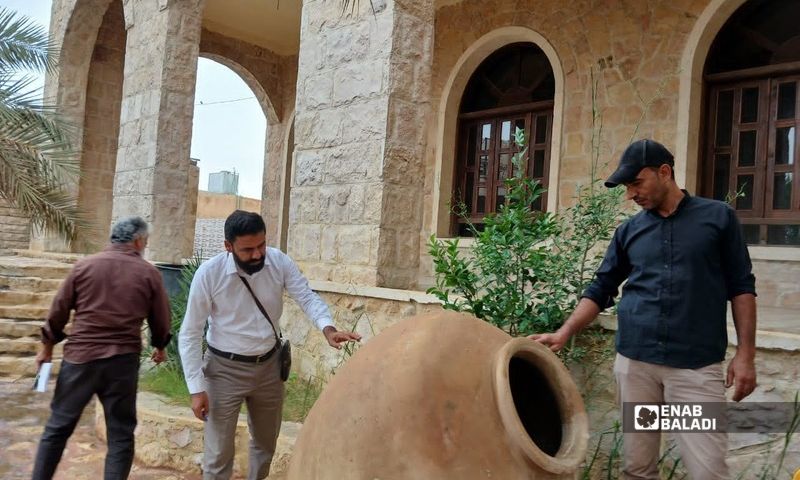
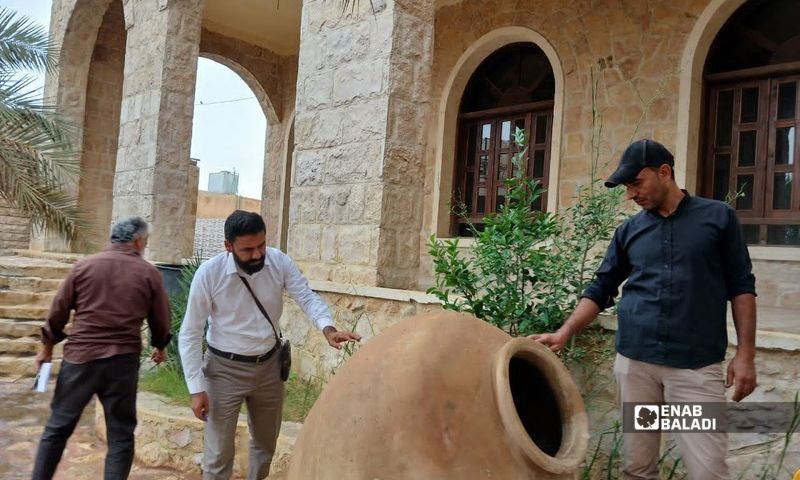
 Raqqa’s Antiquities Directorate receives artifacts from a resident of Raqqa governorate, northern Syria, October 12, 2026 (Enab Baladi/Ahmad al-Hamdi)
Raqqa’s Antiquities Directorate is seeking to recover artifacts lost during the war, when widespread looting and theft targeted the museum and several archaeological sites across the region, according to Abdul Jabbar al-Abdullah, head of Raqqa’s Antiquities Department.
Those circumstances led to the loss of thousands of artifacts from Raqqa Museum’s collections and from archaeological sites and historic mounds across the governorate.
Al-Abdullah told Enab Baladi that the directorate is working with the relevant antiquities and heritage bodies to trace and recover these artifacts and preserve those that remain. Their historical and cultural value, he said, lies in documenting the different periods the region has experienced over the centuries.
The directorate is also encouraging residents to report any artifacts or hand them over to the relevant authorities as part of efforts to protect cultural heritage and preserve it for future generations.
Footage circulating on social media and official pages shows Raqqa residents handing over artifacts to the Antiquities Department. They had kept the objects for years after living near archaeological sites or working at them.
Among them is Abdul Latif al-Khalaf, caretaker of the Heraqla archaeological site (Raqqa governorate). Speaking to Enab Baladi, he said he found the artifacts while working near the site’s storerooms after realizing they were at risk of being looted following Raqqa’s liberation from the former regime in 2013.
Abdul Latif explained that he took the artifacts home and looked after them, then hid them somewhere safe to protect them from theft or damage. He said he regarded their safekeeping as a trust and a national responsibility.
He added that, a few days after the Syrian Democratic Forces (SDF) withdrew and the Syrian government took over state institutions, including the museum, he contacted Raqqa Museum’s curator and informed him about the artifacts. This was followed by a series of communications and follow-up efforts with the Directorate-General of Antiquities and Museums to arrange their handover to the relevant authorities.
According to Abdul Latif, coordination and follow-up continued despite the conditions Raqqa governorate experienced during the war. He remained in contact with antiquities officials even after the Islamic State group took control of the city in 2013, and communication continued until Raqqa was recaptured and the group driven out.
He said that following the city’s liberation, arrangements were made with teams from the Directorate-General of Antiquities and Museums, who visited the location. The artifacts were retrieved from their hiding place and formally handed over to the relevant authorities.
Al-Khalaf said all citizens share responsibility for preserving antiquities. Archaeological heritage, he added, represents a community’s identity and historical memory, and protecting it for future generations requires everyone’s cooperation.
He concluded by urging anyone who finds an artifact or information about antiquities to pass it on to the relevant authorities to preserve the country’s cultural heritage.
Another resident, Khaled Abdul Halim, handed over a collection of artifacts he had safeguarded since 2014 to Raqqa Museum. The objects returned to the Antiquities Department’s custody ahead of their inclusion in the museum’s collections and future displays.
Speaking to the Syrian Arab News Agency (SANA) on October 15, Abdul Halim said he took the initiative to formally hand over the artifacts to the city’s museum after state institutions returned to Raqqa governorate. He said he had carefully protected and wrapped them throughout the intervening years, believing they represented part of his country’s history and cultural identity and must be safeguarded regardless of the circumstances.
Abdul Halim urged residents to hand over any artifacts or historical objects in their possession to the relevant authorities, saying their preservation is a shared national responsibility.
Raqqa is one of Syria’s richest governorates in archaeological sites, with more than 100 sites and ancient mounds spread across the governorate. They date to successive civilizations and historical periods, from prehistoric times to the Islamic era.
Among the most prominent are Resafa, Jaabar Castle, Tell Bi’a (Tuttul), Tell Sabi Abyad, Qasr al-Banat, and Heraqla, all in Raqqa governorate. These sites give Raqqa particular significance within Syria’s cultural heritage.
Al-Abdullah said more than 4,700 artifacts are estimated to have gone missing from Raqqa Museum after 2013, amid conflicting information about their fate and the parties involved in concealing them or causing their disappearance.
He explained that some of the most notable missing objects include cuneiform tablets from the sites of Tell Sabi Abyad and Tell Bi’a, along with distinctive glazed ceramics.
He added that the most important missing holdings include more than 500 artifacts transferred to the Central Bank building in Raqqa in 2013, while the former regime was still present in the governorate, before their whereabouts subsequently became unknown.
Discussing recovery efforts, al-Abdullah said artifacts outside Syria are traced through Interpol and the United Nations Educational, Scientific and Cultural Organization (UNESCO), as well as through direct contact with Western governments and the United States.
He said political and diplomatic channels sometimes help secure the return of artifacts, citing a recent recovery involving the United States.
As for artifacts recovered within the governorate, al-Abdullah said the Antiquities Department had recently retrieved several objects stored by individuals or archaeological site caretakers.
Examples include the caretaker of Tell Bi’a, who hid a large number of artifacts underground for many years, as well as the caretaker of Qasr al-Banat and others who kept artifacts and later handed them over to the relevant authorities.
Al-Abdullah added that some residents bring the museum artifacts that came into their possession over time through various means or that they found by chance. He said it was difficult to establish exactly how many objects had been returned so far, but described the recovered items as a good proportion of the total missing.
Addressing residents of the governorate, al-Abdullah said, “Raqqa Museum is the repository of the governorate’s culture and historical memory. That memory cannot be left unprotected.”
He urged anyone holding artifacts to hand them over to Raqqa’s Antiquities Department so they can become part of the national heritage preserved at Raqqa Museum and help protect the region’s history for future generations.
Since 2013, Raqqa has come under the control of successive forces, beginning with opposition and Islamist factions, followed by the Islamic State group, which seized control by the end of that year. The international coalition and the SDF then captured it from the group in October 2017, before the new Syrian army took control of the governorate on January 18, 2026.
During the three phases preceding the Syrian army’s arrival, the governorate experienced years of upheaval as each controlling force imposed conditions reflecting its ideological, religious, and political outlook. Those periods ended one after another, but their effects remain visible across the governorate and among its residents.
Years of war and successive changes in control contributed to the loss of some of Raqqa’s archaeological holdings. Several sites across the governorate also suffered vandalism and illegal excavation amid a lack of oversight and the difficulty of protecting archaeological sites during the conflict.
if you think the article contain wrong information or you have additional details Send Correction


 A
A
A



 More Society