


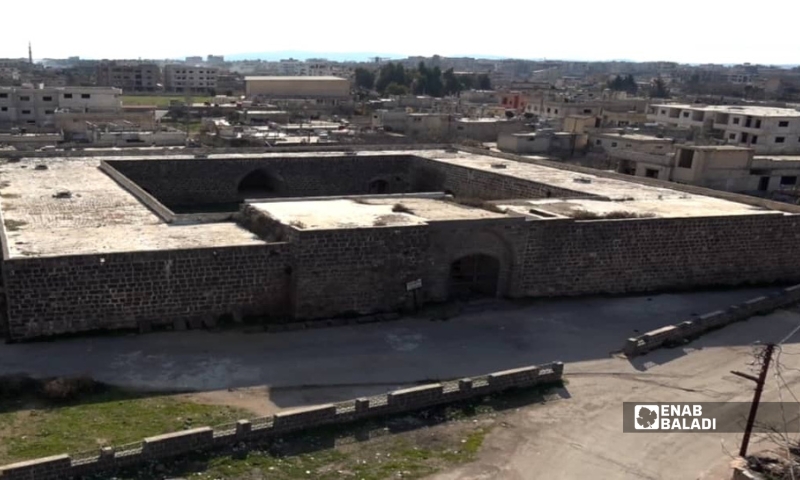
 The square historic caravanserai in the center of Khan Arnabeh (Quneitra governorate, southwestern Syria), October 12, 2026 (Enab Baladi)
Khan Arnabeh, a caravanserai in Quneitra governorate (southwestern Syria), once served as a resting place for trade caravans, pilgrims, and travelers on the road connecting Damascus and Palestine. Its location linked southern Syria with Palestinian territory.
The stone building still bears witness to a period when the caravanserai supported travel and trade, before becoming a historic landmark documenting part of the region’s history.
The caravanserai dates to the late Mamluk and early Ottoman periods, according to an antiquities expert, who told Enab Baladi that it was more than a resting place. It was designed to meet the needs of caravans, providing storage for goods, accommodation for travelers, and shelter for the animals used for transport.
The caravanserai’s significance also stems from its location in the town that bears its name, on the road between Damascus and Quneitra, in an area rich in archaeological remains from different historical periods.
Built from black basalt, a material characteristic of the region’s architecture, the caravanserai covers approximately 2,500 square meters. It consists of multiple rooms arranged around an open courtyard, with a square opening to the sky at its center and arcades on all four sides.
The building originally had two floors. The ground floor housed storage areas for goods and the belongings of travelers and pilgrims, alongside spaces for horses and camels, while the upper floor contained sleeping quarters.
The caravanserai also includes a historic mosque with three arches. Archaeological objects and pottery vessels were found inside, and large sections of the building were restored before it was designated an archaeological museum, according to al-Safadi.
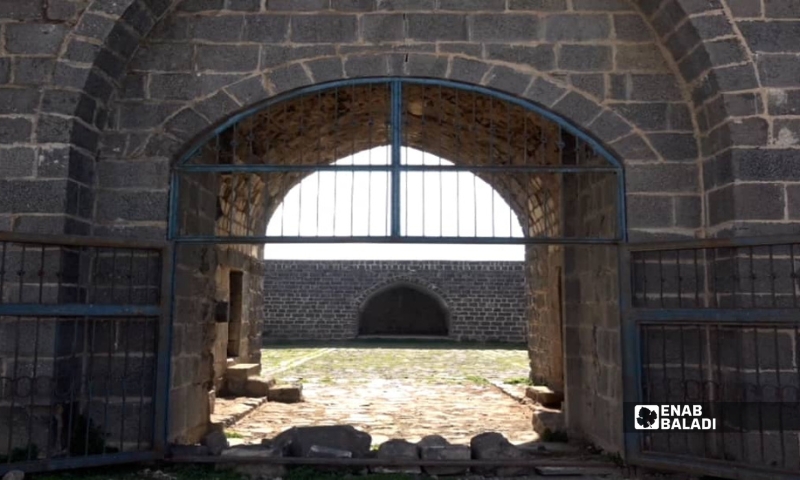
The northern entrance to the historic Khan Arnabeh caravanserai, October 12, 2026 (Enab Baladi)
The archaeological significance of Khan Arnabeh extends beyond its historic caravanserai. The surrounding area contains sites and remains reflecting the succession of different civilizations.
Tal Krum lies north of the town. Roman pools and ancient wells found in some residential properties indicate the area’s importance in earlier periods. The northern pool still survives.
The town’s archaeological sites include the Khan Arnabeh tomb, whose architectural style dates to the Mamluk period. Other antiquities were found among the ruins surrounding the caravanserai, including part of a stone statue depicting the goddess of victory, missing its head and feet. It was previously kept at the Quneitra Museum before the collections were moved to Damascus.
The area also includes two archaeological ruins, al-Mantara and Khatoun. Ancient burial grounds dating to the Roman and Byzantine periods are found at Tal Krum, alongside Tal al-Mira, an archaeological ruin dating to the same periods.
West of the town, on the road leading to the city of Quneitra, stands a low hill known as Manzilat Faisal. According to the account associated with its name, it was named after King Faisal I, son of Sharif Hussein.
Al-Safadi said the caravanserai exemplifies the facilities built to serve trade caravans, travelers, and pilgrims. He explained that its architectural design combined spaces for storing goods, accommodation, and sheltering animals, in keeping with its intended purpose.
The caravanserai forms part of a broader archaeological landscape in Quneitra governorate, which contains sites dating to prehistoric, classical, and Arab-Islamic periods. These reflect the region’s position as a passage for caravans traveling between north and south.
if you think the article contain wrong information or you have additional details Send Correction


 A
A
A



 More Society