


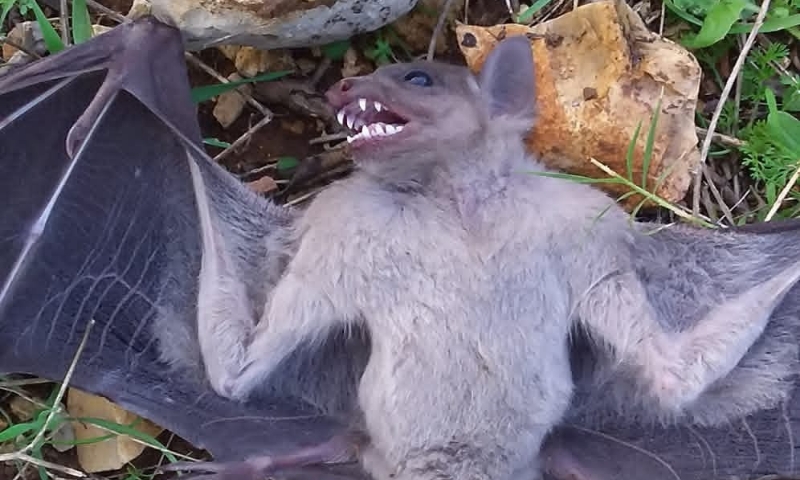
 A bat in a village near Baniyas, Tartous countryside (western Syria), an area known for its widespread populations of cave-dwelling bats and Kuhl's pipistrelle, January 21, 2024 (Syrian Wildlife Enthusiasts/Facebook).
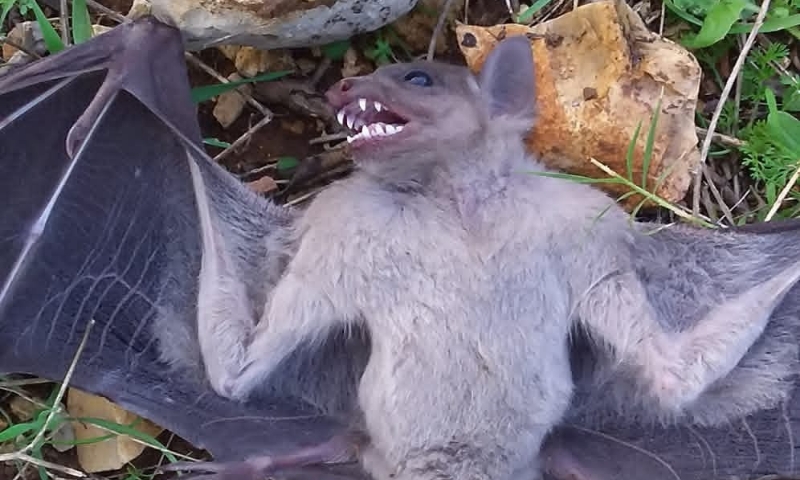
A bat in a village near Baniyas, Tartous countryside (western Syria), an area known for its widespread populations of cave-dwelling bats and Kuhl's pipistrelle, January 21, 2024 (Syrian Wildlife Enthusiasts/Facebook).
Syrian governorates have witnessed a marked rise in rabies cases, with the number of people potentially exposed to the virus increasing by 62.7% in the first quarter of 2026 compared with the same period the previous year.
The threat has not been limited to humans. Still, it has also affected the livestock sector, with sporadic viral outbreaks, most recently in the western Raqqa countryside (northeastern Syria) and orchards surrounding the city of Homs (central Syria). These outbreaks have caused economic losses as livestock have died or had to be culled and disposed of according to sanitary procedures.
The outbreaks have coincided with the spread of local accounts attributing the disease primarily to bat attacks, sparking widespread debate over whether this explanation is scientifically accurate and supported by the facts.
Dr. Fahem Abdalaziz, professor of microbiology at the Faculty of Medicine at Tartous University, confirmed that rabies is an acute, fatal viral infection affecting the central nervous system. It is transmitted to humans and domestic animals through the saliva of infected animals.
Speaking to Enab Baladi, the specialist explained that rabies, also known as hydrophobia, is considered one of the most dangerous viral diseases because it is nearly 100% fatal once clinical symptoms appear.
However, Abdalaziz emphasized that despite the disease’s extreme severity, a crucial preventive option exists: death can be prevented and the disease avoided through the timely administration of vaccines and appropriate medical treatments.
Discussing the epidemiological characteristics of rabies, Abdalaziz explained that it is classified as a zoonotic disease, with a wide range of wild animals, including foxes, raccoons, squirrels, and bats, as well as domestic animals such as dogs and cats, serving as reservoirs of the deadly virus.
Regarding transmission, the microbiology professor said humans are usually infected through bites, although transmission can occur in rarer circumstances through the inhalation of airborne droplets contaminated with the virus.
From a biological perspective, Abdalaziz described the virus’s progression through the body, explaining that once infection occurs, it travels along nerve pathways in the peripheral nervous system.
He added that the retrograde axonal transport of the virus to the central nervous system is the key process underlying the development of natural infection and disease. This explains the severe risks involved and the critical importance of vaccination before it is too late.
Expanding on his analysis of how the disease spreads, Abdalaziz noted that recent years have seen a surge in scientific studies examining how rabies is transmitted specifically from bats to humans, particularly following mysterious deaths involving people who had no obvious bite, scratch, or even contact considered dangerous.
Based on these findings, the microbiology professor explained that recent research has shown that the danger is not limited to a bite in the conventional sense. The virus can also be transmitted through seemingly minor direct contact that leaves no visible mark on the skin.
Abdalaziz attributed the danger of this type of exposure to bats’ extremely fine, sharp teeth, which can cause microscopic wounds that go unnoticed, explaining why some infected people do not realize they have been exposed.
Regarding the role of bats in spreading the disease, the specialist said recent laboratory analyses have demonstrated that bats are not merely incidental carriers of the virus but natural reservoirs in which it can persist. This increases the possibility of transmission through direct contact, even when no wounds are visible.
To illustrate these findings, the specialist cited several documented examples of exposure and infection identified in scientific research:
Discussing the specifics of bat-related transmission, Abdalaziz pointed out that international studies and regional statistics indicate that the prevalence of rabies infection among bats is extremely low, at less than 1%. He explained that bats are major reservoirs of the disease, particularly in North and Latin America.
Despite the relatively low likelihood of infection locally, the specialist stressed the need for extreme caution following any direct bite or scratch from a bat, particularly one that cannot fly or displays unusual behavior. Bat teeth are extremely fine, and people may not notice being bitten or scratched while sleeping or during close contact.
Regarding their characteristics and distribution, the microbiology professor explained that bats are flying mammals whose heads resemble those of dogs. Syria is home to several species of different sizes, inhabiting caves, grottoes, forests, and coastal areas. The most prominent include:
Abdalaziz reassured residents that most bat species native to Syria feed on insects or fruit, and that the country has no vampire bats that feed on the blood of living animals. However, he cautioned that bats can contract rabies in the same way as other mammals, through exposure to the infected saliva of another animal, such as another bat, a fox, or a wild animal carrying the virus. The virus can also spread within bat colonies through close contact or shared, confined roosting spaces.
Concluding this section, Abdalaziz issued a firm preventive recommendation, emphasizing that despite the low probability of infection in Syria, people should avoid contact with bats altogether. Under no circumstances should they directly handle or pick up a live or dead bat with their bare hands.
Regarding the routes of transmission, Abdalaziz explained that rabies is usually transmitted to humans through a bite or deep skin scratch from an infected animal. Infection can also occur when virus-contaminated saliva comes into direct contact with human mucous membranes, such as the eyes or mouth, or with fresh wounds.
The microbiology professor explained that dogs are the primary host and transmitter of rabies, accounting for approximately 99% of human rabies cases worldwide. Other potential carriers include carnivorous animals such as hyenas, foxes, wolves, and cats, as well as bats and monkeys.
Regarding the virus’s progression through the body, the specialist explained that it enters tissues and peripheral nerves at the site of exposure through infected saliva, then travels slowly along the nerves until it reaches the central nervous system and brain. Once it reaches the brain and multiplies, it spreads to the salivary glands, allowing the infected animal to transmit the virus to another through biting or contact with its saliva.
Turning to the complex mechanisms through which the disease develops inside the body, Abdalaziz described the virus’s progression following infection. He explained that the virus may initially replicate locally after inoculation into the body before traveling to the brain through the axoplasm of peripheral neurons, where it replicates and develops within the gray matter. It then spreads outward through the autonomic nerves to other organs.
According to the specialist, this process can lead to infection of the lungs, kidneys, adrenal medulla, and salivary glands. He explained that the presence of the virus in saliva at this stage is the scientific reason an infected animal can transmit the disease through a bite.
Regarding the time between exposure and the appearance of symptoms, he noted that the incubation period varies considerably between individuals, depending on the host’s resistance, the amount of virus transmitted, and the distance between the initial site of infection and the central nervous system.
The microbiology professor said the incubation period typically ranges from one to eight weeks but can, in unusual cases, extend to several months or even years after exposure. He stressed that this makes it essential not to underestimate any suspicious contact with animals capable of transmitting the disease.
The microbiology professor described the clinical manifestations of rabies in humans, explaining that the disease typically begins with unusual sensations and tingling at the bite site before rapidly progressing to fatal encephalitis and severe neuronal degeneration in the brain and spinal cord.
He added that early symptoms initially resemble influenza, including fever, headache, general fatigue, and numbness or severe itching at the bite site. The disease then progresses into one of two main clinical forms:
Abdalaziz noted that paralytic rabies is frequently misdiagnosed, contributing significantly to the underreporting of the disease’s actual prevalence.
The specialist also highlighted a fundamental difference in how symptoms appear in different animals. Unlike some other species, an infected bat may not exhibit obvious agitation or aggression. Instead, it may display unusual behavior or movements, such as flying during daylight hours, suddenly falling to the ground, or being unable to fly. Such signs require the public to exercise extreme caution and avoid approaching these animals.
The microbiology professor outlined available medical measures for treatment and prevention, emphasizing that no effective treatment exists once clinical symptoms of rabies have appeared. At the same time, he stressed that immediate, early medical intervention offers the only reliable means of preventing the disease from developing.
Regarding first aid, the specialist explained that washing the affected area as quickly as possible with soap and water and thoroughly cleaning the wound can significantly reduce the number of viral particles at the exposure site.
He also recommended using a disinfectant capable of inactivating the virus, such as povidone-iodine, iodine tincture, aqueous iodine solution, or ethanol. If mucous membranes, including the eyes, nose, or mouth, have been exposed to the virus, they should be thoroughly rinsed with water without delay.
Beyond these immediate measures, Abdalaziz emphasized that effective prevention requires seeking appropriate medical care and visiting a healthcare facility immediately to receive the rabies vaccine and, when indicated, rabies immunoglobulin as soon as possible, before any clinical symptoms develop.
Regarding preventive immunization, the microbiology professor noted that inactivated rabies vaccines are available, including the human diploid cell vaccine used in the United States. He explained that vaccination can also be administered before exposure to individuals considered at high risk because of their occupations, such as veterinarians and dog breeders.
Veterinarian Abdul Basit Wakiyeh, a specialist in ruminant diseases and surgery, expressed regret over the current situation in comments to Enab Baladi, noting that previous governments had provided medicines and antiserums for communicable and infectious diseases.
According to Wakiyeh, government medical centers currently lack the necessary antiserums and vaccines, forcing residents to purchase them at their own expense, often from unreliable sources where neither their effectiveness nor their storage conditions can be verified.
He added that vaccines for immunizing animals are not available in Syria in the first place. Domestic animals are therefore not routinely vaccinated locally, even in areas classified as severe disease hotspots.
The veterinarian also warned about the dangerous state of slaughterhouses in Syria, describing their conditions as “backward” because they lack specialized laboratories and mechanisms for collecting samples for analysis. Instead, inspections rely solely on visual examination, which he stressed is entirely insufficient to detect serious diseases.
In this context, Wakiyeh warned that the absence of laboratory oversight allows unscrupulous individuals to pass infected meat into the market. He emphasized that meat may show no visible signs indicating infection, making the situation extremely dangerous for public health.
if you think the article contain wrong information or you have additional details Send Correction


 A
A
A
A
A
A







 More Society