


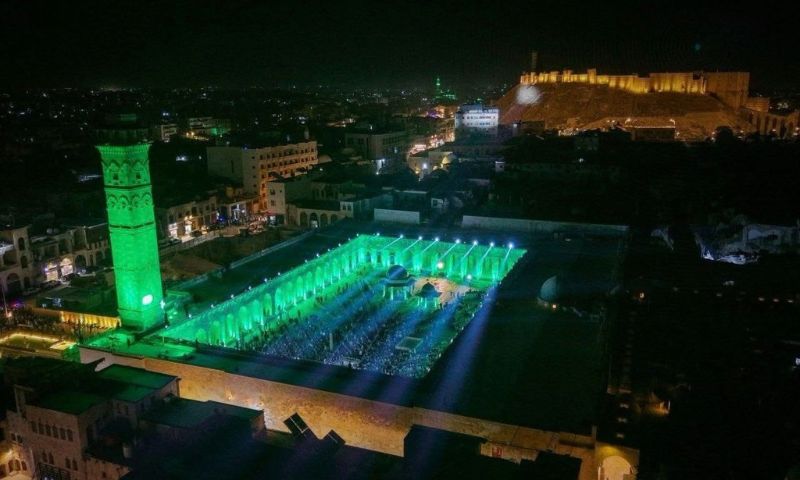
 An aerial view of Aleppo’s Great Umayyad Mosque during its reopening, October 8, 2026 (SANA)
An aerial view of Aleppo’s Great Umayyad Mosque during its reopening, October 8, 2026 (SANA)
The Great Umayyad Mosque in Aleppo’s Old City (northern Syria) opened its doors to worshippers and visitors on Thursday, October 8, after years of closure and restoration carried out in stages following damage sustained during the war.
According to Enab Baladi’s correspondent in Aleppo, the latest rehabilitation work covered several parts of the mosque, including its arcades, the Hijaziyah hall, courtyard paving, public drinking fountain, and ablution area. It also included completing the reconstruction of the historic minaret, which collapsed during the war in 2013, using a substantial proportion of its original stones, which had been salvaged, sorted, and documented.
In November 2025, the Aleppo Directorate of Religious Endowments announced that restoration had resumed under its direct supervision, with the aim of reopening the mosque. The work focused on repairing damaged sections while preserving its distinctive architecture and heritage.
The Great Umayyad Mosque stands in the al-Jalloum neighborhood, in the heart of Aleppo’s Old City. It is one of the most prominent landmarks within the Ancient City of Aleppo, a UNESCO World Heritage site.
During the battles in Aleppo between 2012 and 2016, the mosque lay on the front line between the warring parties. It sustained shelling, fires, and damage to various parts of its structure.
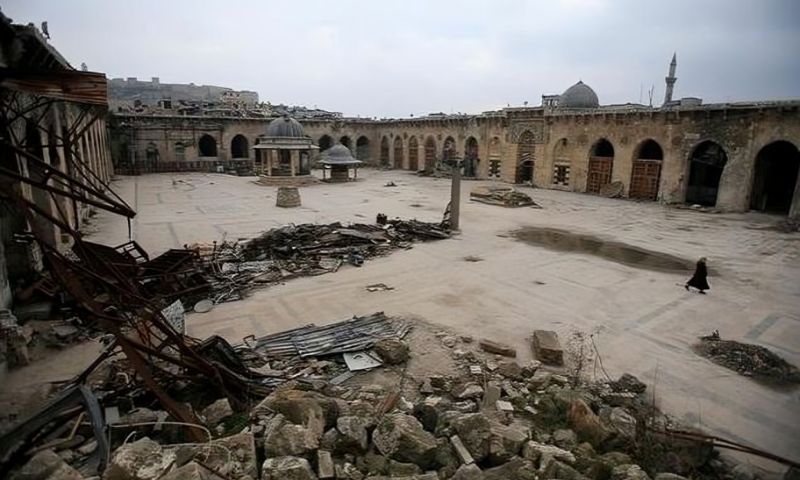
Damage to Aleppo’s Great Umayyad Mosque in 2013 (Reuters archive)
The Syrian Heritage Archive estimates that approximately 30% of the mosque was damaged, excluding the minaret, which was completely destroyed in April 2013.
The damage affected the eastern arcade, where large holes appeared in the roof, as well as the southern prayer hall, which suffered fires. The main entrance and wooden doors were also damaged.
The northern arcade and the mosque’s gateway were damaged, and sections of the courtyard paving were lost.
The minaret collapsed on April 24, 2013, during fighting in the area. At the time, regime forces and opposition factions traded accusations over responsibility for its destruction.
Built during the Seljuk period, approximately between 1090 and 1096, the minaret stood about 45 meters tall and remained standing for roughly nine centuries before its collapse.
The damage extended beyond the minaret. A UNESCO mission in 2017 identified extensive damage to the mosque, including its western entrance, prayer hall columns, and other architectural elements.
Efforts to rehabilitate the mosque began in the years following the battles in Aleppo in 2016.
A document submitted by Syrian authorities to UNESCO in 2017 states that rehabilitation work began that year with $1.4 million in funding from the Chechen Republic. It also states that the detailed restoration study was prepared by the University of Aleppo’s Faculty of Civil and Architectural Engineering, in coordination with the Directorate-General of Antiquities and Museums.
That same year, it was announced that Chechen leader Ramzan Kadyrov had provided $14 million through the Akhmad Kadyrov charitable foundation to rebuild the mosque, according to Aleppo’s mufti, Mahmoud Akkam, whose remarks were reported at the time.
Akkam said the announced sum was allocated to rebuilding the mosque, with additional funding possible if it proved insufficient.
Reconstructing the minaret was one of the most difficult stages of the project, given its almost complete collapse during the war.
UNESCO documents show that the project involved sorting the minaret’s stones according to their strength, with the aim of reusing as many original stones as possible, before beginning reconstruction of its base in accordance with the approved studies.
Later stages also included restoring the arcades, rehabilitating the southern prayer hall, carrying out woodwork and electrical work, and repairing bullet and shrapnel damage to the walls and facades.
In subsequent years, restoration continued across several sections of the mosque.
Published reports on the project documented work on the southern section, prayer hall, eastern and northern arcades, and Hijaziyah hall, alongside work on the minaret and the religious endowment library.
Restoration of the minaret had made progress before the end of 2024, but the project remained unfinished, and parts of the mosque still required further work.
Following the fall of the Assad regime in December 2024, restoration stopped for a period before the Aleppo Directorate of Religious Endowments resumed work at the mosque in 2025.
On November 29, 2025, the directorate announced that restoration had resumed under its direct supervision, in a step it said was intended to reopen the mosque to worshippers and visitors.
An initial phase of work had already been completed in March 2025, when the mosque opened its doors to worshippers for Tarawih prayers, the special evening prayers held during Ramadan, for the first time in years, following approximately three months of work.
Rehabilitation subsequently continued in other parts of the mosque, culminating in the completion of work on the minaret, arcades, Hijaziyah hall, courtyard, public drinking fountain, ablution area, and service and technical facilities.
The mosque’s origins date to the Umayyad period. Historical sources differ over whether Caliph al-Walid ibn Abd al-Malik or his brother, Sulayman ibn Abd al-Malik, ordered its construction, while some sources indicate that it was completed in the early eighth century.
However, the building familiar to Aleppo’s residents today no longer retains the original form of the Umayyad mosque. Over the centuries, the mosque experienced fires, earthquakes, invasions, reconstruction, and restoration, with successive eras leaving their mark on its architecture.
The newly reconstructed minaret is one of the clearest examples of this history. It was not originally Umayyad, but was built during the Seljuk period in the late eleventh century and remained standing until its collapse in 2013.
The mosque includes a central courtyard surrounded by arcades, a prayer hall on its southern side, prayer niches, a pulpit, and a chamber traditionally associated with the shrine of the Prophet Zechariah. Other architectural elements bear traces of different periods in Aleppo’s history.
The Ancient City of Aleppo was inscribed on UNESCO’s World Heritage List in 1986. The Great Mosque is one of the most important elements of its historic urban fabric, alongside the citadel, markets, caravanserais, schools, and religious buildings.
if you think the article contain wrong information or you have additional details Send Correction


 A
A
A
A
A
A






 More Society