
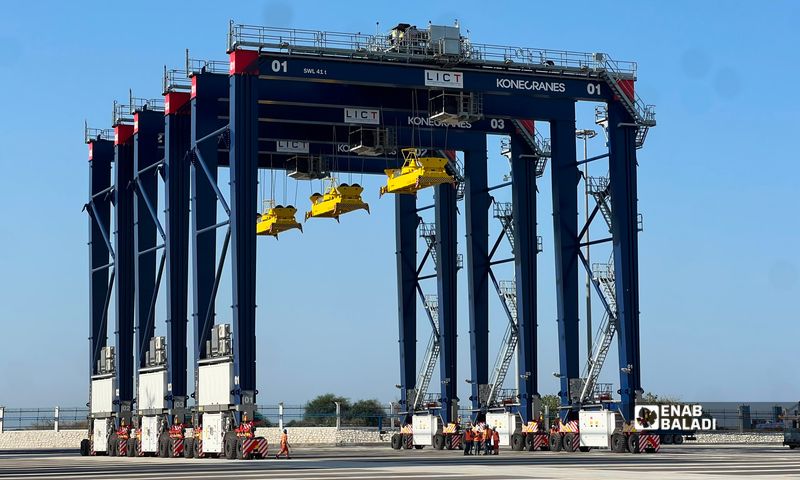

Latakia Port (on Syria’s Mediterranean coast) has received six modern rubber-tired gantry cranes worth more than €16 million in total, as part of a development plan overseen by Syria’s General Authority for Ports and Customs in cooperation with French shipping company CMA CGM. The equipment is intended to increase the container terminal’s operating capacity and speed up vessel loading and unloading.
The new cranes are part of a 30-year agreement signed with the French company in May 2025 to develop and operate Latakia Port, with announced investments totaling €230 million.
The agreement covers modernization of the international container terminal, its infrastructure and equipment, alongside construction of a new berth with investment of up to €200 million over the four years following the signing, according to Damascus’s announcement at the time.
Faisal Hawilo, director of the Latakia container terminal, told Enab Baladi that the six cranes are part of a long-term development plan for the port. Their arrival, he said, marks the beginning of a broader modernization process covering the equipment and technology systems used to operate the terminal.
Hawilo added that the cranes use a hybrid power system, in line with CMA CGM Group’s environmental policies. He said their operation is expected to increase the port’s handling and operating capacity and enable faster container handling.
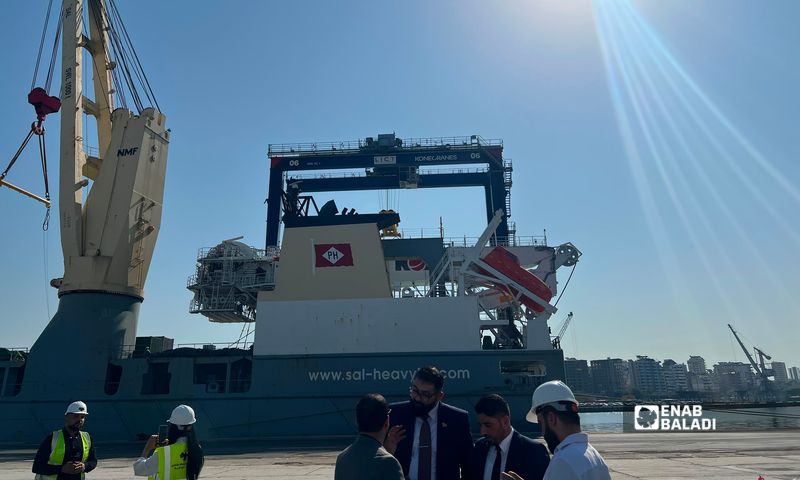
Latakia Port receives modern gantry cranes to develop and modernize Lattakia International Container Terminal, October 22, 2026 (Enab Baladi/Doha Saqqa)
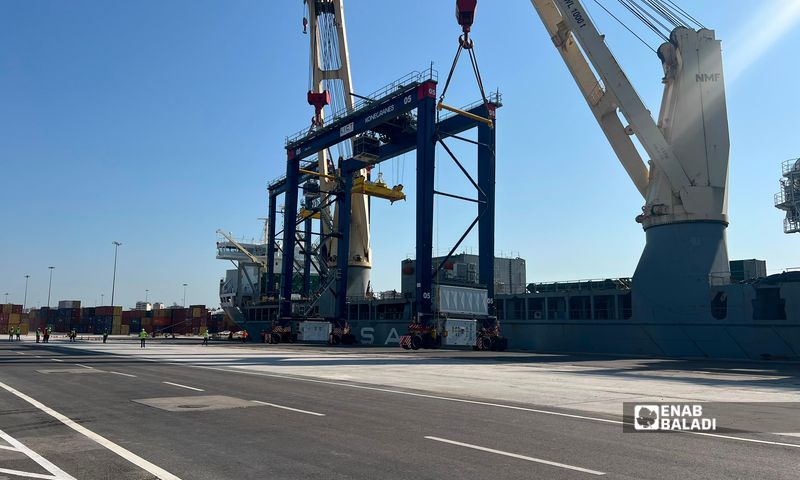
Modern fifth-generation rubber-tired gantry cranes at Latakia Port, October 22, 2026 (Enab Baladi/Doha Saqqa)
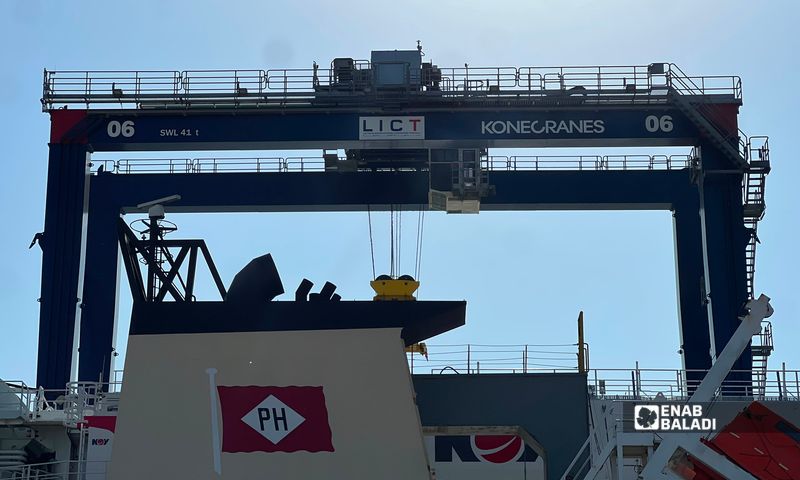
Latakia Port receives modern gantry cranes to develop and modernize Lattakia International Container Terminal, October 22, 2026 (Enab Baladi/Doha Saqqa)
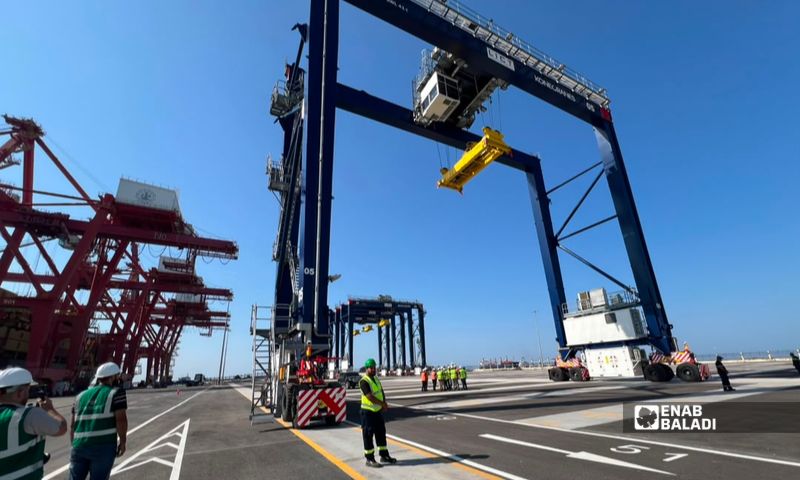
Modern fifth-generation rubber-tired gantry cranes at Latakia Port, October 22, 2026 (Enab Baladi/Doha Saqqa)
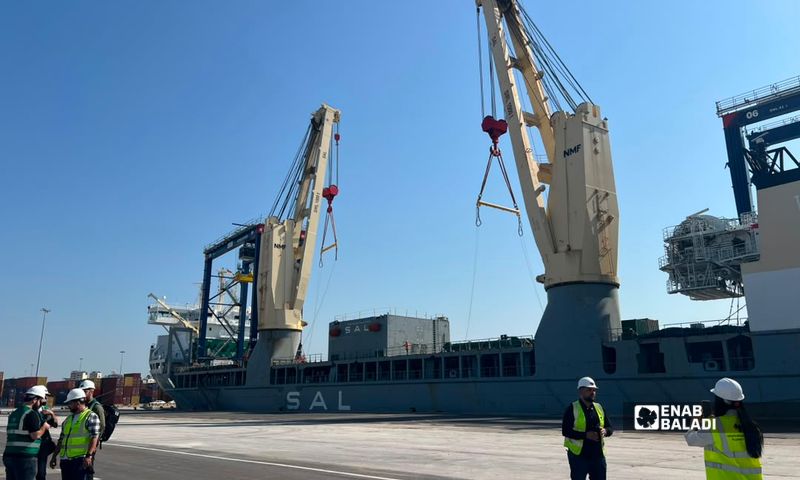
Latakia Port receives modern gantry cranes to develop and modernize Lattakia International Container Terminal, October 22, 2026 (Enab Baladi/Doha Saqqa)
Upgrading Equipment and Operating Systems
The development plan includes additional equipment alongside the new cranes. Hawilo said the terminal had received nine reach stackers and four empty-container handlers, as well as terminal tractors and other equipment.
He said the modernization also covered the technology used to manage terminal operations, through an upgrade to the terminal operating system (TOS), which organizes container movements and storage locations and coordinates operations within the terminal.
The system upgrade is taking place alongside the introduction of new equipment, as part of efforts to improve the terminal’s overall operations rather than simply increase the number of machines.
According to Hawilo, the six cranes are part of the port’s announced investment plan, rather than a separate project.
Abdul Hamid al-Wahab, director of Latakia Port, told Enab Baladi that both the general cargo sector and the container terminal are operating under the General Authority for Ports and Customs’ plan to steadily increase cargo handling rates and improve reliability, safety and operational readiness.
Al-Wahab added that the work includes improving the condition of existing equipment and introducing modern machinery. He described the six new cranes as among the most advanced in the region.
He said introducing this equipment would affect how long vessels spend in port, the reliability and safety of operations, and the speed at which work is completed.
Faster Cargo Handling and Its Impact on Trade
The operational importance of the new cranes lies in their ability to speed up container handling between vessels and storage yards. This process affects how long vessels spend in port and how quickly goods move from unloading to storage or delivery, with the reverse sequence applying to exports.
According to the container terminal’s director, the new equipment will help increase the productivity of waterside and landside cargo handling and improve the flow of imports and exports, allowing vessel operations to be completed more quickly.
He added that faster operations benefit shipping agencies seeking to complete their vessels’ loading and unloading as quickly as possible, as well as traders and cargo owners who could benefit from shorter handling times for their shipments.
This aligns with al-Wahab’s comments about reducing the time vessels spend in port. Handling speed depends on the terminal’s ability to unload and load containers efficiently, which could help shorten turnaround times for vessels and cargo.
These results, however, depend on how efficiently the new equipment operates and how well it integrates with the terminal’s other machinery and systems, as well as the readiness of berths and storage yards and the organization of truck and cargo movements.
The investment’s impact will therefore be measured by more than the number of cranes delivered. It will also depend on their effect on handling rates, vessel waiting times and the speed at which operations are completed.
In his comments to Enab Baladi, Hawilo did not specify the expected increase in handling productivity or how much time could be saved during vessel loading and unloading. Assessing the equipment’s actual impact will therefore depend on operational data available after it enters service.
A €230 Million Investment
In May 2025, Damascus signed a 30-year agreement with French company CMA CGM to develop and operate Latakia Port, with the aim of modernizing the international container terminal and expanding its operating capacity.
According to the Syrian government’s announcement at the time, the agreement provided for €230 million in investment, including €30 million allocated to the first year. The following four years would include construction of a new berth at the port, with investment of up to €200 million.
The six cranes are part of this investment program, which aims to develop equipment, infrastructure and operating systems at one of Syria’s main maritime facilities.
The French company had operated the container terminal at Latakia Port since 2009, during the rule of ousted President Bashar al-Assad, under a contract renewed several times before the new agreement was signed following the overthrow of the former regime in late 2024.
In August, Syrian President Ahmed al-Sharaa and the French company’s CEO, Rodolphe Saadé, agreed during a meeting in Damascus to accelerate the launch of the port expansion project’s second phase, according to a company statement issued after the meeting.
Latakia Port is a major gateway for Syria’s maritime trade. Its development is particularly relevant as the Syrian government seeks to modernize public facilities and sign agreements with regional and international companies to develop transport and infrastructure.