
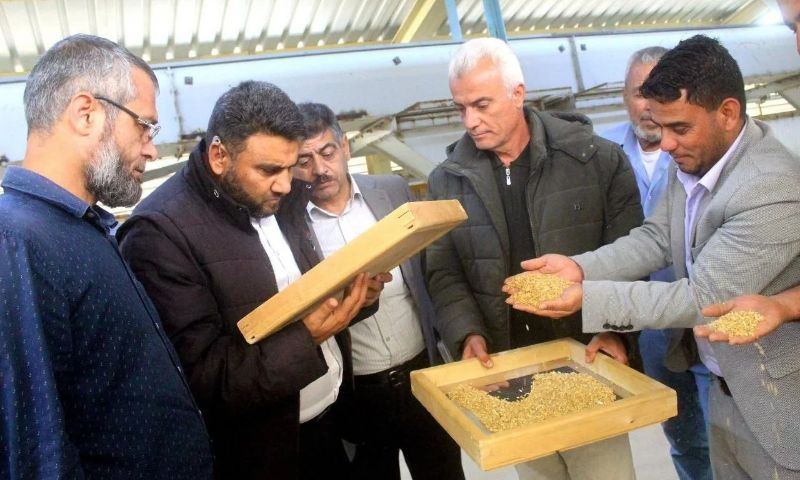

The Syrian Grain Corporation in Hama governorate (central Syria) denied reports on Saturday, November 7, that wheat stored in its silos had been infested with khapra beetles, following allegations by a former grain expert who said the insects had been detected in the facilities.
The corporation described the reports as entirely false and baseless, amid conflicting technical accounts of the nature of insect infestations recorded at the Qalaat al-Madiq silos.
Mohammed Awad al-Shareii, director of the Syrian Grain Corporation’s Hama branch, said in a statement on November 7 that routine inspections conducted by specialized committees at the Qalaat al-Madiq silos had confirmed that the entire wheat stock was safe.
He also confirmed that specialized technical teams were continuing fumigation operations and regular monitoring in accordance with established technical procedures and scientific research conducted by the General Commission for Scientific Agricultural Research, to ensure the protection and preservation of the grain.
The corporation’s Hama branch urged media outlets and citizens not to be misled by what it described as false rumors and to obtain information from official, authorized sources.
Minor Insect Infestations Detected in Some Storage Cells
Al-Shareii explained that an insect inspection conducted on November 1 at the Qalaat al-Madiq wheat silos found several storage cells free of infestation, while minor insect infestations were recorded in others. Cells fumigated in late October were also found to be free of infestation.
He stressed that no khapra beetle infestations had been detected, explaining that the insects present were limited to common stored-grain pests, including the confused flour beetle and the lesser grain borer. He said these infestations were within the normal range that may be observed in grain storage facilities and posed no threat to the safety or quality of the wheat stock or to food security. Preventive and technical measures were continuing to address them.
He added that fumigation operations were being carried out by a specialized team, taking into account the severity of each infestation and under the supervision of relevant branch officials, in accordance with instructions issued by the corporation’s central administration. He noted that the fumigation team was conducting regular insect inspections of storage cells, with the participation and assessment of the responsible grain storage specialist. These inspections had confirmed that the recorded infestations were limited to common stored-grain pests, with no evidence of khapra beetles.
Al-Shareii explained that the technical assessment was consistent with scientific research and experiments conducted by the General Commission for Scientific Agricultural Research, which indicate that grain storage cells may be susceptible to common storage pests because such infestations can occur under storage conditions. He reiterated that the nature and severity of the current infestations did not threaten the safety of the wheat stock.
50,000 Tons of Wheat Allegedly at Risk
In contrast, agricultural engineer Shaher al-Khalil, who previously worked as a grain expert at the corporation’s grain and silo branch, presented a different account. He confirmed to Enab Baladi the accuracy of claims he had published on his personal Facebook page concerning insect infestations in the silos and the circumstances surrounding his removal from his position.
Al-Khalil said that when he returned to work, the wheat stock stood at approximately 30,000 tons. However, he was surprised to find that the silos were not prepared for fumigation or grain screening. Insect infestations began appearing in some storage cells during routine inspections conducted every two weeks, despite reports being submitted to officials in Hama.
He explained that he had repeatedly called for the existing wheat stock to be fumigated before new shipments were received, but his requests were rejected. Wheat deliveries continued, increasing the stock to approximately 50,000 tons as insect infestations worsened.
According to al-Khalil, fumigation reports from October showed infestations of grain weevils and grain beetles, as well as a khapra beetle infestation in one storage cell with a capacity of approximately 1,000 tons.
He added that when he attempted to explain the actual condition of the stock and identify technical mistakes, he was insulted and expelled from a meeting by Hazem al-Sarmani, director of Supply and Consumer Protection, who recommended that his contract not be renewed, according to his account. Al-Khalil attributed the decision to his exposure of what he described as “corruption and manipulation of people’s food supplies.”
Wheat Shipment from Qamishli to Salamiya Mill
Al-Khalil said fumigation operations began on October 20, at a rate of one storage cell per day.
He also warned that a truck carrying wheat from Qamishli (northeastern Syria) arrived on October 11 carrying grain allegedly infested with khapra beetles. The shipment was then redirected to a mill in Salamiya (Hama governorate, central Syria). He said he had personally observed beetle larvae in the wheat.
Al-Khalil stressed that khapra beetles pose a risk to wheat safety and that infested grain should not be considered suitable for human consumption without appropriate technical and laboratory testing and assessment.
He called for the formation of an independent oversight committee to inspect the stock, investigate fumigation reports and insect infestations, determine what happened to wheat shipments transferred to mills, hold anyone found negligent accountable, and ensure fair treatment for qualified experts and specialists.