




 A
A
A
A
A
A
Wasim al-Adawi | Ghina Jabr | Rkkan al-Khder
Since 1958, hundreds of thousands of Syrians have lost their land through laws that stripped them of their property under various headings, from agrarian reform to urban planning and public benefit, rather than through transactions they chose. Behind every expropriated plot is the story of an owner who inherited land from parents and grandparents, only to face a decision giving the state the upper hand over property that should have belonged exclusively to them.
Over seven decades, land seizures have taken various forms, including nationalization, land reclamation, confiscation, and expropriation for industrial and urban development.
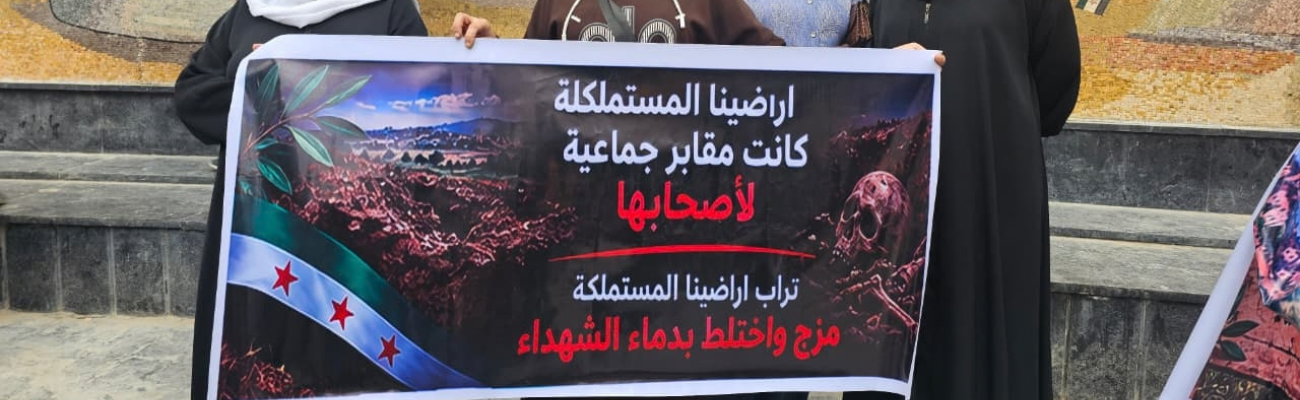
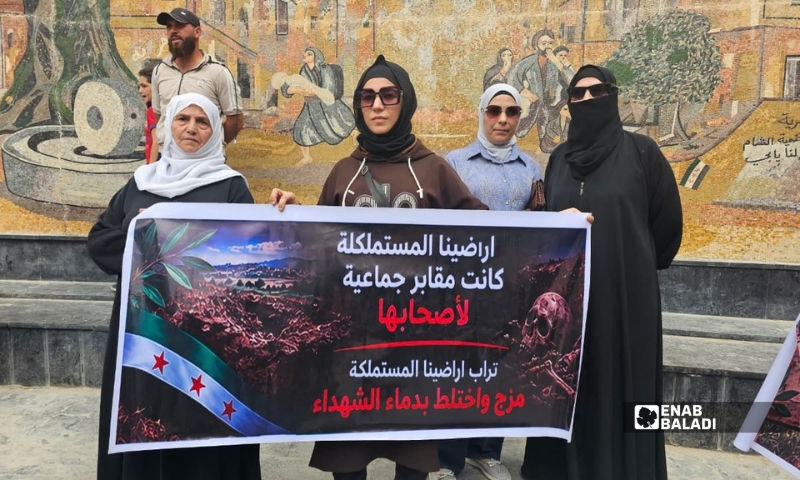
Landowners have protested in several areas, including al-Qarabis neighborhood in Homs (central Syria), where demonstrators gathered on September 28 to oppose the inclusion of expropriated land in the “Boulevard” project.
On September 26, residents of Qudsaya, Dummar, Moadamiyat al-Sham, al-Hameh, Jamraya, Jdeidet al-Wadi, al-Bajaa, and other areas in Damascus countryside and its outskirts held a protest demanding that expropriated land neither be disposed of nor used for investment projects before its owners’ rights were resolved.
Moadamiyat al-Sham also witnessed a protest demanding property rights on September 24.
Owners of expropriated land in Damascus and its countryside also gathered outside the People’s Assembly on August 28 to protest expropriation.
The issue has historical, legal, and social dimensions that Enab Baladi explores with legal professionals and landowners, examining compensation criteria, forms of compensation, and what would be required to provide redress.
Government Affirms the Legality of Expropriation
The Era Ended, but Its Effects Remain: Protests Resume
The “usurpation” of property through the force of law spans three main periods in Syrian history:
First: The nationalization period in Syria, from 1958 to 1965, during which ownership was taken entirely from the owners of industrial establishments and banks.
Second: The period of agrarian reform and land confiscation, from 1958 to 1963, when Syria experienced its most extensive legally enforced seizure of agricultural land. An estimated 1.225 million hectares were taken and redistributed under Agrarian Reform Law No. 161 of 1958 and its amendments under the now-dissolved Baath Party in 1963.
Third: The period of urban and industrial expropriation, from 1974 to 2018, during which successive governments relied on Expropriation Law No. 20 of 1983 and urban planning laws to expropriate agricultural and other land.
Legislative Decree No. 20 of 1983, the principal framework governing expropriation in Syria, grants ministries, departments, public institutions, administrative bodies, and state-sector entities the right to expropriate developed and undeveloped real estate, whether privately owned or held as a religious endowment, to implement projects serving the public benefit.
The fall of the former regime did not end the effects of legislation such as Decree No. 66 of 2012. Property records, expropriation decisions, compensation, and projects built or planned on expropriated land remained unresolved issues for the new state. This revived the question: What happens to land when the purpose for which it was expropriated no longer exists or changes, and who has a claim to it when it shifts from a public project to an investment project? That question has sparked protests in several Syrian governorates, particularly because most of the people whose land the new government has offered to Gulf investors are still alive, watching their land before them without being able to do anything.
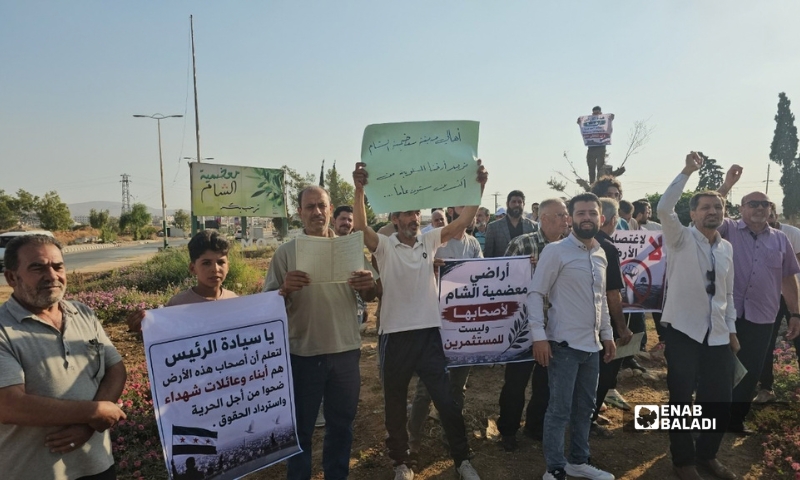
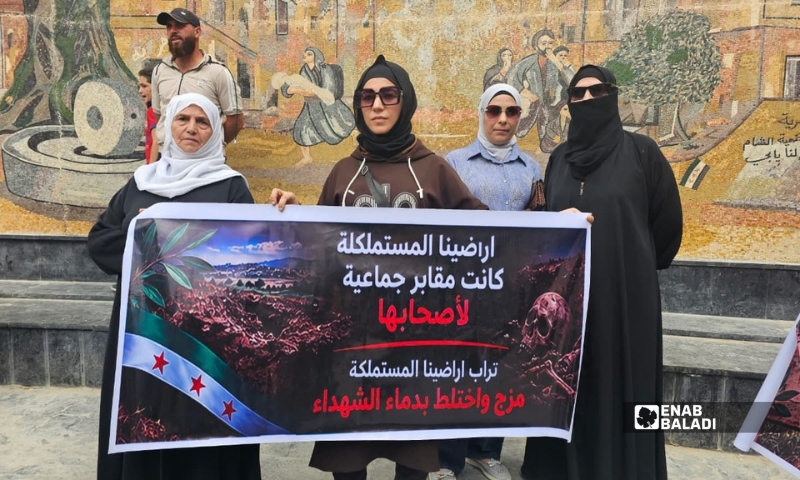
A protest against expropriation laws in Moadamiyat al-Sham, Damascus countryside, September 11, 2026 (Enab Baladi/Ahmad Maslamani)
Housing Ministry: Expropriation Is Lawful
The Syrian government has followed the protests held in parts of Damascus and its countryside against land expropriation decisions and investment projects announced in those areas.
In a statement issued on September 28, the Ministry of Public Works and Housing described expropriation as “a legal and legitimate tool used by all countries to build roads, schools, hospitals, infrastructure, cities, and housing projects.”
The ministry added that expropriation is lawful only when undertaken for public benefit, in accordance with the law, and in return for the prescribed compensation, while guaranteeing affected people the right to object and seek review.
It said objections to a particular case neither invalidate expropriation as a tool nor nullify all decisions and procedures taken under it, noting that establishing rights requires official documents and records.
The ministry described information circulating on social media about expropriation as “selective accounts that portrayed the facts as the sale of citizens’ land or the abandonment of their rights.”
It said decisions concerning expropriated land were issued decades ago, transferring ownership to public bodies, and that compensation was deposited according to established procedures. It referred to payments documented in official records and said some landowners had benefited from allocations and priority access to purchase plots or shares of floor space, while cautioning against assuming that all cases were identical.
The ministry explained that claims of an error or entitlement concerning a specific property must be resolved through documents, land registry records, and evidence of deposits, receipt of payment, and transfers of ownership.
According to the ministry, delays in implementing some projects, caused by corruption under the former regime and then years of revolution and instability, do not in themselves invalidate expropriation or automatically restore ownership, as long as the public benefit remains.
“Public Benefit” Projects
The Ministry of Public Works and Housing said the new projects were neither straightforward sales of state land, purely profit-driven investments, nor housing intended for a single group.
It explained that new urban communities qualify as “public benefit” projects, which by their nature encompass multiple types of housing, projects, services, and facilities.
These include the investment, commercial, and service components needed to create integrated urban developments and ensure the projects’ economic sustainability.
According to the ministry, the General Housing Establishment is authorized to implement projects directly or through partnerships under existing laws and regulations. The land becomes part of a partnership model that preserves the public entity’s rights and returns in exchange for the construction of housing, services, and infrastructure and the creation of jobs.
The ministry said state revenues help strengthen its ability to complete housing projects and support affordable and social housing, programs for people on low incomes, and those most in need.
It expressed respect for citizens’ right to peaceful expression and to demand their rights, while noting that stopping machinery or blocking roads does not establish a legal claim to ownership.
Housing Establishment: Tourist Housing on Expropriated Land
Tamam al-Debel, director general of the General Housing Establishment, said in press statements in late September that the master plan for the “Sham View” and “Abyat Hills” projects was drawn up in 2004 for tourist housing, recreational facilities, and hotels, rather than social housing. By contrast, the entire Qudsaya suburb was designated for social, youth, and workers’ housing. He noted that, for social housing, the establishment charges only construction costs, excluding the price of the land.
According to al-Debel, the establishment does not sell expropriated land or transfer ownership to companies. Instead, it develops the land while retaining ownership until it passes directly to the final beneficiary.
He explained that partnerships with the Sham View and Abyat Hills companies are based on valuing the land at the prevailing market price. If the land is worth $100 million and an investor contributes $300 million, the total becomes $400 million, giving the establishment a 25% share of revenues, or $250,000 for every $1 million.
Al-Debel expected the Abyat Hills project alone to generate approximately $150 million for the establishment, paid in installments according to construction progress. The money would be used to complete stalled projects, which he did not identify.
He said the establishment had turned to investment in these properties to bring in funding, complete stalled projects, generate financial returns, and launch new projects.
Throughout his discussion of protesters’ demands, whether for the return of land or compensation, al-Debel relied on Expropriation Law No. 20 of 1983 without addressing the substantial gap between the value of properties expropriated decades ago and their current value following urban expansion and rising prices per square meter.
Regarding compensation, al-Debel said expropriation in Qudsaya and the al-Dimas plain (Damascus countryside, southwestern Syria) took place under Decree No. 2076 of 1975, when the area consisted of woodland and barren steppe. He said the General Housing Establishment had distinguished itself from other ministries by granting additional compensation in kind equivalent to 10% of the expropriated area, subject to a maximum of six dunams, in the form of floor space.
He explained that applications for compensation in kind were accepted from 1997 to 2008, under the former regime. Of 3,905 applications received, 730 were processed. Applications would reopen as part of a strategy to redress grievances, al-Debel said.
Housing Ministry Declines to Answer
Enab Baladi submitted several questions to Syria’s Ministry of Public Works and Housing about the legal basis for expropriation, compensation criteria and forms, and landowners’ rights. The ministry’s media office apologized for being unable to respond at present, citing the General Housing Establishment’s involvement in several activities.
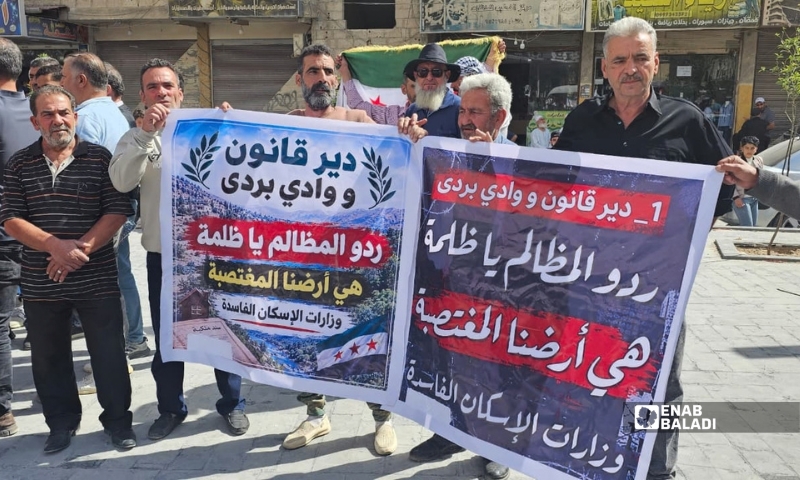
Residents of Deir Qanoun and Wadi Barada (Damascus countryside, southwestern Syria) participate in a protest against expropriation laws in Moadamiyat al-Sham, October 2, 2026 (Enab Baladi/Ahmad Maslamani)
One Pound per Square Meter: Unfair Compensation in Damascus and Its Countryside
Landowners in parts of Damascus and its countryside are demanding a review of expropriations carried out decades ago. They say the compensation they received was unfair and that expropriation continues to affect their ability to use their land, build on it, and settle there.
During a protest condemning the Expropriation Law and demanding its repeal, Enab Baladi interviewed several landowners about losing their land, the compensation they received, and the effects of expropriation on their lives over the decades.
Abu Saeed al-Boushi, from Kafr Sousa (a Damascus neighborhood), said residents did not want their land to remain subject to expropriation decrees issued under Hafez al-Assad without a resolution. Finding a solution had become necessary, he said.
He added that some land remained agricultural and that its owners continued to cultivate it despite uncertainty about its future. This had led them to grow short-cycle vegetables instead of long-lived trees, after olive trees were uprooted during earlier expropriation operations.
Abu Saeed’s land, expropriated in 1985, lies in Qanawat al-Basatin, within a cadastral area served administratively by eastern Mezzeh (Damascus).
Legal professional Mohammed Suleiman, another protester interviewed by Enab Baladi, said land expropriations began under Hafez al-Assad and were carried out arbitrarily and at gunpoint. He explained that successive decrees involved multiple bodies, including the Housing Ministry, Defense Ministry, and Damascus governorate.
Some owners cannot access their land or find out what has happened to it. Suleiman called for an independent body to resolve disputes between landowners and the state, with the aim of returning land to its owners.
Mustafa al-Akash said the General Housing Establishment expropriated residents’ land during the 1980s and, according to him, forced owners to accept compensation of one Syrian pound per square meter, or approximately 400 pounds per dunam.
He compared that compensation with land prices at the time, when a dunam in other areas cost between 25,000 and 30,000 Syrian pounds. He said the effects of expropriation went beyond losing land, preventing owners from building on it and limiting their children’s ability to settle there and own homes.
Al-Saboura: 91% of Land Under Expropriation
Discussing land in al-Saboura (Damascus countryside, southwestern Syria), Khalil al-Abdullah described the expropriation of extensive areas stretching from Yafour to Ras al-Jabal and land in Moadamiyat al-Sham and Qudsaya.
He estimated that al-Saboura’s land covered approximately 60,000 hectares, of which about 51,000 hectares, equivalent to approximately 91%, had been expropriated, leaving owners with only limited areas.
Although the relevant authorities consider the owners to have been compensated, al-Abdullah said the amounts were extremely low compared with the land’s value. The compensation they received approximately 50 years ago, he said, did not equal the value of one year’s work on the land.
Al-Abdullah said expropriation had deprived residents of the use of agricultural land that had provided work and production, leaving some areas barren.
“The compensation we received approximately 50 years ago does not equal the value of one year’s work on the land.”
Khalil al-Abdullah, a landowner affected by the Expropriation Law in al-Saboura
Ali al-Salibi, from Deir Qanoun in Wadi Barada, called for a resolution concerning land expropriated by the General Housing Establishment and for owners to receive their rights. He said large areas had been taken in exchange for granting their owners only limited areas.
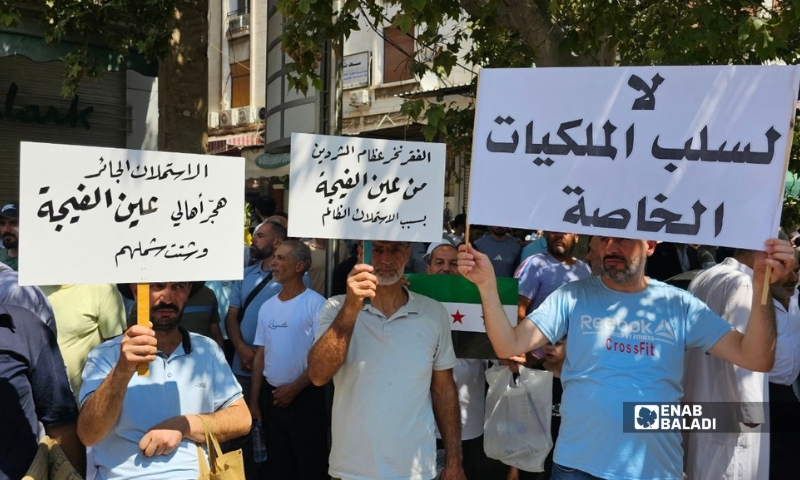
A protest against expropriation laws in Damascus, August 28, 2026 (Enab Baladi/Ahmad Maslamani)
Dummar: Owners Barred From Land That Was Never Expropriated
Landowners’ objections in Dummar (a western Damascus neighborhood) focus on properties expropriated for projects that were never implemented, as well as land whose owners say they still officially hold title but cannot access or use.
Muheeb Misto, a landowner affected by the Expropriation Law in Dummar, told Enab Baladi that his objection did not concern land expropriated for completed public benefit projects, such as hospitals and roads, provided the owners received fair compensation equivalent to the land’s value.
According to Misto, the disputed cases include land with no expropriation notation in its records and still registered in the names of its owners or their heirs, who are nevertheless barred from entering it, as well as expropriated land where the intended projects were never implemented.
Owners of some of this land encounter armed, masked individuals who prevent access. Their complaints circulate among government bodies, from the Defense Ministry to Damascus governorate and the Housing Ministry, without identifying which authority is responsible for denying them entry.
Misto described these cases as “taking possession,” saying they affected extensive areas in eastern and western Dummar.
He criticized the use of some expropriated land for real estate and commercial projects, arguing that expropriation should serve a clear public benefit, such as a hospital or road, rather than investment projects such as towers, shopping centers, and hotels.
Dummar landowners submitted complaints to several authorities without reaching a resolution, prompting them to organize protests demanding their rights. Those authorities included Dummar municipality, its city council, Damascus governorate, the People’s Assembly, the Housing Ministry, and the Presidential Palace.
Misto summarized residents’ demands as a fair expropriation law that balances the state’s interests with landowners’ rights, linking expropriation to a genuine public benefit rather than a fictitious one invoked for decades.
“Expropriation must serve a clear public benefit, rather than investment projects.”
Muheeb Misto, a landowner affected by the Expropriation Law in Dummar
Misto said compensation should be calculated according to the land’s actual value, zoning status, and construction and investment potential. He proposed independent property valuation committees instead of allowing the expropriating authority alone to determine compensation.
He said valuations should consider the land’s value, the number of floors that could be built on it, and the value of buildings in the surrounding area, ensuring compensation proportionate to the land’s worth.
Dummar Residents: The Defense Ministry Bars Us From Our Land
Hafiza Aita, a member of Dummar’s committee for expropriated land and land taken into possession, told Enab Baladi that affected owners’ main demands were to halt projects on expropriated land, restore ownership of properties where no public benefit project had been implemented, and provide fair and adequate compensation for properties where projects had been completed.
According to Aita, landowners were not offered compensation when forced expropriation began in 1980. Compensation payments only began to be deposited in banks after 2000, she said.
She described those payments as meager, saying their value remained unchanged through 2026.
Osama al-Joukhdar, spokesperson for residents of Damascus’s Dummar neighborhood, told Enab Baladi that residents’ principal demand was to halt projects on expropriated land still subject to legal disputes until its ownership and future were determined.
According to al-Joukhdar, compensation for expropriated land was set in the 1970s, but deposits in banks only began around the start of the millennium. Most neighborhood residents had not received those payments, he said.
The only cases in which landowners received compensation concerned properties near the People’s Palace that fall within the Mezzeh cadastral area.
Al-Joukhdar also said landowners had previously submitted objections and letters to the relevant authorities without receiving responses, apart from limited engagement by some members of the People’s Assembly.
He said the bodies that expropriated land in Dummar included the Housing Ministry, Damascus governorate, and the Defense Ministry.
Al-Joukhdar estimated the areas expropriated or taken into possession by different authorities as follows:
– Approximately 9,000 dunams for Damascus governorate in eastern Dummar.
– 2,000 dunams taken into possession for the Defense Ministry.
– Approximately 6,000 dunams in western Dummar taken into possession for the Defense Ministry.
– 2,000 dunams expropriated without projects being implemented, associated with the presidency and the Housing Ministry.
“The compensation is extremely low, which is why most families in the neighborhood have not received their entitlements.”
Osama al-Joukhdar, spokesperson for residents of Damascus’s Dummar neighborhood
A protest against expropriation laws in Damascus, August 28, 2026 (Enab Baladi/Ahmad Maslamani)
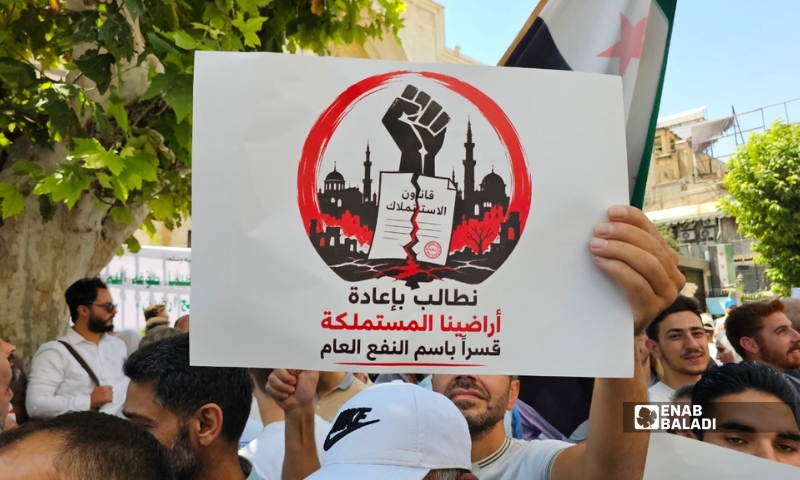
No Law Provides for Returning Expropriated Land: What Solutions Are Possible?
Syrian law contains no explicit provision allowing expropriation to be canceled or land to be automatically reclaimed by its owners when legal deadlines for achieving the purpose of expropriation expire, according to legal adviser Rajab Hassan, who reviewed the protesters’ demands.
After the government offered land in Dummar, Qudsaya, and Moadamiyat al-Sham for new investment or real estate projects instead of the original public benefit specified in the expropriation instrument, a question arose: Does this constitute an infringement and a breach of lawful expropriation that would permit the decision to be annulled administratively or judicially?
Hassan told Enab Baladi that it did constitute an infringement and a breach of lawful expropriation, and that the courts might accept this argument. He expected the government institution to argue that the alternative project also served the public benefit specified in the expropriation instrument, leaving the judiciary to make the final decision.
“The National Authority for Transitional Justice has jurisdiction over expropriation cases, and a claim can be brought against the establishment on the grounds that it transferred ownership through seizure.”
Rajab Hassan, legal expert
He cited legal precedents involving “lawsuits in which expropriation decisions were annulled,” saying the outcome depended entirely on each case’s circumstances. However, he added: “As long as no new law repeals or replaces the old provisions, previous procedures are considered consistent with the legislation and laws currently in force.”
According to the lawyer, it should be possible to challenge the constitutionality of the Expropriation Law or invoke transitional justice principles to protect the constitutionally guaranteed right to private property. He noted that there were, so far, no serious administrative indications of a government intention to annul expropriation decisions made by governments under the former regime.
Regarding compensation and differences between past and present property valuations amid varying inflation rates, Hassan said cases needed to be examined individually and that the matter depended primarily on the administration’s seriousness and willingness to find a solution.
Addressing the Syrian Housing Ministry’s statement denying further entitlements to some owners compensated in the past, Hassan said no explicit legal provision granted additional compensation to owners who had already received expropriation payments. Nevertheless, from the perspective of justice, reform, and equity, those owners had suffered harm and injustice.
Hassan identified two avenues for redress:
– Establishing administrative committees genuinely committed to providing redress.
– Turning to the courts, which take account of principles of justice and equity and draw on higher administrative court precedents.
According to Hassan, there is also no direct legal basis for halting construction while a property is officially registered in the General Housing Establishment’s name. However, he said the body with jurisdiction was the National Authority for Transitional Justice, before which a claim could be brought against the establishment on the grounds that it transferred ownership through seizure.
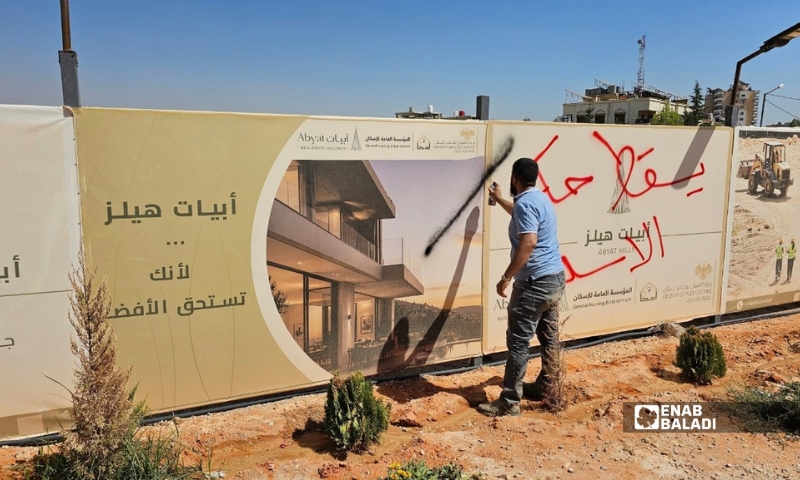
A protest against the Abyat Hills project in Qudsaya, Damascus countryside, September 26, 2026 (Enab Baladi/Ahmad Maslamani)
Administrative Court Adviser: Public Bodies May Dispose of Properties
To examine administrative law and the handling of expropriation cases before the Council of State, Syria’s independent judicial body responsible for administrative justice, Enab Baladi spoke to a lawyer and adviser with more than 30 years of experience handling expropriation cases in the administrative courts. He requested anonymity.
The adviser said no legal provision required a public administration to implement an expropriation project within a specified period. Under the law and judicial precedents, delays in implementation do not constitute grounds for lifting expropriation.
Paragraph 1 of Article 35 of the law allows public bodies that expropriated properties for public benefit to dispose of them through any form of transaction if that public benefit no longer exists. At the same time, expropriation is understood to be free of commercial purposes, meaning public bodies should not unjustly enrich themselves at owners’ expense.
The lawyer described the Syrian judiciary’s approach to expropriation cases as “timid, lacking the necessary boldness, and contrary to the principles of justice and the restoration of rights on which the blessed Syrian revolution was founded.”
The 2025 Constitutional Declaration for the transitional period maintained laws in force under the former regime, except exceptional legislation such as that governing terrorism courts and field courts. The Expropriation Law therefore remains in effect.
The lawyer said the Council of State should:
– Act more boldly as a judiciary that develops legal principles, is not confined to the literal wording of statutes, and has authority to review the legality of administrative decisions.
– Deal firmly with expropriation cases.
– Use all available means to investigate whether a public benefit exists and whether the expropriated properties are genuinely needed, rather than accepting the administration’s assertion without substantive evidence of its seriousness and the project’s actual need for the properties.
– Order expropriation lifted when expropriation decrees do not satisfy the public benefit requirement.
– Treat prolonged administrative inaction without implementing a project as evidence that it is not being pursued seriously and is not genuinely needed.
According to the lawyer, numerous earlier judicial decisions found that properties were not needed and ordered expropriation lifted because a relatively long period, more than 25 years, had passed since the expropriation decree without implementation. However, the courts subsequently departed from that precedent and became stricter about protecting expropriation decrees from challenge.
Expropriation and Transitional Justice
The administrative court adviser believes transitional justice does not apply to properties expropriated in accordance with existing law.
Under the previous Supreme Constitutional Court Law, No. 7 of 2014, the constitutionality of laws, including the Expropriation Law, could be challenged by raising the issue before courts, which would refer it to the Supreme Constitutional Court. However, no new law governing the Supreme Constitutional Court has yet been issued.
The lawyer said that where land had been taken into possession without an expropriation decree, seizure decision, or martial-law order, and without being subject to the Agrarian Reform Law, interested parties could bring an appropriate action to recover it. Depending on the circumstances, this could involve recovery of possession, an action to prevent interference with property rights, or eviction of an unlawful occupier.
Compensation faces the obstacle of paragraph 3 of Article 25 of the Expropriation Law, which requires, only in cases of delayed deposit of compensation, interest equivalent to 6% of its value. For properties taken into possession, the rate rises to 8% after five years from the date possession was taken.
Article 33 of the same law also provides that owners’ right to collect expropriation compensation becomes time-barred if 15 years pass without their receiving payment for the land.
After the initial land valuation and review by the reconsideration committee, no legal provision allows those entitled to compensation to have the value reassessed. The lawyer added that, where legal grounds exist, such as the absence of a “public benefit,” an owner’s receipt of payment does not prevent a claim for the land’s return. However, an action cannot be brought to halt work on expropriated land.
The People’s Assembly and Council of State: Addressing Expropriation
The administrative court adviser said Syria’s People’s Assembly should address expropriation by ending injustice and providing reparations, “in accordance with the principles of the blessed revolution, whose flame was kindled, blood was shed, and millions of lives were sacrificed for its success solely to uphold rights, end injustice, and support the oppressed,” as he put it.
He called on the Council of State to free itself from the fear that prevailed under the former regime and fulfill its role as a guardian of justice and overseer of legality.
He also urged it to develop its jurisprudence to end injustice and support those wronged by investigating whether a public benefit genuinely exists and whether the expropriated property is seriously needed, and by lifting expropriations where a long period has elapsed without implementation of a public benefit project or where the purpose was commercial.
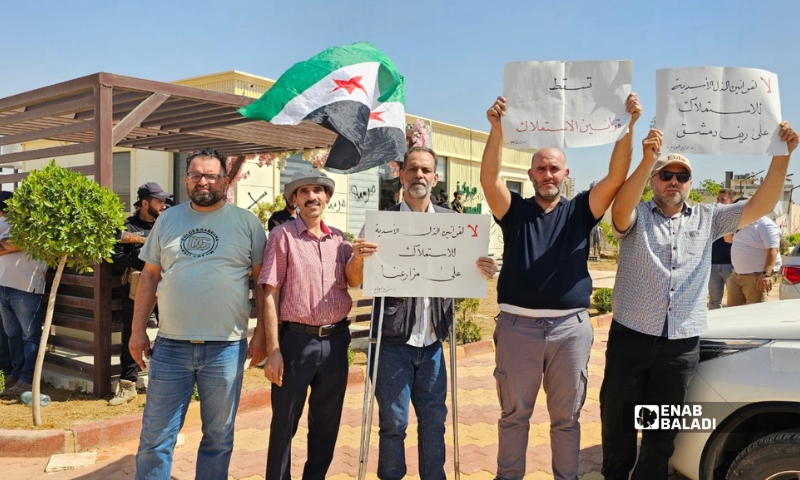
A protest against the Abyat Hills project in Qudsaya, Damascus countryside, September 26, 2026 (Enab Baladi/Ahmad Maslamani)
if you think the article contain wrong information or you have additional details Send Correction
النسخة العربية من المقال
-
Follow us :






 More In-Depth
 Most viewed
- Syria Arrests Mihrac Ural, Suspect in Baniyas Massacre
- Damascus, Moscow Work on Final Deal for Russian Bases
- Death and Prison Sentences Issued Over Syria Coast Violence
- Syria's Energy Ministry Explains Contaminated Gasoline Crisis, Vows Accountability
- Online Harassment and Blackmail in Syria: Fear of Stigma and Seeking Protection