A Syrian government plan to convert Mezzeh Military Airport in Damascus into a private aviation hub has raised widespread concern among rights groups and local residents as redevelopment work begins in September 2026. They warned that the project could disturb suspected mass graves in the area, destroy forensic evidence needed to identify victims, and disregard ownership rights over extensive areas of land.
The rights and public campaign coincides with an announcement by the Civil Aviation Authority, in a report published by the official Syrian Arab News Agency, SANA, that preparations are underway to reclassify Mezzeh Military Airport for use as a limited civilian facility focused on private and executive aviation, as a step intended to complement Damascus International Airport.
The official report said debris removal and infrastructure modernization work had already begun at the site.
The announcement that the airport would be rehabilitated and developed into a private civilian facility has also brought the issue of state expropriated land back to the forefront, triggering a new wave of rights based and community demands.

Dozens of residents from areas in Rural Damascus, including Muadamiyat al-Sham, al-Sabboura, Qudsaya, and the Kiwan area, gather to demand the repeal of expropriation laws and resolution of the status of land previously confiscated from them, September 11, 2026. (Enab Baladi/Ahmad Maslamani)
The project has also emerged as a test of how the Syrian government will balance efforts to attract investment and redevelop state assets against two unresolved legacies, the fate of tens of thousands of missing Syrians and property rights affected by decades of confiscation.
Leaked Documents Reveal Airport’s Role as Mass Execution Site
Reuters revealed new documents on Saturday, September 12, showing the airport’s central role as a site for carrying out executions under the former regime. Mezzeh Airbase housed major branches of the Air Force Intelligence Directorate as well as several secret detention centers where government opponents were subjected to systematic torture, execution, and enforced disappearance. Other parts of the base were used for presidential flights and official missions.
According to Reuters, the documents indicate that senior Syrian military officials approved the use of the Mezzeh area in 2012 as a main site for carrying out death sentences issued against detainees by field military courts.
One document outlined a proposal to move executions from Saydnaya Prison, regarded as the country’s most notorious prison, to the Mezzeh base because it was a heavily fortified, “closed security complex” near Damascus.
Later correspondence discussed using a “firing range,” followed by an “aircraft hangar” next to the airport runway, as possible locations for carrying out the executions.
Based on these findings, a human rights letter reviewed by Reuters called on the Syrian government to immediately halt all construction and excavation until the two sites are investigated. The letter warned that ongoing digging and debris removal could damage buried human remains and destroy crucial forensic evidence needed to identify victims.
Public Protests Demand Repeal of Expropriation Laws
Against this backdrop, dozens of residents from Muadamiyat al-Sham, al-Sabboura, Qudsaya, the Kiwan area, and other areas around Damascus gathered to demand the repeal of expropriation laws they consider unjust and a resolution to the status of land confiscated by successive Syrian governments.

Dozens of residents from areas in Rural Damascus, including Muadamiyat al-Sham, al-Sabboura, Qudsaya, and the Kiwan area, gather to demand the repeal of expropriation laws and resolution of the status of land previously confiscated from them, September 11, 2026. (Enab Baladi/Ahmad Maslamani)
Enab Baladi documented residents demanding the restoration of their property rights in a video recording on September 11.
The property dispute stretches back decades. Over previous decades, Syrian authorities routinely confiscated privately owned land for government and military projects, often without providing fair compensation to those affected.

Dozens of residents from areas in Rural Damascus, including Muadamiyat al-Sham, al-Sabboura, Qudsaya, and the Kiwan area, gather to demand the repeal of expropriation laws and resolution of the status of land previously confiscated from them, September 11, 2026. (Enab Baladi/Ahmad Maslamani)
Land Without Compensation, Airport’s Contested History
Land records issued by the municipality of Muadamiyat al-Sham, in Rural Damascus, indicate that Mezzeh Airport was originally built on land belonging to hundreds of citizens, covering an estimated 2.76 square kilometers, or 1.1 square miles.
A former municipal official, who asked not to be identified, told Reuters that the government at the time justified its control of the land by issuing retroactive expropriation decrees when the airport was built in 1956. The official said financial compensation has still not been paid to the land’s original owners.

Dozens of residents from areas in Rural Damascus, including Muadamiyat al-Sham, al-Sabboura, Qudsaya, and the Kiwan area, gather to demand the repeal of expropriation laws and resolution of the status of land previously confiscated from them, September 11, 2026. (Enab Baladi/Ahmad Maslamani)
One organizer of the public protests stressed residents’ ownership rights, saying that “sitting at the negotiating table to discuss shares and compensation should be done directly with the new investors, not with the current government, since residents possess documents proving their legitimate right to this land.”
International Pressure and UN Calls for Accountability
The escalating dispute comes as Syria faces growing pressure and calls to address property seizures and land rights violations carried out over past decades.
United Nations experts on land rights issued an urgent appeal on September 2 calling on the Syrian government to suspend and repeal laws that had enabled authorities to systematically seize property.
The UN experts also called for clear national mechanisms to return properties to their legitimate owners or provide fair and adequate financial compensation to those affected.
Vague Pledges Without Guarantees
SANA, meanwhile, quoted a Civil Aviation Authority spokesperson as saying that the renovation of Mezzeh Airport would take into account the nature of the surrounding urban area as well as related legal and social issues.
However, official reports did not specifically mention the suspected mass graves or the disputed land rights. The identity of the investor or companies that will formally undertake the airport redevelopment project also remains unclear.
Mezzeh Military Airport is the closest airport to Damascus, located less than eight kilometers from the city center and about one kilometer from the beginning of its western neighborhoods. It has been struck by Israel several times, including one strike just days after the fall of the former regime.


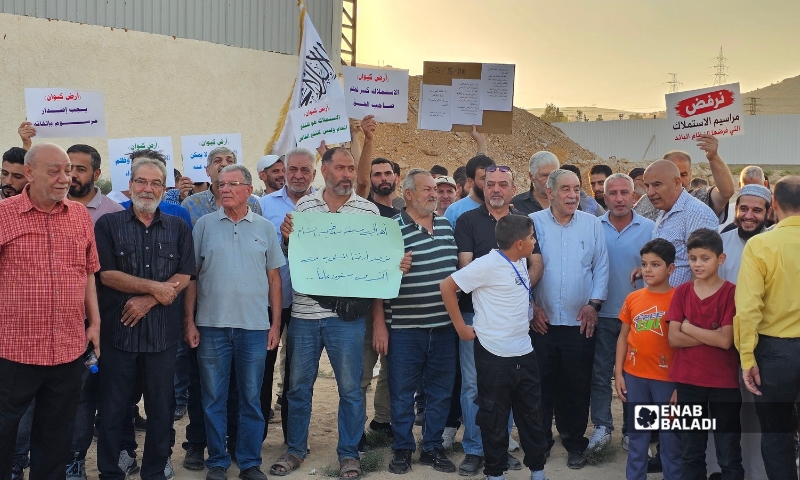
 Dozens of residents from areas in Rural Damascus, including Muadamiyat al-Sham, al-Sabboura, Qudsaya, and the Kiwan area, gather to demand the repeal of expropriation laws and resolution of the status of land previously confiscated from them, September 11, 2026. (Enab Baladi/Ahmad Maslamani)


 A
A
A
A
A
A


 More HLP