


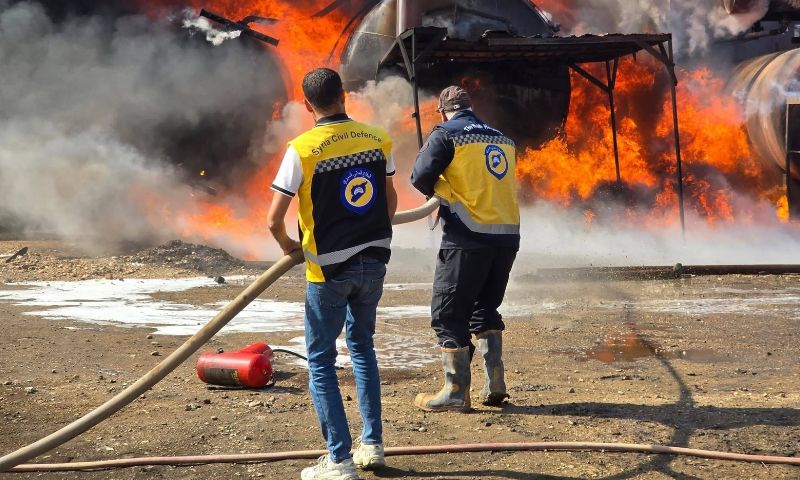
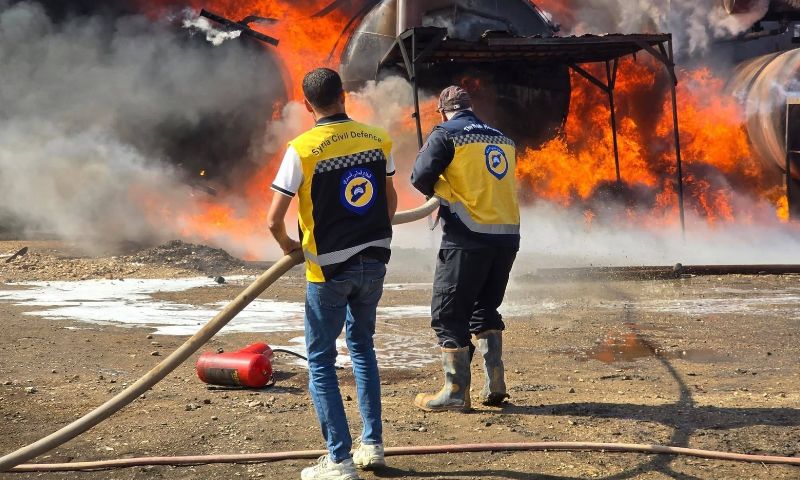
 Civil Defense teams work to extinguish a fire at the al-Jabsa oil fields facility in al-Hasakah countryside, October 21, 2026 (al-Hasakah Emergency Directorate).
A fire broke out at a refinery within the al-Jabsa oil fields facility, east of al-Shaddadi in the southern countryside of al-Hasakah (northeastern Syria), on Wednesday, October 21. Syrian Civil Defense teams extinguished the blaze, with no civilian injuries reported, according to the governorate’s Emergency and Disaster Management Directorate.
The directorate said in a statement that Civil Defense teams responded to a report of a fire at one of the refineries in the al-Jabsa oil fields, explaining that the blaze was caused by a leak of flammable materials following a power outage.
It added that the teams headed to the site immediately after receiving the report and managed to bring the fire under control and extinguish it, with no civilian injuries reported.
Residents of the area told Enab Baladi that the fire affected a refinery near the gas plant belonging to the al-Jabsa facility. No further information was available about the extent of the material damage or whether operations at the facility had been affected.
The fire came days after the Syrian Petroleum Company began repairing a gas export pipeline from the al-Jabsa plant in the al-Arabidi area of al-Hasakah countryside, following an explosion on the evening of Thursday, October 15, that caused the pipeline to catch fire.
On Saturday, October 17, the Syrian Petroleum Company said its teams had begun maintenance work alongside Civil Defense crews after completing the necessary procedures to address the damage caused by the explosion, which occurred approximately 60 kilometers from al-Shaddadi.
Oil and gas pipelines and energy facilities across Syria have experienced a series of incidents since August, causing technical damage and fires. In some cases, these incidents have led to the suspension of gas pumping and disrupted supplies to power generation plants.
The al-Jabsa gas pipeline was hit by an explosion on August 18, forcing gas pumping through the pipeline to stop. According to the Syrian Petroleum Company at the time, preliminary investigation findings suggested that the explosion had resulted from an “act of deliberate sabotage.”
Following the incident, the wells were isolated, safety valves were closed, and repair teams began addressing the damage. The following day, the company announced that the pipeline had been repaired and returned to service, explaining that it supplies the gas needed to operate power generation plants.
On September 28, the gas pipeline extending between the al-Shoula area and the city of Deir Ezzor was targeted in an act of sabotage that caused one of its sectional valves to explode and a fire to break out, forcing gas pumping through the pipeline to stop.
Technical teams began repairing the damage and replacing an affected section measuring 18 meters in length and 16 inches in diameter, before completing work to restore the pipeline to service.
On September 30, an explosion occurred in a gas pipeline at the Tishreen Thermal Power Plant in eastern Ghouta, Damascus countryside. The resulting fire caused the Deir Ali, al-Nasiriya, and Tishreen power generation plants to go completely out of service, according to the Syrian Electricity Company at the time.
The interruption of gas supplies needed to operate the plants reduced available electricity generation capacity, amid expectations of a temporary increase in electricity rationing hours.
On October 7, an oil pipeline near Tel Hamis in al-Hasakah countryside was targeted in an attack that the Syrian Petroleum Company described as “sabotage.” The incident damaged the pipeline and prompted maintenance and emergency teams to isolate the affected section and carry out repairs.
The company said at the time that the relevant authorities had identified and arrested those responsible for the attack, without disclosing their number or identities. It added that the suspects had been handed over to the competent authorities to complete legal procedures and refer them to the judiciary.
On October 15, an explosion occurred in a gas export pipeline in the al-Arabidi area of al-Hasakah countryside, coinciding with a gasoline leak from a petroleum products pipeline extending between Baniyas and Homs, near the village of Hadida in western Homs countryside.
The Syrian Petroleum Company announced that it had contained the leak in the Baniyas-Homs pipeline after closing the valves, isolating the damaged section, and reducing pressure by directing the petroleum product back to a designated point and draining it into tanker trucks. These measures brought the leak under control on the evening of Friday, October 16, and allowed a temporary repair to the pipeline.
The company explained that the Baniyas-Homs incident resulted from an act of sabotage intended to facilitate theft, while it did not identify the cause of the latest explosion in the al-Jabsa gas pipeline.
These incidents highlight the importance of oil and gas pipelines in meeting energy needs, particularly because some gas pipelines supply power generation plants. Repeated damage requires isolation procedures, maintenance, and precautionary measures to reduce risks to workers and residents living near energy facilities.
Jabsa Gas Pipeline Blast Marks Sixth Energy Incident in Syria
if you think the article contain wrong information or you have additional details Send Correction


 A
A
A





 More Economic Reports