


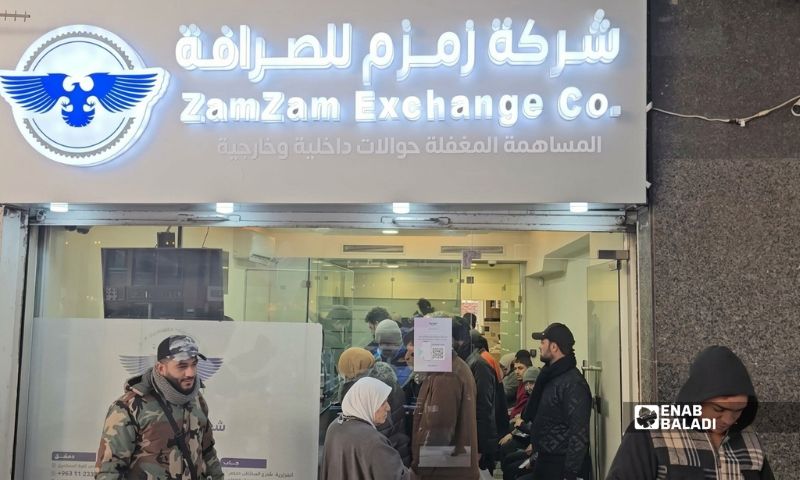
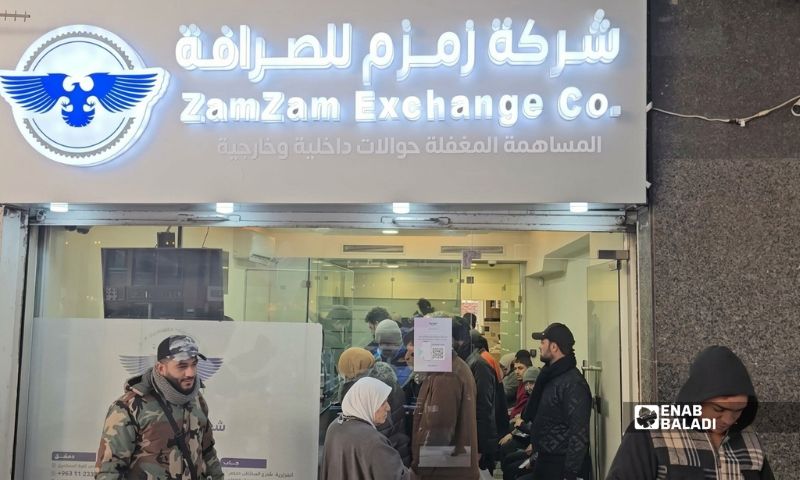
 Customers at a currency exchange company in Damascus, February 5, 2026 (Enab Baladi / Ahmed Muslimani).
Customers at a currency exchange company in Damascus, February 5, 2026 (Enab Baladi / Ahmed Muslimani).
The Syrian pound has depreciated against the US dollar since Syria’s Ministry of Finance announced on August 31 that the state budget had recorded a deficit in the first half of 2026, with government spending exceeding revenues by approximately $1 billion.
On Wednesday, October 14, the dollar’s exchange rate on the parallel market stood at around 139 Syrian pounds for buying and 140 for selling, marking a slight improvement in the pound’s value of just one Syrian pound compared with the previous day. The currency remains under growing pressure amid rising fuel prices and a widening gap between official and parallel market exchange rates.
The latest depreciation has also raised questions about the ability of fiscal and monetary policies to ease pressure on the pound, as banks continue to impose withdrawal restrictions and economic activity faces difficulties in accessing financing and foreign currency.
While banking economist and academic Dr. Mahmoud Abdul Karim attributes the latest decline to rising fuel costs and their impact on price expectations, monetary and banking policy expert Mukhlis al-Nazer, former first deputy governor of the Central Bank of Syria, argues that the problem extends beyond the amount of Syrian currency in circulation to include:
The dollar rose on the parallel market from approximately 132 Syrian pounds in September to nearly 140 in October, while the Central Bank of Syria maintained its official exchange rate at 121.50 pounds for buying and 122.50 for selling.
This divergence widened the gap between the two rates to nearly 15%. According to Abdul Karim, this means that people selling dollars at the official rate receive less than they would on the parallel market, encouraging traders and other market participants to avoid official banking channels and limiting foreign currency inflows into those channels.
Speaking to Enab Baladi, Abdul Karim linked the beginning of the latest increase in the dollar’s value to decisions to raise fuel prices, particularly the September 13 pricing bulletin, which increased diesel prices by approximately 40% and gasoline prices by between 26% and 28%.
In his assessment, the primary effect of these decisions was not an increase in actual demand for dollars to import fuel. Rather, higher fuel prices translated into increased costs for production, transportation, agriculture, and the operation of generators and bakeries, all of which contribute to the prices of a wide range of goods and services.
According to Abdul Karim, the main ways in which fuel price increases affect the exchange rate can be summarized as follows:
The market is also becoming increasingly sensitive to global oil prices because Syria relies on imports to meet part of its petroleum needs. As import costs rise, public finances and consumers face additional pressure, whether through higher spending on imports or the transmission of these costs to fuel and commodity prices.
Finance Ministry data showed that public revenues reached approximately $2.7 billion in the first half of 2026, compared with expenditures of $3.7 billion, resulting in a deficit of nearly $1 billion.
Abdul Karim believes the deficit puts pressure on confidence in the Syrian pound but does not necessarily mean the government has injected additional quantities of local currency into the market. The monetary impact of the deficit depends on how the government finances its spending, whether through short-term financing instruments or direct borrowing from the Central Bank.
Syrian Finance Minister Mohammed Yisr Barnieh stated in late August that the ministry relies on short-term financing without borrowing from the Central Bank or injecting additional cash liquidity into the market.
On that basis, Abdul Karim sees insufficient evidence that the deficit has so far led to a substantial increase in the money supply. However, he warns that the method used to finance it will remain an important factor in determining the direction of the exchange rate.
According to this assessment, the deficit’s impact on the pound depends on three main factors:
Abdul Karim estimates that the dollar’s current exchange rate does not appear excessive given existing economic pressures. Instead, he considers it consistent with the pound’s depreciation, rising fuel costs, and inflation expectations.
He outlines three possible scenarios for the exchange rate in the coming period:
Central Bank intervention through dollar sales could temporarily lower the exchange rate, Abdul Karim said. However, he believes a sustained decline would require actual foreign currency inflows, increased oil production, or lower fuel prices.
In a LinkedIn post on October 12, Dr. Mokhles al-Nazer argued that restricting bank withdrawals does not necessarily reduce demand for dollars and may instead increase it. He maintained that the decisive factor is not merely the amount of Syrian currency in circulation, but people’s confidence in the currency, their ability to use it, and their access to savings.
Al-Nazer explained that economic theory assumes a reduction in local currency liquidity could reduce demand for foreign currencies if other factors remain unchanged.
However, this assumption does not necessarily apply to Syria, where withdrawal restrictions coincide with concerns about the value of savings, difficulties in commercial activity, and a limited supply of foreign currency.
According to al-Nazer, citizens or traders who cannot freely withdraw their money may interpret these restrictions as evidence of a monetary problem. When they obtain part of their funds in Syrian pounds, they may rush to convert them into dollars or gold rather than retaining the pounds or depositing them in banks.
Al-Nazer identified four main sources of demand for dollars under current conditions:
According to al-Nazer, the problem is not limited to demand. The weak supply of dollars is also a fundamental factor behind the currency’s rising exchange rate. In a market with limited supply, even a modest increase in demand can move the exchange rate, despite a shortage of Syrian pound liquidity.
He also warned that increasing burdens on formal economic activities could weaken production and investment rather than stimulate capital circulation and expand employment opportunities.
Al-Nazer, the former deputy governor of the Central Bank, believes addressing pressure on the Syrian pound requires more than reducing the amount of money in circulation. Instead, the process should begin by restoring confidence in the banking system and improving the economy’s ability to generate foreign currency.
He proposed four main measures:
While the assessments presented by Abdul Karim and al-Nazer do not suggest that restricting liquidity alone is sufficient to stabilize the pound, both experts place confidence in the local currency, access to dollars, and the stimulation of productive economic activity at the center of efforts to address the crisis, rather than simply reducing the funds available to citizens and traders.
if you think the article contain wrong information or you have additional details Send Correction


 A
A
A
A
A
A







 More Economic Reports