


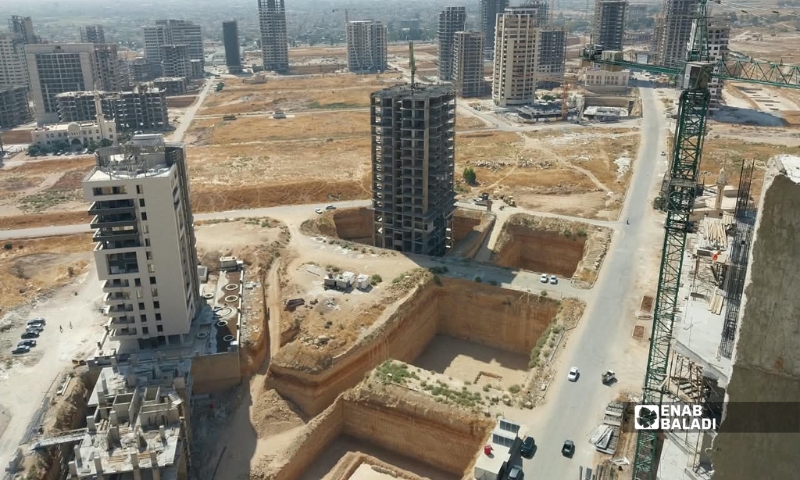
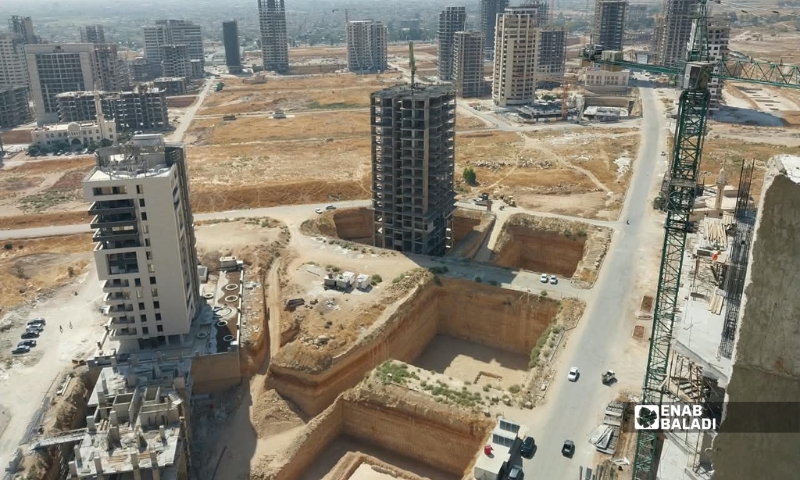
 The Marota City project introduces isolated glass buildings and towers that disrupt Damascus's traditional skyline and create a stark contrast with neighboring residential areas, April 6, 2026 (Enab Baladi).


 A
A
A
Damascus real estate investment is gaining renewed attention following the fall of the former Syrian regime in late 2024, as the capital prepares for major reconstruction projects. The developments raise questions about preserving the city’s historic architecture and identity after years of war and decades of neglect, during which informal settlements expanded across its outskirts.
Today, Damascus is awaiting a series of investment projects covering its center, expanding urban areas, and nearby countryside. These developments raise questions about the city’s ability to accommodate modern buildings and projects without compromising its historic fabric and identity. Damascus has already experienced distortions to its architectural character, some of which appear to have been deliberate, resulting in the loss of part of its cultural, artistic, and aesthetic value.
The new projects present challenges in integrating contemporary architecture into the existing urban fabric and identifying areas capable of accommodating towers and large-scale developments while preserving the city’s skyline and ensuring that its major landmarks remain visible.
These questions arise amid growing announcements about the launch of reconstruction projects and developments incorporating modern technologies, designs, and architectural features.
Amjad Farakh, director of the Old Damascus Directorate, told Enab Baladi that the Damascus Governorate’s vision is based on the principle that reconstruction should not merely replace damaged buildings or increase the volume of construction. Rather, it should provide an opportunity to reorganize the city’s growth while preserving its historical and architectural character.
Damascus, which specialists describe as the world’s oldest continuously inhabited capital, contains a historic old city designated a UNESCO World Heritage Site in 1979. The area is home to most of the city’s historical landmarks, some dating back to the Hellenistic period, an era of ancient history characterized by the spread and influence of Greek culture.
Farakh said reconstruction must distinguish between areas of high historical and architectural sensitivity, transitional areas, and zones designated for modern urban development. Planning approaches, construction regulations, and investment controls should therefore vary according to the characteristics of each area.
He explained that the ultimate goal is to develop a city capable of meeting its economic, residential, and service needs without losing its character and identity or severing its historical continuity.
Farakh added that Damascus already has urban master plans and regulations governing construction and investment in its different districts. However, the next phase requires developing these tools within a broader vision that treats the city as a collection of areas with distinct characteristics and architectural values, rather than evaluating each property or project in isolation.
Farakh’s explanations concern heritage areas and do not address the surroundings covered by Damascus’s master plan. These include an area known as the “green belt,” encompassing Eastern and Western Ghouta, where construction is completely prohibited under the Écochard urban plan.
In 1936, French architects Michel Écochard and René Danger developed Damascus’s first urban master plan. Reflecting the urban planning principles of the time, it featured a network of main roads connecting geometrically shaped squares, alongside secondary roads. Architect Mazhar Sharbaji previously told Enab Baladi that this was a transitional period in Damascus’s urban development.
According to Sharbaji, the city’s outskirts have become pollution hotspots because of industrial facilities and factories, as well as sewage and chemical pollutants discharged from them, posing a threat to Damascus.
Farakh said priority in heritage areas should be given to preservation, maintenance, and rehabilitation. Areas of particular visual sensitivity, especially those connected to the historic city or its major landmarks, require special regulations. Other districts, meanwhile, can accommodate higher building densities and more modern architectural styles.
He emphasized the importance of linking these classifications to a comprehensive urban database and a strategic plan identifying areas requiring protection, those in need of rehabilitation, and locations capable of accommodating intensive urban development.
Over recent decades, Damascus’s architectural identity has been undermined by unplanned construction patterns. The Old City has been affected by high-rise structures such as the 29-story Damascus Tower and the Yalbugha Complex, while multi-storey residential buildings have also altered the city’s skyline.
Farakh said Damascus Governorate currently applies a set of criteria when approving reconstruction projects and new developments in historic areas.
He explained that projects in these areas cannot be assessed solely on their size, number of floors, or investment feasibility. They must also consider their impact on architectural and heritage values.
The main criteria include the location’s characteristics, the historical value of the building or surrounding area, the project’s relationship with the existing urban fabric, building height, size and massing, construction materials, and visual impact. The analysis also considers traffic movement, infrastructure capacity, and the proposed use of the development.
Farakh believes that cultural, heritage, tourism, and traditional crafts investments, alongside the adaptive reuse of historic buildings, can generate long-term value for Damascus that exceeds the benefits of conventional real estate investment.
He added that protecting Damascus’s identity does not necessarily obstruct investment. Instead, the city’s heritage could become one of its economic and competitive assets in the future, provided it is managed through a vision that balances heritage protection with residential, economic, and service needs.
Khaled al-Ayoub, a specialist with a doctorate in architectural engineering and urban planning, said Damascus faces the challenge of balancing modernization and population growth with the preservation of its architectural and historical fabric.
Speaking to Enab Baladi, al-Ayoub identified real estate speculation as one of the most significant challenges facing modern construction regulations. Rising land values, he explained, encourage indiscriminate demolition or the gradual alteration of traditional buildings in favor of concrete and commercial developments that promise quick profits.
High-rise buildings can coexist with Damascus, provided they are restricted to specific new expansion corridors and separated from the historic center by designated visual protection zones.
Al-Ayoub explained that this requires studying sightlines and prohibiting skyscrapers from being constructed behind major landmarks, such as the Umayyad Mosque or Mount Qasioun, to preserve their natural and historical backdrops. Modern buildings should also be subject to carefully calculated height limits that protect the city’s historic skyline, prevent landmarks from being obscured, and maintain a human scale at street level.
Farakh, meanwhile, said building height is an integral part of the urban landscape. Future assessments of building heights must therefore take into account visual corridors and sightlines, along with visual impact studies, particularly around historic sites, major landmarks, and areas of significant architectural value.
This means that a building height considered acceptable in one location may be inappropriate in another, even at the same distance from a landmark. Decisions must depend on the nature of the landscape, topography, sightlines, and architectural value of each location.
Farakh added that high-rise buildings should not be adopted as a uniform development model across Damascus. At the same time, preserving the city’s architectural identity does not mean completely preventing vertical development.
According to Farakh, the priority is to identify areas capable of accommodating greater building densities and heights based on the capacity of their roads, infrastructure, transportation networks, and services. At the same time, protected areas, buffer zones, and visual corridors should be designated, with clear restrictions imposed on building heights.
Preserving historic buildings does not mean excluding them from economic activity or preventing investment in them. They can contribute to the city’s economy in ways compatible with their architectural characteristics. Urban expansion, meanwhile, requires identifying areas outside the city center that can accommodate major development projects.
The expansion of Damascus real estate investment has intensified debate over how modern urban development can coexist with the city’s historic character.
Damascus and its surroundings have seen several urban redevelopment projects approved under special legislation. Among the most prominent are Marota City and Basilia City, alongside redevelopment plans for the industrial district of Qaboun and the Jobar neighborhood, as well as high-rise and real estate investment projects in other parts of the city.
Al-Ayoub believes that Marota City introduces isolated glass structures and towers that disrupt Damascus’s traditional skyline. The project creates a sharp contrast with neighboring residential areas in terms of building density and their social and economic character.
Basilia City, meanwhile, is designed to replace the area’s former agricultural land and informal settlements with an extensive grid-based urban layout and major arterial roads. Although the project offers an opportunity to ease pressure on the city, it also threatens to isolate the traditional rural Damascene identity of the southern districts.
In the planned redevelopment of industrial Qaboun and Jobar, the character of the city’s entrances is being transformed through the replacement of workshops and traditional craft-based neighborhoods with towers and modern real estate investments. These changes also risk severing the historical connection between Damascus and the orchards of Eastern Ghouta.
High-rise and commercial expansion projects in areas such as the surroundings of Baramkeh and Kafr Sousa raise additional concerns about infrastructure capacity and severe traffic congestion. They also create direct visual competition with major historical and urban landmarks, including the Takiyya al-Sulaymaniyya complex, Damascus University, and Mount Qasioun.
if you think the article contain wrong information or you have additional details Send Correction





 More HLP