


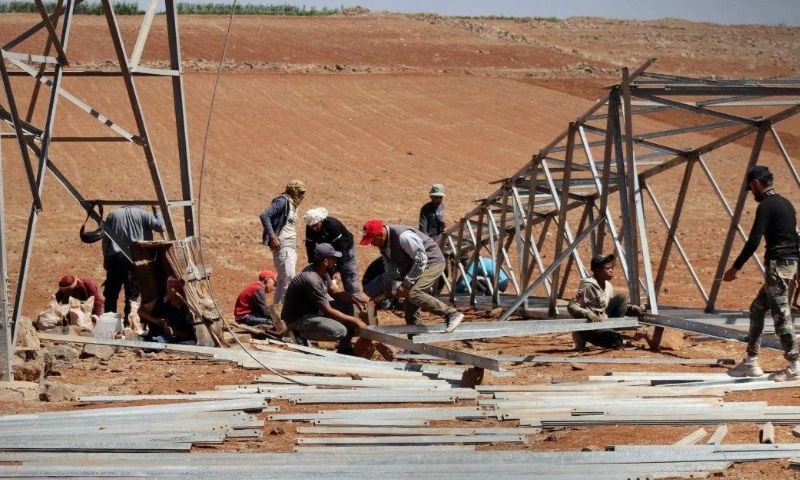
 Repair work on the 230-kilovolt Ghazalat al-Kom high-voltage transmission line supplying Suwayda governorate, September 20, 2025 (SANA).
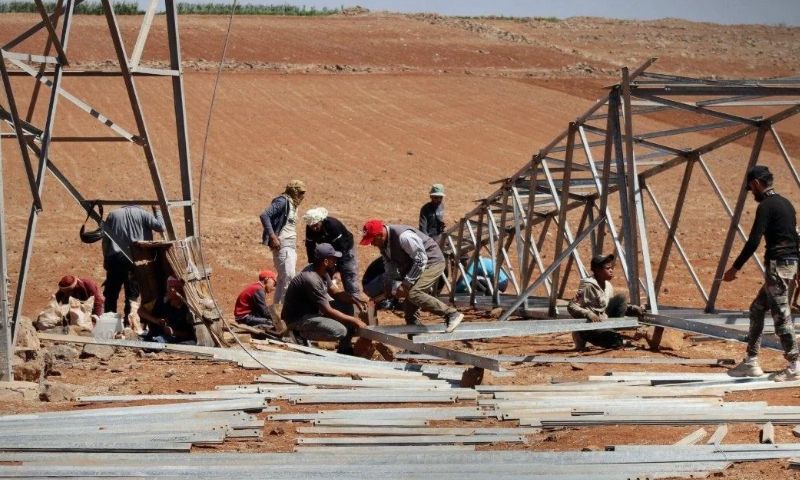
Repair work on the 230-kilovolt Ghazalat al-Kom high-voltage transmission line supplying Suwayda governorate, September 20, 2025 (SANA).
Turkish discussions on establishing an electricity transmission line connecting Turkey, Saudi Arabia, Jordan, and Syria have opened the door to a potential regional role for Syria in electricity transmission, along with possible financial revenues and opportunities to purchase electricity.
However, these ambitions face a major obstacle: Syria’s damaged electricity grid, which, according to technical assessments, cannot be synchronously interconnected with neighboring countries’ grids until it is rehabilitated.
Turkish Minister of Energy and Natural Resources Alparslan Bayraktar announced that his country is holding discussions on a project to establish an electricity interconnection and transmission line linking Turkey, Saudi Arabia, Jordan, and Syria, with the aim of strengthening regional cooperation and addressing uncertainty in global energy markets.
While Syria’s geographical location could allow it to become an electricity transit corridor between Turkey, Jordan, and the Gulf countries, the technical condition of its grid raises questions about its ability to fulfill this role and the options available before transmission lines are repaired and the electricity system is rehabilitated.
Electrical and energy engineering consultant Nidal Qarmousha told Enab Baladi that Syria’s electricity grid is currently unprepared to transmit electricity between countries, such as from Jordan to Turkey, because of extensive damage sustained by 400-kilovolt high-voltage transmission lines during the years of war.
Qarmousha explained that the damage included the destruction of transmission towers and the removal and theft of overhead conductors, noting that repairing them would require substantial investment and funding.
According to Qarmousha, the problem extends beyond damaged transmission lines. Syria’s electricity system also suffers from frequent technical failures and a generation deficit that prevents it from meeting domestic demand, alongside prolonged power rationing.
He added that these conditions prevent Syria’s electricity system from being synchronously interconnected with neighboring grids, as technical disturbances in the domestic network could spread to interconnected systems and affect their stability, a phenomenon he described as “electrical pollution.”
Qarmousha explained that synchronous interconnection means operating interconnected electricity grids at the same frequency, making it possible for a major disturbance in one grid to affect the others.
Despite Syria’s grid being unprepared for full integration with neighboring networks, temporary technical solutions could allow electricity to be transmitted through Syrian territory or imported electricity to supply specific areas, according to Qarmousha.
Qarmousha said the first option involves direct power injection, whereby electricity could be transmitted between Turkey and Jordan, for example, through lines crossing Syrian territory without synchronously connecting Syria’s domestic grid to those of the two countries.
If Syria wanted to purchase and import electricity from a neighboring country, such as Jordan, it could instead adopt a system known as electrical islanding.
Qarmousha explained that this system involves isolating the Syrian area designated to receive electricity from the national grid, creating a separate “electrical island” supplied by imported power. This would prevent disturbances elsewhere in the domestic grid from affecting the isolated area or being transmitted to the supplying country’s network.
These solutions would allow Syria to benefit partially from the interconnection project before its grid rehabilitation is completed, but they would not constitute full integration into the regional electricity system.
According to Qarmousha, expanding the project to include Saudi Arabia would require connecting Jordan’s electricity grid to the northern section of the Saudi grid.
If Syria’s transmission lines are repaired and rehabilitated, the country could play a role in transmitting electricity from Turkey to Jordan and the Gulf countries, and in the opposite direction, taking advantage of its geographical location between the countries involved in the project.
However, achieving this remains dependent on repairing high-voltage transmission lines, ensuring domestic grid stability, and securing the investment needed to rehabilitate the infrastructure.
This raises the question of how Syria could benefit from the interconnection.
The energy engineering consultant explained that Syria could benefit economically from the project in two ways. The first would be collecting transit fees for electricity passing through its territory if its transmission lines became part of the regional transmission network.
The second would be purchasing surplus electricity from neighboring countries, particularly when imported power is cheaper than domestic generation.
According to Qarmousha, Syria’s ability to benefit from this option depends on whether the Ministry of Energy or the General Electricity Company has sufficient financial liquidity, as well as the domestic grid’s technical capacity to receive and distribute imported electricity.
Syria previously participated in regional electricity interconnection projects, most notably the Eight-Country Electricity Interconnection Project, which brought together Syria, Jordan, Egypt, Lebanon, Iraq, Libya, Turkey, and Palestine, Qarmousha told Enab Baladi.
He added that the project, completed at the end of 2011, enabled the electricity systems of Syria, Jordan, Egypt, and Libya to operate in parallel, alongside the conclusion of electricity exchange agreements among participating countries.
However, extensive damage to many of Syria’s high-voltage transmission lines during the years of the revolution and war caused them to cease operating.
According to Qarmousha, the current regional discussions are part of efforts to rehabilitate electricity transmission lines and modernize regional electricity interconnections, helping address power supply shortages.
if you think the article contain wrong information or you have additional details Send Correction


 A
A
A
A
A
A




 More Economic Reports