


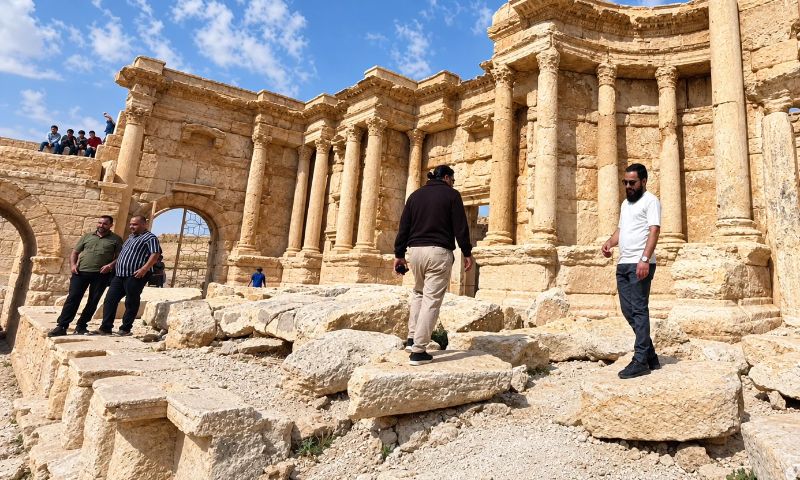
 Tourists visit the archaeological landmarks of Palmyra, October 13, 2026. (Ministry of Tourism)
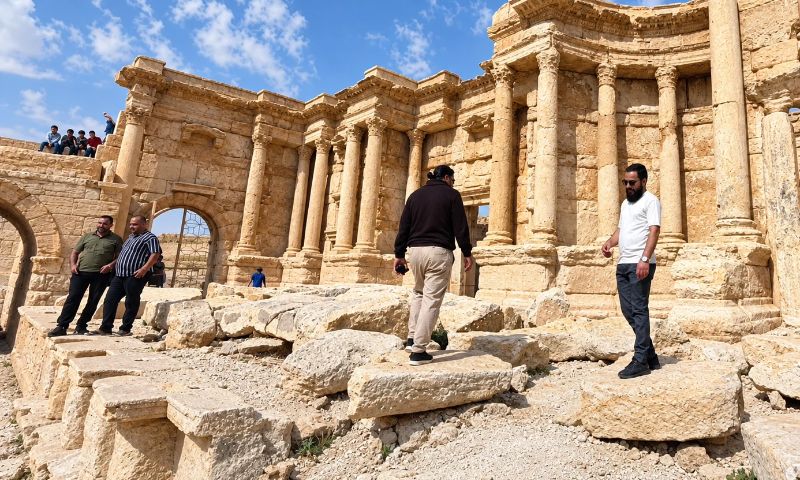
Tourists visit the archaeological landmarks of Palmyra, October 13, 2026. (Ministry of Tourism)


 A
A
A
A
A
A
Syria’s General Authority of Civil Aviation and Air Transport has announced plans to convert Palmyra Military Airport (Homs governorate, central Syria) into an international civilian airport, in a move it says aims to promote tourism and cultural activities in the ancient city and facilitate access for visitors from around the world.
Omar Hosari, head of the General Authority of Civil Aviation and Air Transport, explained that the project does not involve building a new airport from scratch or undertaking large-scale construction, as the site already has basic infrastructure that can be utilized.
The plan focuses on restoring facilities suitable for rehabilitation and installing the equipment necessary to meet civilian aviation requirements, Hosari told the official Syrian al-Ikhbariya television channel on Thursday, October 15.
One of the main anticipated requirements is the construction of a passenger terminal suited to the airport’s tourism-oriented role, designed to accommodate tourist delegations and groups. Its capacity would correspond to expected traffic volumes, without expanding facilities beyond actual needs.
Rehabilitation and modernization work will be carried out in phases, based on the results of technical assessments and safety, security, and operational requirements, he said.
According to Hosari, the project timeline will be determined once the assessment and identification of the required work are completed. The aim is to keep the project practical, relatively low-cost, and feasible within a reasonable timeframe.
The head of the General Authority of Civil Aviation and Air Transport noted that a previous study prepared in 2004 could serve as a technical and historical reference. However, he cautioned that the project’s current circumstances differ in terms of infrastructure conditions, operational requirements, and the nature of the tourism market.
The current assessment includes examining the condition of the runway, existing facilities, and equipment, identifying infrastructure that can be rehabilitated and reused, and reviewing air navigation, safety, security, and civilian operational requirements in accordance with current standards.
The study also covers potential tourism demand, economic feasibility, and the most suitable operating model, with particular emphasis on charter flights that could connect Palmyra directly with regional and international tourism markets.
Hosari stressed that the objective is not simply to update an old study, but to develop a realistic technical, operational, and economic plan that makes maximum use of existing infrastructure and identifies the airport’s actual requirements without investments or facilities that cannot be justified by anticipated tourism demand.
The proposed vision centers on developing Palmyra Airport as a “specialized civilian airport” serving tourism, with an emphasis on charter flights rather than necessarily adopting the model of airports that operate scheduled commercial services.
Hosari believes this model is well suited to historical destinations, as it allows airlines and tour operators to organize direct flights according to tourism programs and actual demand in targeted markets. This would enable tourist groups to reach Palmyra without passing through other airports.
According to Hosari, operational options will not be limited to particular airlines. Instead, available arrangements will be assessed based on economic feasibility, market requirements, and the airport’s operational readiness.
Hosari described Palmyra Airport as a project that would complement Syria’s airport network and could eventually provide an additional gateway for tourists to reach one of the country’s most prominent archaeological and historical destinations directly, strengthening the competitiveness of Syria’s tourism sector.
He noted that it remains too early to discuss specific figures before completing the tourism demand and economic feasibility studies, particularly because the proposed operating model differs from airports that primarily serve scheduled passenger traffic.
Hosari emphasized that the project’s potential value should not be measured solely by passenger numbers. It also includes facilitating tourist arrivals, stimulating tourism activity, and potentially supporting investment, services, and employment opportunities in Palmyra and the surrounding area.
The charter flight model would also allow flexible operations aligned with demand and tourism seasons, without requiring extensive infrastructure or passenger capacity exceeding the airport’s actual needs.
Hosari said the key measure of success is not the airport’s size or the number of flights, but its ability to support tourism development and generate sustainable economic value within the broader vision for developing Syria’s civil aviation system.
The announcement comes as the Syrian government considers a plan to prepare the ancient city of Palmyra to receive visitors by next season, with the aim of turning the revival of tourism into an economic driver that creates jobs and attracts investment.
On October 13, a government team conducted an extensive field visit to the city to assess the rehabilitation of essential infrastructure and damaged facilities, as part of preparations to revive tourism and economic activity by next season.
The ministers of tourism and culture, the head of the General Authority of Civil Aviation and Air Transport, and the governor of Homs participated in the visit. The aim was to coordinate their efforts and ensure the rapid implementation of rehabilitation plans and the provision of necessary tourism services.
The visit included a comprehensive assessment of the technical and logistical requirements for reopening and operating Palmyra International Airport, alongside a survey of damage to hotels and accommodation facilities to schedule their restoration.
The team also examined the condition of damaged archaeological sites and plans to prepare them for visitors, aiming to accelerate the restoration of services and provide the necessary conditions for launching cultural tourism and related economic activity in the area as soon as the new season begins.
Assessing Palmyra International Airport was a central focus of the field visit, to identify the requirements for its rehabilitation and operation. The airport is seen as a key starting point for revitalizing tourism in the region, attracting more visitors, and facilitating the inclusion of Palmyra in domestic and international travel itineraries.
Tourism Minister Mazen al-Salhani said in a statement received by Enab Baladi that revitalizing Palmyra requires coordinated and integrated efforts across all aspects of the tourism experience.
The minister explained that Palmyra is one of Syria’s most important cultural and historical destinations. He said the current vision focuses on delivering a comprehensive visitor experience worthy of the city’s historical significance by linking the reopening of the airport with hotel rehabilitation, archaeological restoration, and the development of essential services.
He added that the primary objective is to prepare the city to receive visitors by next season, ensuring that the revival of tourism becomes an economic driver that creates direct employment and investment opportunities, sustainably benefiting residents.
if you think the article contain wrong information or you have additional details Send Correction





 More Economic Reports