
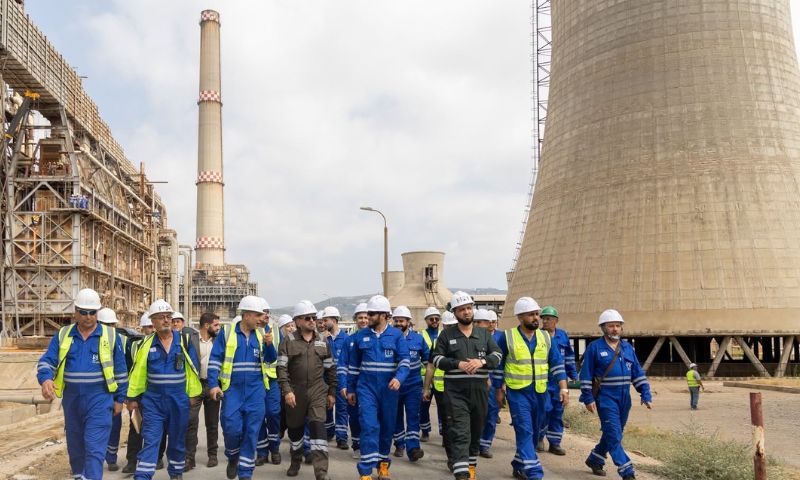

French energy company TotalEnergies is seeking a stake in a consortium of U.S. and Qatari companies planning to build an oil pipeline linking Syria and Iraq and extending to Baniyas (Tartus governorate, western Syria), paving the way for exports through the Mediterranean Sea.
TotalEnergies CEO Patrick Pouyanné told The National that the company is seeking a stake in a new international consortium planning to build a pipeline to help export Iraqi oil to the Mediterranean through Syria.
Pouyanné said on Sept. 14 that TotalEnergies is in active discussions to acquire a stake in the consortium planning to build the Basra-Baniyas pipeline.
Pouyanné made the remarks during a ceremony at the Élysée Palace in Paris, during Iraqi Prime Minister Ali al-Zaidi’s visit to France, where the two sides signed a series of agreements.
Baghdad also signed agreements with TotalEnergies related to the energy and oil sectors.
Unnamed sources told The National that TotalEnergies is seeking a 10% stake in the consortium, which would give the company a role in developing the pipeline and provide Iraq with an alternative route for exporting crude oil.
U.S. and Qatari Companies
The Iraqi Council of Ministers approved on July 4 an initial agreement between the Basra Oil Company and a consortium that includes the U.S. companies Capital IT and Chevron, as well as Qatar’s UCC Holding.
The consortium will conduct technical and financial feasibility studies comparing the proposed routes, including the Basra-Haditha-Kirkuk-Ceyhan route and the Basra-Haditha-Baniyas route.
Reuters reported on Aug. 17, citing two unnamed sources familiar with and involved in the project, that building the oil pipeline between Iraq and Syria would take about four years because new infrastructure would need to be constructed rather than merely rehabilitating the old pipeline.
The project’s cost could reach at least $15 billion.
These figures remain preliminary estimates as technical and financial studies continue, and the parties involved have not yet reached the stage of signing final implementation contracts.
The Kirkuk-Baniyas pipeline previously connected Iraqi oil fields in the Kirkuk region with the Syrian port of Baniyas on the Mediterranean. However, it sustained extensive damage during the wars in Iraq and Syria and has not operated regularly since the 1980s.
Two sources involved in the project told Reuters that the current plan requires building entirely new infrastructure, although part of the new pipeline would follow a route close to that of the old Kirkuk-Baniyas pipeline.
According to one of the sources, sections of the old pipeline that remain intact do not meet the newly developed specifications, making them unsuitable for use in the new project.
The proposed system includes the development of an integrated crude oil transport network beginning at oil fields in southern and northern Iraq, continuing to a collection hub in the city of Haditha in western Iraq, and then extending through Syrian territory to Baniyas on the Mediterranean coast.
The new system is designed for an initial capacity of up to two million barrels of crude oil per day, about six times the old pipeline’s design capacity of approximately 300,000 barrels per day.