
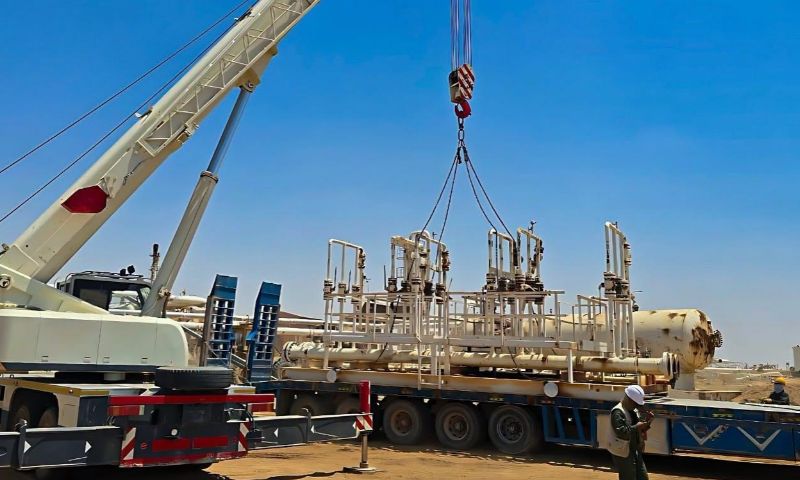

While Syria’s energy sector needs billions of dollars in investment to rehabilitate its fields and infrastructure, its revenues are being directed toward financing wages and government projects, raising questions about whether the sector can continue funding the state treasury while maintaining production at the same time.
Recent statements by Energy Minister Mohammed al-Bashir, during a press conference and a hearing before the People’s Assembly, revealed that the Ministry of Finance relies heavily on the Ministry of Energy’s resources to cover investment projects and wages.
Economist Mohammad Saleh Fteih told Enab Baladi that the energy minister’s testimony before the People’s Assembly indicates that Energy Ministry revenues may have accounted for around 55% of Finance Ministry revenues during the first half of 2026.
Fteih reached this conclusion based on figures disclosed by the finance minister, who said revenues during the first half of 2026 amounted to around $2.7 billion, while the energy minister said his ministry had provided the equivalent of $250 million per month, or around $1.5 billion over the same period.
More Than Half of Revenues
These figures indicate that the Ministry of Energy contributed around 55% of the Ministry of Finance’s total revenues, a proportion Fteih described as extremely high. In terms of the public treasury’s dependence on oil and energy revenues, he said this places Syria close to oil-producing countries such as Saudi Arabia.
The economist explained that even without the recent geopolitical crises, the 2026 budget was, in his assessment, drawn up on unrealistic assumptions because it projected that oil and gas would account for 28% of revenues. He considered this a high proportion for a country that imports between 50% and 70% of its oil needs and around 75% of its gas needs.
According to Fteih, the Ministry of Finance’s reliance on oil and gas revenues represents a major risk because Syria remains an importer of both commodities, while current revenues are collected from the domestic market through the direct sale of these products or indirectly through electricity bills.
Fteih added that interruptions or fluctuations in international oil and gas shipping affect transportation costs and the arrival of these commodities in Syrian markets. This creates compounded damage by reducing their availability and harming economic production, which in turn affects Ministry of Finance revenues.
A Sector That Needs Billions in Investment
Syria has long been an importer of gas, even at the peak of domestic production in 2010, when local output covered around 80% of consumption. Demand was expected to rise as power plants began shifting from fuel oil to natural gas.
In the oil sector, most Syrian fields are old and have entered the enhanced recovery stage through water injection, a process that significantly increases extraction costs and produces high levels of pollution, according to Fteih.
The economist said this helps explain why production has remained at around 100,000 barrels per day, contrary to previous expectations that output would double within a short period.
Financially, Fteih said oil and gas cannot be relied upon to cover expenditures that increased by 200% in the 2026 budget compared with the 2025 budget.
Using revenues from the Ministry of Energy and the Syrian Petroleum Company to finance wages instead of reinvesting them in exploration, development, and sector rehabilitation raises questions about whether the ministry will be able to maintain current production levels or increase them in the future.
Fteih said the Ministry of Energy maintains a high degree of secrecy around its activities, but current data raise doubts about its ability to finance the rehabilitation and expansion of production infrastructure, given that such operations require investments estimated in the billions of dollars.
Are Wage Increases Sustainable?
Questions are not limited to the energy sector’s ability to finance the treasury. They also concern the sustainability of approving large wage increases based on revenues from a single volatile and uncertain sector.
Fteih said increases in public sector wages cannot be considered separately from other areas of budget spending.
He added that wage increases were necessary, not only to raise employees’ living standards above the poverty line, but also to increase financial flows and stimulate economic activity, since domestic demand is a key driver of economic growth.
The problem, according to Fteih, is that the 2026 budget also provided for a major increase in spending outside the salaries and wages category.
Current estimates for salaries and wages, following the latest increase, exceed $250 million per month, or around $3 billion annually.
Fteih questioned how the remaining budget items, worth more than $7 billion, would be financed. These include allocations for defense and security spending estimated at around $3.5 billion, which he said should be subject to scrutiny and review.
Progressive Taxes as an Alternative
This raises questions about the direct economic risks of tying the government wage bill and public investment to a single unreliable source of revenue, as well as the alternatives the government could have used and activated.
Fteih said the available alternative at the current stage is to increase taxation progressively, particularly on higher-income groups.
He explained that current revenues come primarily from oil and gas proceeds and customs duties. In practice, he said, this means that the largest burden of revenue collection falls on ordinary consumers rather than on the profits of traders, industrialists, and higher-income groups.
Fteih said taxes and fees account for 28.7% of Syria’s total revenues, while customs duties account for 21.8%, bringing the combined share of the two sources to 50.5% of total treasury revenues.
Fteih compared Syria’s revenue structure with Egypt’s, saying that taxes and customs duties account for around 87% of Egypt’s total public revenues. This means that most treasury revenues there come from these two sources, unlike Syria, which relies heavily on oil and gas revenues.
Based on this, the economist stressed that the optimal solution is to change the structure of Syria’s public revenues and increase reliance on taxation, particularly through the adoption of a progressive tax system focused on those with higher incomes and profits, alongside measures to curb tax evasion.
Limited Options
Based on the preceding figures, Fteih said recent developments reveal a lack of realistic planning by the Syrian government, as it has become clear that revenues did not reach $500 million per month during the first months of 2026.
He added that more realistic plans should have been adopted, including plans related to wage increases, rather than preparing a budget that requires monthly revenues of $875 million to achieve balance.
Concluding his remarks, Fteih said the government’s available options at the current stage are limited to implementing severe austerity measures, which could include suspending some investment projects, reducing fuel consumption, and cutting allowances for senior officials.
He also called for a review of the salary and compensation system for all employees.
Fteih said borrowing may become unavoidable, but would not be sufficient to cover the current deficit. He also noted the difficulty of obtaining loans to finance current expenditures, particularly salaries and wages.