


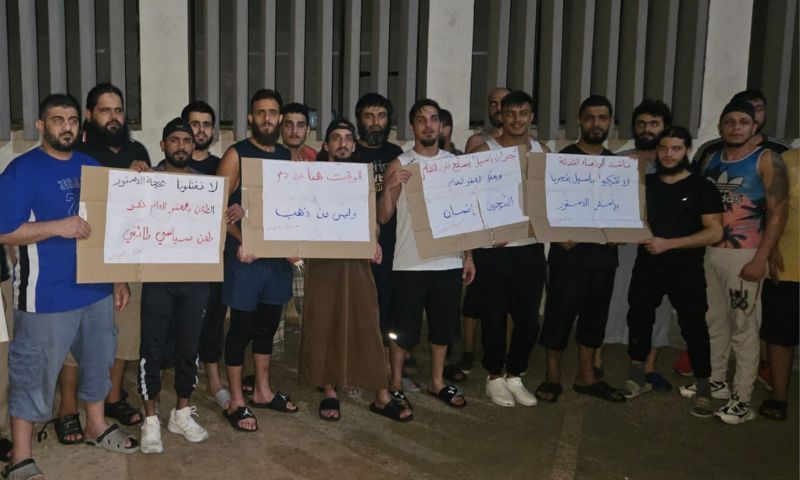
 A protest by Syrian prisoners at Roumieh Prison in Lebanon against the challenge to Lebanon’s amnesty law, September 11, 2026. (Activists among former Roumieh prisoners)
A protest by Syrian prisoners at Roumieh Prison in Lebanon against the challenge to Lebanon’s amnesty law, September 11, 2026. (Activists among former Roumieh prisoners)
Syrian prisoners detained in Building B at Roumieh Prison in Lebanon staged a protest rejecting what they called the challenge filed by a number of Lebanese lawmakers against the general amnesty law.
After holding a group prayer in the courtyard of Roumieh Prison on Friday, September 11, the prisoners raised signs and chanted slogans addressing the political and humanitarian dimensions of their case.
During the protest, they thanked Lebanese President Joseph Aoun, Grand Mufti of Lebanon Abdul Latif Derian, and Maronite Patriarch Bechara Boutros al-Rahi for their positions supporting the amnesty law.
Through chants and signs, the prisoners strongly criticized Lebanese MP Gebran Bassil, describing the challenge he filed against the amnesty law as a “sectarian political challenge.”
The prison courtyard echoed with angry chants, including, “O God, our protector, they have wronged us because of Bassil,” and, “Listen, Lebanon’s leaders, we have been wronged because of Gebran.”
The signs also carried messages and appeals to Lebanon’s “three presidents” to intervene urgently. Among the most prominent were:
The protest comes amid growing demands from detainees’ families to resolve the prisoners’ cases and decide on the general amnesty law in order to reduce overcrowding and injustices inside prisons.
Lebanon’s Constitutional Council issued a decision on September 10 suspending the effect of the law granting a general amnesty and exceptionally reducing the duration of some sentences.
Lebanon’s National News Agency reported that the decision followed a session held by the council under its president, Judge Tannous Mechleb, with the council’s members in attendance.
After deliberating on the challenge filed against the general amnesty law, the council decided by majority vote to suspend the effect of the challenged law.
The decision was also ordered to be formally communicated to the Lebanese president, the speaker of the Lebanese parliament, and the Lebanese prime minister, and to be published in the Official Gazette.
On August 12, the Lebanese parliament had approved a bill granting a general amnesty and exceptionally reducing the duration of some sentences, following years of demands for the law and months of political and legal discussions and disputes over which crimes it would cover and which groups would benefit from it.
Gebran Bassil, head of the Free Patriotic Movement and a Lebanese member of parliament, said, “At the head of a delegation from the Strong Lebanon bloc, we filed a challenge before the Constitutional Council against the general amnesty law issued by parliament.”
Bassil justified his position, according to Lebanon’s National News Agency, by saying there were three concerns regarding the law. The first was justice, the second concerned the victims of crimes, “as perpetrators of murder, rape, and other crimes would be pardoned under this law,” as he put it, and the third concerned those he described as “Islamists who have been wronged,” whose situation was the special case for which the law was originally intended.
He added, “We are challenging this law because we are looking for what is best for all the people I mentioned. Our goal is to correct the law so that it actually targets the limited number of Islamists who have been wronged and who have not been tried for many years, bearing in mind that this problem should not have been resolved by parliament, but rather by the relevant administration or judiciary.”
Roumieh Prison holds Syrian and Lebanese prisoners, including prisoners of conscience who supported or participated in the Syrian revolution, as well as prisoners detained over political and criminal cases. Its inmates have previously staged strikes over poor conditions inside the prison.
The Syrian Network for Human Rights estimated the number of Syrian detainees in Roumieh Prison at about 2,000, including around 190 detained over their participation in the Syrian revolution.
Roumieh Prison is located northeast of Beirut and is Lebanon’s largest prison. It holds more than 4,000 inmates despite having a capacity of no more than 1,200, resulting in overcrowding and poor services.
Meanwhile, there are no official estimates for the number of Lebanese people missing in Syria, but the Association of Lebanese Detainees in Syrian Prisons estimates the number at 622.
Human Rights Watch published a report in August 2023 citing complaints from families of Syrian prisoners in Lebanon that food in prisons had become “insufficient and of such poor quality that it was often unfit for consumption.”
Amnesty International, meanwhile, warned in a report published in June 2023 that the number of deaths in Lebanese detention centers and prisons in 2022 had doubled compared with 2018, before the onset of the economic crisis.
if you think the article contain wrong information or you have additional details Send Correction


 A
A
A
A
A
A




 More Politics