


 Israeli Prime Minister Benjamin Netanyahu speaks from an Israeli military base on Mount Hermon, September 9, 2026. (Israeli Prime Minister’s account on X)
Israeli Prime Minister Benjamin Netanyahu speaks from an Israeli military base on Mount Hermon, September 9, 2026. (Israeli Prime Minister’s account on X)
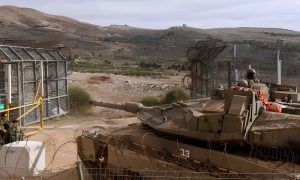
Israeli Prime Minister Benjamin Netanyahu announced today, Wednesday, September 9, that Israeli forces have full control over the area stretching from the summit of Mount Hermon (southwestern Syria) to the Yarmouk River and the Mediterranean Sea.
During a visit to Israeli forces stationed on Mount Hermon in Syria on the eve of the Hebrew New Year, Netanyahu said, “We are at the summit of Mount Hermon. Damascus is here, Lebanon is there, and the Syrian Golan Heights are there,” adding that this level of control “has never existed before,” according to the Israeli prime minister’s account on X.
He added that Israel would not allow any “terrorist army” to take control of its borders, describing this as one of the most significant achievements of its current war, which he called the “War of Redemption.”
Netanyahu made the remarks after receiving a briefing on operational activity at a forward military position overlooking Syria from Mount Hermon. He was accompanied by Defense Minister Israel Katz and Deputy Chief of Staff Maj. Gen. Tamir Yadai, with Northern Command chief Maj. Gen. Rafi Milo and 210th Division commander Brig. Gen. Yair Palai also present.
Netanyahu had said during a government meeting last Sunday that “Israel is stronger than ever, and our enemies are weaker than ever.”
The Israeli prime minister added, “Together with the United States, we have achieved major accomplishments in removing an existential threat hanging over us. We have pushed nuclear bombs and ballistic missiles away from us, and we have dealt a powerful blow to the Iranian axis.”
This is not the first time Netanyahu and ministers in his government have visited what Israel describes as security zones in Syria, which it seized after the fall of the Assad regime on December 8, 2024.
Israeli Defense Minister Israel Katz also visited the summit of Mount Hermon on August 25 and said from there that Israeli forces would remain in the Syrian territories under their control for as long as threats to Israel persisted, stressing that the military “will not move from here.”
Katz accused Turkey of seeking to establish a presence in Syria in a way that threatens Israeli security interests, amid escalating tensions between the two sides that have played out on Syrian territory with the bombing of Abu al-Duhur airport.
Israeli forces targeted Abu al-Duhur Military Airport in the eastern Idlib countryside (northwestern Syria) on August 18.
The Israeli strikes were accompanied by intensive Israeli drone flights over northwestern Syria before the airport runway was targeted. Estimates of the number of strikes varied, while no casualties were reported and the announced damage was limited to military facilities and installations.
Following the bombing, both Israel and Turkey issued statements, while an official Syrian position rejected the Israeli account of the reasons for the attack. The developments reflected a widening dispute over the future of security and military arrangements in Syria and the roles of Turkey and Israel in the country.
Following the attack, Netanyahu’s office said Israel and Syria had agreed to maintain the “status quo” on security matters, claiming that Syria had been about to violate that arrangement by allowing Turkish forces to deploy at an air base near Aleppo.
The office added that Israel had warned Syria “repeatedly” that such a deployment would pose a threat to its security, accusing Damascus of ignoring those warnings.
Netanyahu’s office said Israel would not tolerate threats to its security and claimed that the latest developments had ended with a return to the previous security situation.
The Israeli position comes amid growing tensions over the nature of Turkey’s role inside Syria, particularly the use of Syrian military facilities and bases by Turkish forces, as Ankara and Damascus work to strengthen security and military cooperation.
if you think the article contain wrong information or you have additional details Send Correction


 A
A
A
A
A
A


 More Politics