


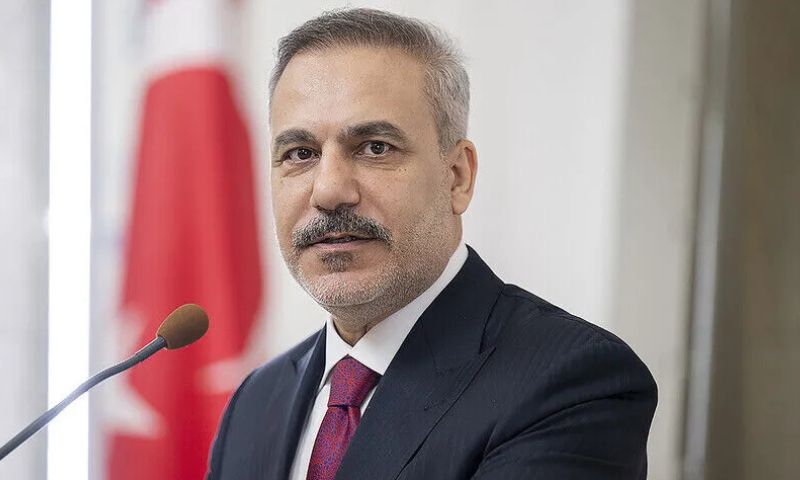
 Turkish Foreign Minister Hakan Fidan, Sept. 16, 2026 (Anadolu)
Turkish Foreign Minister Hakan Fidan, Sept. 16, 2026 (Anadolu)
Turkish Foreign Minister Hakan Fidan said Israel poses the greatest threat capable of pushing Syria into instability, arguing that its continued policies toward countries in the region obstruct Damascus’s efforts to achieve stability.
Fidan made the remarks to Turkish journalists following a two-day visit to Syria that ended on Monday, Sept. 14, during which he met Syrian President Ahmed al-Sharaa and Foreign Minister Asaad al-Shaibani.
According to Turkey’s Anadolu Agency, Fidan said Israel “does not particularly favor neighboring countries being strong and stable,” arguing that it sees the stability and strength of these countries as a threat and therefore “carries out destabilizing actions against them.”
He added that Syria wants to live in peace, saying that at some point Israel will recognize this approach and accept peaceful coexistence with the region, or continue policies he described as “aggressive,” which, he said, would leave it “more isolated within the international community.”
The Turkish minister said his stay in Damascus during the visit indicated that life in Syria was beginning to return to normal, pointing to the political and economic developments the country has witnessed over the past period.
Fidan said Syria “has been removed from the sanctions list” and that there is no longer an obstacle to economic investment. He also stressed the importance of removing Syria from the list of state sponsors of terrorism.
He added that Syria has significant potential if stability is achieved, but needs time to reach better conditions, arguing that economic developments in the country are directly linked to its stability.
Fidan also addressed the Israeli government’s policy toward countries in the region, saying Israeli Prime Minister Benjamin Netanyahu views all countries in the region as threats.
He added that Israel derives its strength from the weakness of countries in the region, arguing that continued attacks on Syrian capabilities undermine policies aimed at achieving stability and positive developments in Syria.
Fidan said Israeli attacks on Syria “indirectly support the Islamic State,” adding that they harm the process of building the Syrian state.
Syrian Foreign Minister Asaad al-Shaibani had said during Fidan’s visit that Damascus’s position on the Israeli escalation is “firm and resolute,” and calls for an Israeli withdrawal to the lines in place before Dec. 8, 2024.
Al-Shaibani linked the Israeli escalation to the state-building process, saying that the targeting of Abu al-Duhur Airport in Idlib (northwestern Syria) sent a “disruptive message aimed at striking the state-building process.”
On Syria’s domestic affairs, Fidan said the highest priority in the country’s integration process is for the Syrian Democratic Forces (SDF) to cease being a “threatening and hostile element.”
He added that developments so far have carried “positive messages,” explaining that Ankara is closely monitoring how the process advances on the ground.
“We expect implementation to be consistent with the messages announced to the public,” he said.
The SDF announced on Aug. 25 that it had dissolved its military structure as part of its integration into the Syrian state, while negotiations continue over mechanisms for implementing the agreement and integrating into state institutions.
Fidan said the SDF dissolving itself and fully integrating into the Syrian state represents an “important and valuable step,” pointing to the development of security cooperation between Ankara and Damascus over the past period.
During his visit to Damascus, Fidan announced an expected visit to Syria by Turkish President Recep Tayyip Erdogan, without specifying a date.
He said meetings between the two countries would be “intensive” in the coming period and would cover political, economic, and military issues. He added that the two sides agreed to establish a joint committee chaired by ministers from both countries to advance cooperation across various sectors.
Syrian-Turkish relations have seen continued political, economic, and security activity since the fall of Bashar al-Assad’s government on Dec. 8, 2024, with both sides announcing plans to expand cooperation and activate joint institutional frameworks.
if you think the article contain wrong information or you have additional details Send Correction


 A
A
A
A
A
A





 More Politics