

Despite the expiry of the deadline set by the Central Bank of Syria at the end of July for transactions using the old Syrian pound, and its confirmation that any reference to the “Syrian pound” now means the new denominations exclusively, people in Damascus and its countryside remain caught in a state of “accounting confusion,” as the old figures remain fixed in the minds of citizens and traders alike.
Enab Baladi documented numerous violations, irregularities, gaps and problems that emerged after the new Syrian currency became the sole means of payment in transactions among residents, markets and transport services.
At the end of the deadline, the Central Bank thanked employees at public and private banks, currency exchange companies and money transfer firms for their “sincere efforts that contributed to completing the replacement of the old Syrian currency efficiently and within the specified deadline,” according to its statement.
Prices in Thousands, Reality in Hundreds
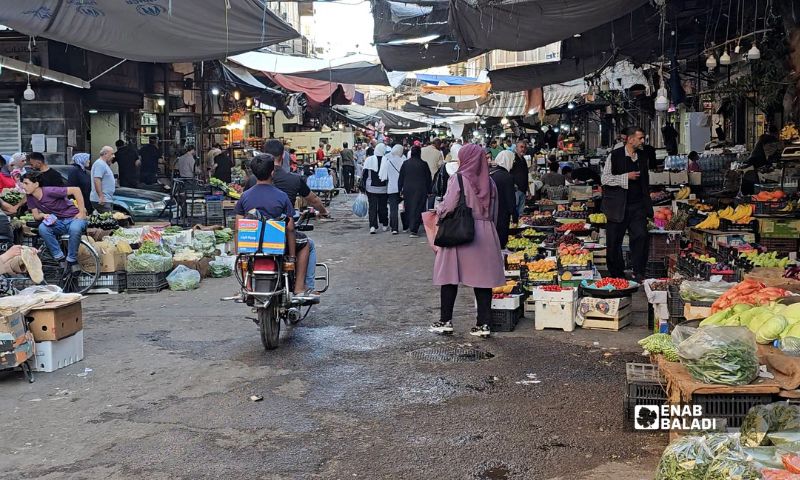
During field visits to monitor daily transactions, Enab Baladi observed that markets and shops in several areas of Damascus and its countryside had not yet adjusted to the removal of two zeros from the national currency.
Syrians still refer verbally to the new banknotes according to their old values. A new 200-pound note is called “20,000” during purchases, while the new 500-pound note is called “50,000.” The new 100-pound note is similarly referred to as “10,000,” following the Central Bank’s decision to remove two zeros from the Syrian pound.
The problem extends beyond people’s calculations to the pricing of most goods and services. Many shops, restaurants and transport providers continue to use the old values in areas including al-Baramkeh in central Damascus, as well as Sahnaya, Ashrafiyat Sahnaya, Darayya, Jdeidat Artouz and Jaramana in Rif Dimashq Governorate, creating daily confusion.
Waiving the Difference Becomes a Necessity
The gap between listed prices and collected payments, combined with a shortage of small new denominations such as 10 and 25 pounds and the absence of a five-pound note, has led citizens, transport drivers and supermarket owners to reluctantly waive small balances.
Most daily transactions end either with the buyer giving up the change or the seller waiving it because there are no precise denominations to cover the difference.
Payments in shared minibuses and supermarkets have become subject to daily negotiation. Customers either leave the remainder with the seller, or the seller waives an amount that neither party can provide, according to corroborating accounts gathered by Enab Baladi.
Owners of vegetable and fruit shops, as well as pharmacies, said that since the beginning of August, the lack of small denominations has prompted them to use goods as substitutes for change, including eggs, candy and adhesive medical bandages. Vegetable sellers may add or remove a piece of produce to avoid needing change and compensate customers for remaining balances.
The Blue 500 Returns to Circulation
To address the shortage of small change, citizens and traders have found ways around the problem. Markets have seen a notable return of the old blue 500-pound note, which is being circulated alongside the new 25-pound note, equivalent to 2,500 old pounds, even though transactions using all old denominations have been prohibited.
Enab Baladi also documented several practices and violations resulting from the final transition to the new currency in recent days:
- Confusion over pricing and the failure of a broad segment of traders to update price lists to the new currency, opening the door to manipulation and fraud.
- Cases in which traders refused to accept the new 25-pound note because it does not correspond with government-set prices or transport fares. Unlike a hypothetical 20-pound note, which would equal 2,000 old pounds, using the new 25-pound denomination forces traders either to waive the difference or ask customers to do so.
- The emergence of a black market for small change. Some people have exploited the shortage by selling quantities of small-denomination notes to traders and residents for a fee, a practice clearly observed at the al-Hal wholesale market.
- The emergence of a “black market for discounting the old pound,” exploiting citizens seeking to dispose of old currency after the Central Bank’s deadline. For example, some people offer 90 new pounds in exchange for 10,000 old pounds. This prompted Syria’s Supreme Fatwa Council to issue a statement declaring that exchanging or selling old currency for less or more than its nominal value is prohibited under Islamic law.
- The spread of rumors that a pink five-pound Syrian banknote would be introduced.
On Sunday, August 2, the Central Bank announced an exceptional window for exchanging old currency for new notes for one week only, through August 6, at public and private banks and post offices, without fees or commissions. The measure followed severe crowding and difficulties faced by citizens before the first official deadline expired on July 30.
After the exceptional exchange period ends, exchanges will be limited exclusively to the Central Bank’s headquarters in Damascus for five years, in accordance with provisions of Syria’s Monetary and Credit Law.