
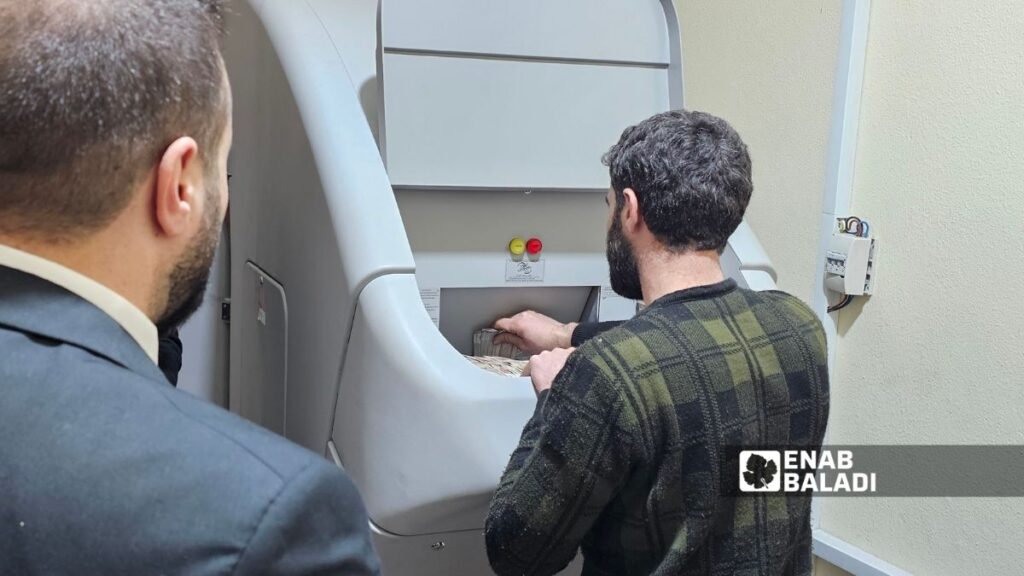

The Central Bank of Syria on Sunday, July 26, ended speculation over a possible extension of the old Syrian pound’s legal tender status, reiterating that the old banknotes will cease to be legal tender and become invalid for circulation starting July 31.
In new instructions, the central bank said the deadline for exchanging old banknotes will expire on July 30. It also announced that the replacement process had reached an advanced stage, without specifying the completion rate.
Central Bank Governor Mohammad Safwat Raslan said on July 10, during a public-private sector roundtable in Damascus, that approximately 80% of the old Syrian currency had been replaced since the beginning of 2026.
The central bank warned that, in official transactions, the term “Syrian pound” will automatically refer to the new currency starting July 31. It called on citizens to:
- Obtain information about withdrawal procedures exclusively through official channels.
- Follow the announced instructions.
- Avoid rumors and unofficial sources.
What Are the Central Bank’s New Instructions?
The Central Bank of Syria issued a set of instructions on Sunday that effectively establish the following:
- Old banknotes will no longer be legal tender or valid for financial transactions starting July 31.
- The exchange of old banknotes at all financial institutions and designated exchange centers will end on July 30.
- The withdrawal and redemption period for old banknotes will begin on July 31 and continue for five years.
- Withdrawal procedures will be conducted exclusively through the Central Bank of Syria, the only institution authorized to receive withdrawal applications.
- Each withdrawal application must include at least 100 banknotes, regardless of denomination. Applications involving fewer than 100 banknotes will not be accepted.
- After the application is reviewed and approved, the equivalent value will be transferred to the beneficiary’s bank account in new Syrian pounds.
- The withdrawal process will be conducted without commissions, fees, or taxes.
Merchants Reject the Old Syrian Pound
Since the Central Bank of Syria announced on June 22 that the old currency would lose its legal tender status at the end of July, it had remained silent until issuing Sunday’s instructions. As the end of July 2026 approached, Syrian markets experienced severe confusion and daily disputes between citizens and merchants over refusals to accept the old currency in commercial transactions and public transportation.
The silence of central bank officials, and their failure to clarify whether the old and new currencies had to remain in simultaneous circulation until the end of July, appeared to reflect concerns that such a position could affect the stability of the Syrian pound’s exchange rate. Exchange rate stability is a central focus of the bank’s decisions, statements, and monetary policies.
The executive instructions governing the currency replacement process require all businesses and financial institutions to accept both issues until the end of the month. Although old banknotes can still be redeemed through central bank branches during the five-year withdrawal period, conditions on the ground indicate a severe crisis of confidence between citizens and business owners.
A source close to the Central Bank of Syria, who requested anonymity, said the bank was proceeding with its decision to end the old currency’s legal tender status at the end of July because the measure had contributed to exchange rate stability.
The source said old banknotes had been used as a “tool” for exchange rate speculation in the markets. The central bank’s policy of restricting liquidity, together with the removal of the old pound from circulation, was helping strengthen the new pound against the US dollar, according to the source.
Economist Proposes Solutions to the Central Bank
Syrian economist and financial expert Dr. Mohammad al-Faqih told Enab Baladi that the Central Bank of Syria could adopt several proposals to address violations in the markets and ensure that the new Syrian currency is accessible to all citizens.
The proposals include:
- Issuing an immediate clarification confirming that the old currency will remain legal tender until the end of July.
- Extending the period of simultaneous circulation for the two currencies and introducing a flexible grace period of 30 to 60 days to absorb the remaining liquidity.
- Simplifying bank exchange procedures and lifting daily restrictions on withdrawals and deposits of the new currency.
- Providing mobile exchange services by sending banking vehicles to rural and remote areas.
- Requiring state-owned and private banks to accept old banknotes without commissions or complicated procedures.
Market Oversight Measures
Al-Faqih stressed the need to activate consumer protection authorities and deploy intensive inspection patrols to monitor businesses refusing to accept the old currency. He called for immediate deterrent penalties, including closing businesses that violate the rules and revoking the operating licenses of public transportation vehicles.
Despite the limited time remaining before the old pound loses its legal tender status, al-Faqih said complaint hotlines could still be established to allow citizens to report businesses and drivers refusing to accept the currency.
He also said government service institutions should be required to continue accepting old currency for the payment of bills and fees.
Al-Faqih also proposed banking and technological measures, including:
- Accelerating the digital transformation of markets and requiring commercial establishments to provide electronic payment options.
- Temporarily waiving fees on electronic retail payments to encourage their adoption.
- Opening exchange windows at key locations, including bus terminals, Syrian Trade Establishment centers, and municipal offices.