
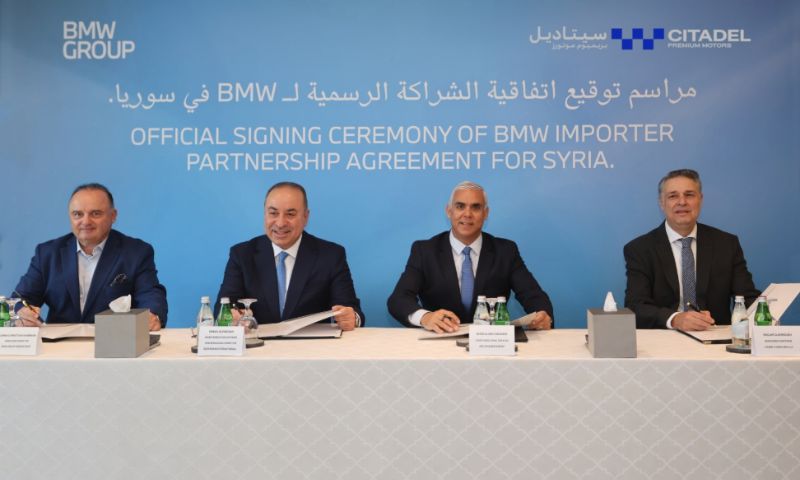

BMW Group Middle East announced the appointment of Citadel Premium Motors as the official dealer for the BMW and MINI brands in Syria on Tuesday, September 22.
According to a statement from the group, a copy of which was received by Enab Baladi, BMW and its official dealer, Citadel Premium Motors, are committed to providing BMW and MINI vehicles in Syria and delivering a high-quality experience focused on meeting customer needs and adhering to standards for after-sales services.
The partnership aims to build sustainable, long-term value by contributing to the development of local capabilities and skills through investment in Syrian talent, with the goal of creating employment opportunities for qualified women and men and supporting knowledge transfer in sales, after-sales services, customer experience, and operations.
The group said this approach would support the local economy and help build a sustainable ecosystem for Syria’s luxury automotive sector.
The statement said the announcement reflects the group’s confidence in the promising long-term potential of the Syrian market and represents an opportunity for BMW Group Middle East to reconnect with customers and establish a sustainable, long-term presence.
Kareem Christian, managing director of BMW Group Middle East, said the appointment of Citadel Premium Motors as a dealer in Syria represents an important milestone for BMW Group Middle East and reinforces the group’s responsibility to return to the market in cooperation with the right partner and in accordance with the strict standards of the BMW and MINI brands.
Malak Jarwa, chair of Citadel Premium Motors, said the partnership seeks to develop local expertise and provide integrated sales and after-sales service experiences across Syria.
She affirmed the company’s commitment to building a reliable and sustainable business that reflects the strength of the two brands while meeting the expectations of customers in Syria.
The statement said further details about the official launch event and the opening of BMW and MINI facilities in Syria would be announced later.
Citadel Premium Motors is a partnership bringing together Habib Jarwa LLC, Abu Khader Group, which operates in the automotive sector in Jordan and the region, and Alfardan International Group, a leading Qatari company in the luxury automotive sector.
What Is BMW Group?
BMW Group is one of the world’s leading manufacturers of automobiles and motorcycles through its four brands, BMW, MINI, Rolls-Royce, and BMW Motorrad, and also provides financial services.
The group operates more than 30 production sites worldwide, while its global sales network extends to more than 140 countries.
The group formally closed its operations in Syria and suspended its activities in 2011, coinciding with the outbreak of the Syrian revolution and the subsequent deterioration of security and economic conditions and the imposition of international sanctions.
Why Does It Matter?
Economic and political analyst specializing in Middle Eastern affairs Dr. Mohammad Saleh al-Fteih said the entry of official automobile dealerships into Syria would make original spare parts available and end the need to rely on smuggled or counterfeit parts, which drain foreign currency and cause harm to vehicle owners and users.
In a previous interview with Enab Baladi, al-Fteih said the entry of official dealerships into the Syrian market would help regulate the market and end the disorder surrounding imports by some traders, including imports of cars and used vehicles. He explained that many major automobile companies now operate programs for selling used vehicles, which are reassessed, regulated, inspected for safety, and then sold as company-certified used cars.
According to al-Fteih, automobile dealerships can also work more transparently and reliably with banks to offer installment payment facilities, noting that this option is still not widely available in Syria.
He added that such financing would reduce the burden of replacing older vehicles and ease pressure on the capital of both individuals and companies.
Economist and banking expert Dr. Ibrahim Nafea Qushji told Enab Baladi that the return of international companies’ dealerships to Syrian markets and their role in developing local commercial infrastructure constitute a strategic step toward rebuilding the national economy and strengthening confidence in the investment environment. He explained that the presence of these dealerships is not limited to introducing new products and services, but also extends to restructuring local commercial infrastructure and improving its efficiency.
Qushji said the return of automobile dealerships contributes to strengthening confidence in the local economy because it serves as a positive indicator of market stability and its ability to attract investment, while sending a reassuring message to local and foreign investors that the Syrian market has the potential for growth and greater openness.
He added that the move contributes to transferring expertise and international standards, explaining that global automobile companies operate according to established administrative and marketing systems, which can help improve local commercial performance. Introducing the quality standards used by these companies, he said, can also enhance the competitiveness of Syrian products and prepare them for integration into regional and international markets.
Qushji also pointed to another potential benefit in the development of commercial infrastructure. Global dealerships typically invest in modern distribution networks, service centers, and advanced logistics systems, he said, adding that such investments improve supply chain efficiency and reduce operating costs, ultimately benefiting consumers.
What Are the Drawbacks?
Economic analyst Mohammed Saleh al-Fteih said the advantages of automobile dealerships entering the Syrian market do not eliminate possible negative effects on conditions in Syria.
Al-Fteih explained that the return of these dealerships means reopening imports without restrictions, which would increase demand for foreign currency and consequently place pressure on the Syrian pound, particularly in the absence of export capacity.
He identified another potential drawback in allowing imports without first addressing the status of older vehicles currently on the roads, which could lead to worsening traffic congestion, particularly in major cities.
Al-Fteih also pointed to the limited experience of vehicle maintenance workshops in Syria, resulting from more than 14 years without significant exposure to new cars.
He said some technologies common in countries across the region, such as hybrid engines powered by both fuel and electricity or fully electric motors, remain largely unfamiliar in the Syrian market. He explained that a large influx of new vehicles without sufficient technical expertise to service them could give automobile dealerships the ability to monopolize maintenance services and impose high prices on users who lack alternative options, a scenario he described as highly likely.