


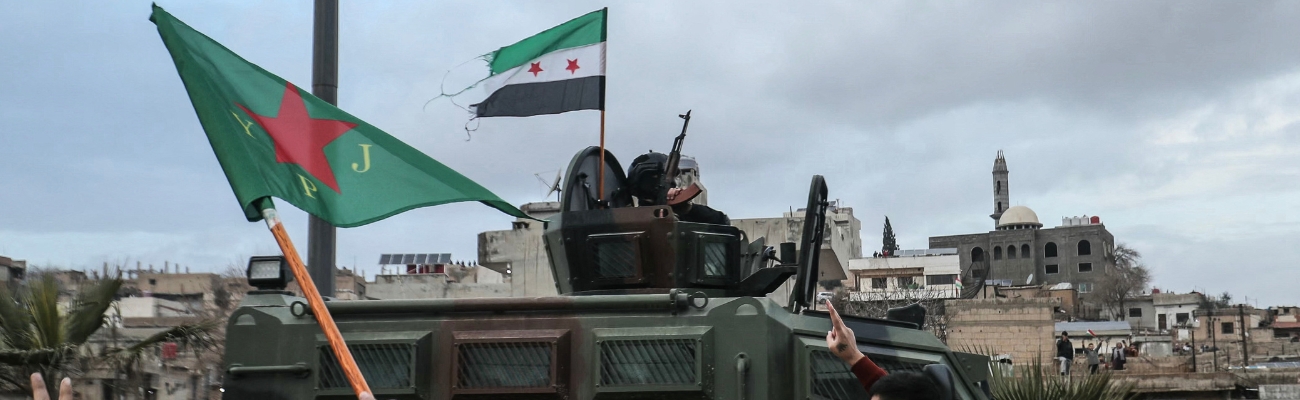

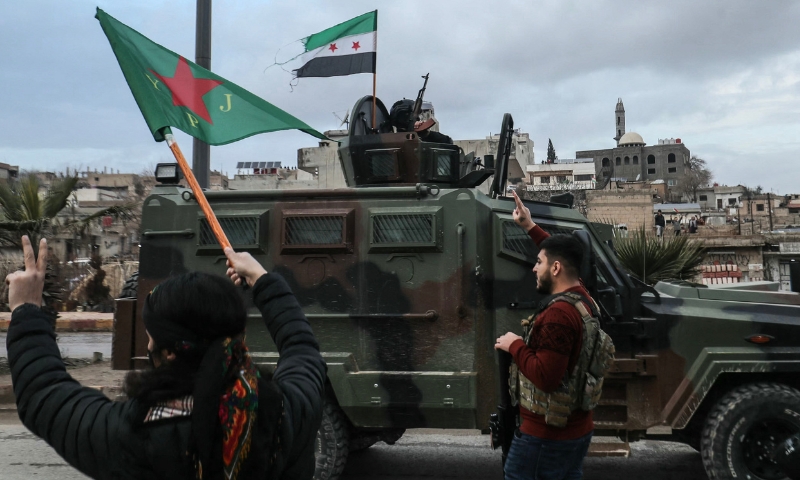
 SDF fighters wave the flag of the Women’s Protection Units as Syrian army forces enter Qamishli (northeastern Syria) following the integration agreement, February 3, 2026. (AFP)


 A
A
A
A
A
A
Rakan al-Khadr, Amir Huquq, Mohammed Jaffal
Six months after the January 29, 2026 agreement between the Syrian government and the Syrian Democratic Forces (SDF), the administrative map of northeastern Syria looks different from what it was before the deal, but it has yet to reach the unified administration model stipulated in its provisions.
The agreement came amid military and political changes in northeastern Syria at the beginning of 2026. It stipulated the integration of Autonomous Administration institutions into state institutions and the formal retention of their employees, along with reorganizing the security and military and resolving issues related to education and local administration. However, implementation over the past six months has revealed significant differences between sectors, with service sectors moving faster while sovereignty-related issues and the legal framework have remained more complicated.
The government has restored its presence in several service and administrative institutions and begun integration measures in some sectors. More sensitive files, including the judiciary, education, universities, civil registry, and employees, remain subject to disagreements over implementation mechanisms, the limits of authority, and the form of local administration.
Enab Baladi examines the most significant changes in the administration of al-Hasakah governorate (northeastern Syria) following the integration agreement, including service, economic, educational, security, and military institutions.
It also speaks with experts and researchers about the most important steps completed so far, the consequences of delays in fully implementing the agreement, and possible future scenarios for the process at different levels.
State and Administration
Gradual Return of Institutions, Uneven Integration Across Sectors
Implementation of the provision on integrating civilian institutions has not proceeded at the same pace since the agreement was signed. The past six months have shown clear differences between sectors, with noticeable progress in some service institutions while others linked to sovereignty and the legal framework remain stalled.
At the administrative level, the Agriculture Directorate, Grain Office, and the water and health sectors have taken initial integration steps through the formation of joint administrations and the distribution of responsibilities between government and Autonomous Administration employees. The government has also begun establishing its presence in a number of official institutions, appointing local officials and taking over some public facilities. More complicated files, including education, the judiciary, and the civil registry, have remained outside any final settlement.
Journalist and political researcher Samer al-Ahmad believes what has been achieved so far “cannot be described as full institutional integration, but is closer to a transitional phase of administrative coordination.” He explained that the success of any integration process is not measured merely by transferring employees or issuing appointment decisions, but by establishing a single administrative authority and a legal framework governing the work of all institutions.
Al-Ahmad said the continued existence of dual administration in some sectors means citizens must deal with more than one authority to obtain the same service, limiting the effectiveness of measures already implemented.
Writer and journalist Ezz al-Din Malla agrees with al-Ahmad, saying the government has achieved relative progress in service files that are less politically sensitive, while institutions linked to sovereignty remain more complicated, explaining the different levels of integration from one sector to another.
“There are decisions issued by government institutions, but their implementation sometimes remains dependent on understandings with forces and structures operating on the ground. Therefore, the issue has not yet been resolved.”
Samer al-Ahmad
Journalist and political researcher

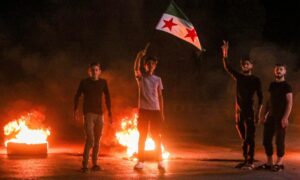
Young men riding a motorcycle wave the Syrian flag as Syrian government forces enter Qamishli following the agreement with the SDF, February 3, 2026. (AFP)
Education and Judiciary Remain the Most Complex Files
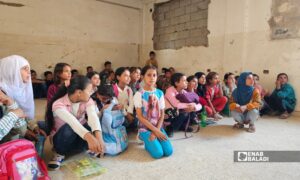
Efforts to unify education and judicial institutions continue to face obstacles that have prevented full implementation of the agreement. In education, despite the appointment of a director of education in al-Hasakah and the head of an educational district in Qamishli, questions over curricula, recognition of certificates issued by Autonomous Administration schools and universities, the future of teaching staff, and the mechanism for integrating them into the official system remain unresolved.
The same applies to higher education. Steps have begun to integrate Al-Sharq University in Raqqa (northeastern Syria) into Euphrates University, while general principles have been announced for integrating Rojava University. No similar developments have been recorded regarding Kobani University.
The stalemate is even clearer in the judicial track, one of the main tests facing the restoration of state administrative functions. The absence of an agreed mechanism for incorporating Autonomous Administration judges into Syria’s judiciary, along with disputes surrounding the work of the Justice Palace in al-Hasakah, has affected numerous administrative matters. These include the land registry, issuance of official documents, and transactions requiring court rulings or judicial certification, leaving citizens facing two parallel legal systems in some cases.
Political researcher Hassan al-Hashimi said the obstruction is not merely procedural, but is connected to the nature of these institutions. He explained that the judiciary and education represent “the core of state sovereignty,” meaning their unification requires agreement over the legal and regulatory authority before implementation measures can proceed.
Al-Hashimi said the continued duality in these two sectors directly affects other institutions because many administrative services, including civil status records, the land registry, and passports, ultimately depend on a unified judicial and educational system.
Samer al-Ahmad, meanwhile, believes the delay in resolving these files explains why the integration process remains at its initial administrative stage, saying it is impossible to speak of a full restoration of state institutions while legal and educational authorities remain ununified.
Employees, the Real Test of Institutional Integration
Institutional integration has not been limited to transferring powers or redistributing administrations. It is also tied to the fate of thousands of employees and workers in Autonomous Administration institutions. Although the agreement stipulated formally retaining civilian employees and integrating institutions into state bodies, the past months have not produced comprehensive mechanisms for doing so, whether in terms of job classifications, recruitment criteria, or recognition of experience and qualifications. This has left a large segment of workers waiting, particularly in education, local administration, and service sectors.
Political researcher Samer al-Ahmad believes the issue of employees represents “the most important test of the integration’s success,” because no institutional integration process can be completed unless the status of employees is resolved fairly and clearly. He said the continued existence of multiple employment authorities affects institutional performance and stability.
Researcher Ezz al-Din Malla agrees with al-Ahmad, saying the issue requires a legal and administrative approach that takes into account the particular circumstances of the past years and balances the continuity of public facilities with guarantees for employees’ rights. He believes the state’s success in absorbing these personnel into a unified administrative structure will be among the clearest indicators that integration has moved from understandings to institution-building.
“Implementing an integration process of this scale requires a transitional period to address administrative and technical issues, such as reorganizing institutions, settling employees’ status, and unifying financial and administrative systems.”
Ezz al-Din Malla
Writer and journalist
Security and Militarization, More Administrative Than Security Progress
The integration process has also included security institutions. Initial steps have begun to incorporate Asayish members into the Ministry of Interior, alongside the formation of new brigades supervised by the Ministry of Defense and the reorganization of prison administration as part of implementing provisions related to restructuring security institutions.
The government has also assumed oversight of some security and administrative functions, alongside announcements of officials being appointed to shared positions, including the governor of al-Hasakah, the deputy commander of Internal Security, the assistant defense minister for the eastern region, and commanders of brigades formed in al-Hasakah and Ain al-Arab (Aleppo governorate, northern Syria).
Despite these measures, security integration remains in its early institutional stages. Current efforts are focused more on reorganizing administrative structures and distributing authority than on a complete transfer of security management responsibilities to state institutions.
Several files also remain under negotiation between the two sides, including completing the integration of Asayish personnel, the administration of detention centers, and mechanisms for command and oversight, reflecting the gradual nature of the process.
Researcher Ezz al-Din Malla believes the progress in this area should be viewed as part of rebuilding state institutions rather than as a purely military achievement. He said restructuring security agencies requires administrative and legal understandings that guarantee a unified authority and prevent overlapping powers.
Researcher Hassan al-Hashimi, meanwhile, said successful security integration will remain tied to completing the unification of the legal and judicial systems, because no security institution can operate effectively while multiple judicial and administrative authorities remain in place. Completing the remaining integration files is therefore a condition for consolidating state institutions in an integrated manner.
“Reliance on stopgap solutions and slow-moving committees has proved ineffective, and it has become clear that this is merely a waste of time and effort.”
Hassan al-Hashimi
Political researcher
Key Provisions of the Agreement Between the Syrian Government and the SDF
- A comprehensive ceasefire between the two sides and the withdrawal of military forces from contact lines.
- The start of a phased process to integrate SDF forces into state military institutions through the formation of three brigades in al-Hasakah and one brigade in Ain al-Arab.
- The entry of Ministry of Interior security forces into central al-Hasakah and Qamishli, and the start of integrating SDF-affiliated security forces into the ministry.
- The integration of civilian institutions and administrations into Syrian state institutions, the transfer of sovereign files and vital facilities to the Syrian government, and the formal incorporation of employees into the relevant ministries.
- Continued cooperation in combating the Islamic State organization, addressing prison and camp files linked to the group, and working to facilitate the return of displaced people to their areas.

An SDF fighter stands by the roadside as Syrian government Internal Security forces enter Qamishli following the integration agreement, February 3, 2026. (AFP)
From Oil to Wheat and Border Crossings, How the Integration Deal Affected the Economy
The economic effects of the integration agreement between the Syrian government and the SDF have been significant. al-Hasakah governorate contains some of Syria’s main oil fields, produces large quantities of wheat, and includes several border crossings within its administrative boundaries, making the economy one of the most important areas for assessing the effects, returns, and consequences of these assets returning to Syrian government control.
In the oil sector, the Syrian government regained control of the governorate’s most prominent fields, Rmelan, al-Suwaydiyah, and al-Jabsa, amid estimates that their production capacity has declined from 90,000 barrels per day before 2011 to only about 11,000 barrels.
Economic researcher Dr. Ayman Dasouki believes the return of al-Hasakah’s oil fields to Syrian government control in terms of administration and operation could strengthen public finances by increasing revenue and reducing import costs.
Dasouki said the scale of that contribution, despite its importance, remains dependent on several factors, including the volume of actual production that can be marketed domestically and abroad, maintenance costs and expenses linked to the condition and operation of wells and facilities, the efficiency of field management and operation, investment contracts, profit-sharing arrangements, and methods for collecting those revenues.
Economist Dr. Firas Shaabo said the real significance lies not merely in returning the fields to state administration, but in how quickly revenues can actually be generated. Regaining the fields is not sufficient, he said, because inactive wells must be rehabilitated and pipelines need maintenance. All of this requires private financing because the state does not possess the funds needed to repair the fields, particularly as the work requires modern technologies and expertise that Syria lacks.
Despite these considerations, Shaabo does not dismiss the benefits of the move. He said it will help reduce the burden of importing fuel, improve the country’s trade balance, and ease pressure on demand for US dollars, which would ultimately affect citizens’ lives even if the process takes one to two years.
Wheat and Border Crossings
al-Hasakah’s economic importance is not limited to its oil fields. Its wheat production is no less significant, with the governorate ranking first in Syria in production at 1.046 million tons, according to the latest statistics published by the Syrian Grain Establishment on July 29.
The governorate in northeastern Syria also contains several border crossings whose administration Damascus regained following the integration agreement. The most prominent include the al-Ya’rubiyah crossing, which reopened with Iraq in April, the Semalka river crossing with the Kurdistan Region of Iraq, and the Nusaybin crossing with Turkey, which remains subject to follow-up and negotiations toward an official reopening.
Economist Firas Shaabo believes the return of key institutions in al-Hasakah to state administration will be highly significant in increasing the amount of wheat available in the Syrian market because al-Hasakah is the country’s food basket. This, he said, will contribute to building a large strategic reserve, particularly after the abundant agricultural season this year.
Regarding state control of border crossings, Shaabo said the measure will help regulate and unify laws and procedures, facilitating and organizing trade movement and improving import and export operations compared with a situation in which multiple authorities control the crossings and each applies different laws and regulations.
“The return of al-Hasakah’s wheat stocks to government warehouses will contribute to improving Syrian food security.”
Firas Shaabo
Economist
Economic researcher Ayman Dasouki explained that integration allows state institutions to redeploy throughout al-Hasakah governorate, including institutions responsible for purchasing wheat from farmers and paying them, which can strengthen food security while reducing the cost of wheat imports.
Unifying management of the border crossings can also increase public revenues from customs duties and taxes collected there and combat illicit economic activity harmful to the national economy, such as smuggling or flooding the market with goods that fail to meet quality standards or harm Syrian productive sectors, according to Dasouki.
Dasouki added that unified border management helps cut off financial resources to non-state groups. He said the return of state institutions to manage the crossings and supervise security and vital sectors creates a safer environment for official trade and individual movement, while also expanding supply-chain options and connecting production and import areas with consumption and transit markets.
Sectors Most Likely to Benefit From Integration
With experts discussing the economic benefits of the integration agreement between the Syrian government and the SDF, a question arises over which sectors stand to benefit most.
Economic researcher Ayman Dasouki said the sectors most likely to benefit from the economic stability resulting from integration include energy, including electricity. More stable supplies of oil and gas could positively affect electricity production and the availability of locally sourced petroleum products compared with foreign sources that are more vulnerable to regional crises and political and security tensions.
Dasouki also identified the financial and banking sector as a potential beneficiary because integration could open new areas for financial and banking services, provided legal and financial systems are unified. He also pointed to transportation and logistics because of the potential to strengthen transport and transit activity.
He expected integration to increase employment opportunities by returning these areas to the national framework and making them accessible to Syrian and foreign investors. He also said central government revenues could be allocated to the region for infrastructure and public service projects that create jobs for local residents and support social stability. Economic integration with other Syrian regions would also expand existing businesses in transport, agriculture, trade, and other sectors, increasing demand for labor.
“The full impact of integration on the Syrian economy as a whole will require time and reliable statistics.”
Ayman Dasouki
Economic researcher
Economist Firas Shaabo believes Syria’s eastern regions in general, including al-Hasakah, lack investment incentives and still require the degree of security necessary for investment projects, which will remain an obstacle to attracting investors to the area.
Shaabo said the state’s efforts to extend its control over the region could provide reassurance to local and foreign investors considering launching projects there.
He said all sectors in the eastern governorates have been devastated and require development, expecting agriculture, energy, construction, and reconstruction to experience the greatest growth in the coming period if stability and an investment-friendly environment are available.
Failure of the Agreement Could Carry Economic Risks
More than six months after the Syrian government and SDF signed the integration agreement, implementation has not been completed at all levels, amid disagreements over how to apply some parts of the deal.
The slow pace of certain administrative steps raises questions about whether delays in full integration could cause the agreement to fail or face obstacles that might generate future tensions, and what effect that could have on the economic gains recorded in recent months.
According to economic researcher Ayman Dasouki, failure of the integration agreement or serious obstacles to its implementation could disrupt the production and marketing of oil and gas, increase import costs, revive illicit war-economy activities, and deprive the state of revenues it badly needs at an extremely sensitive stage.
Dasouki said failure of the agreement could also entrench fragmented economic structures that support projects opposed to Syria’s territorial unity, while obstructing regional economic integration projects. This could exclude Syrian territory from some of these initiatives and result in lost opportunities for revenues and investment.
Economist Firas Shaabo said failure of the agreement would not be positive for the Syrian economy as a whole, despite a measure of reassurance in central and coastal areas. Any security breakdown or tensions in the eastern region, he said, would affect Syria’s overall investment climate.
Shaabo does not believe the oil sector would be the most affected. He said the involvement of US companies in investing in the sector would likely lead Washington to protect it and keep it insulated from tensions. He expected service operations and citizens’ daily needs to suffer the greatest impact if tensions emerge in the future.

Syrian President Ahmed al-Sharaa meets SDF commander Mazloum Abdi to discuss completing the SDF integration agreement, April 17, 2026. (SANA)
Between Slow Implementation and Conflicting Messages, What Is Next for the Damascus-SDF Deal?
While Damascus maintains that the integration agreement with the SDF is the only political framework for addressing issues in northeastern Syria, assessments differ over the actual level of implementation. Several security and administrative files remain unresolved, while regional and international calculations continue to influence the agreement’s trajectory.
Observers believe the agreement has moved beyond the stage of declaring intentions, but its ultimate success depends on overcoming the trust crisis between the two sides and resolving the most complicated issues, from military integration to the return of displaced people and the future of local administration, weapons, and Kurdish political rights.
From Political Understanding to Implementation Test
According to journalist and political researcher Samer al-Ahmad, the agreement entered the stage of practical implementation months after it was signed, with the integration of some brigades beginning, efforts starting to incorporate Asayish forces, and state institutions returning to several areas that had been outside their direct administration.
Al-Ahmad said these steps reflected a clear direction toward ending security and administrative duality, despite the continued postponement of several files.
Nawaf Khalil, director of the Kurdish Center for Studies in Germany, meanwhile, acknowledges a Kurdish commitment to implementing the agreement even though it did not fulfill all Kurdish demands.
Khalil said the Autonomous Administration and the SDF accepted the agreement out of political realism, but stressed that relations with Damascus still suffer from a crisis of trust because of continued media rhetoric that, in his view, does not help create an appropriate environment for implementation.
“The Autonomous Administration and the SDF accepted the agreement out of political realism, but the relationship with Damascus still suffers from a crisis of trust.”
Nawaf Khalil
Director of the Kurdish Center for Studies
Al-Sharaa’s Messages, Commitment to the Agreement or Tougher Conditions?
Statements by Syrian President Ahmed al-Sharaa acknowledging the slow implementation of the agreement while stressing that it remains the most suitable framework for resolving outstanding issues have prompted different interpretations of the message Damascus intended to send.
Analyst Samer al-Ahmad believes al-Sharaa delivered a dual message. On one hand, he acknowledged that implementation is proceeding more slowly than expected. On the other, he confirmed the state’s continued commitment to the agreement, while emphasizing the need to move from statements to practical steps on the ground.
Nawaf Khalil, by contrast, believes the political discourse from Damascus contains a contradiction between maintaining commitment to the agreement and diminishing the significance of the party that signed it.
Khalil said distinguishing between Kurdish society and the SDF does not send reassuring messages. He stressed that building trust requires translating statements about the Kurdish people into constitutional recognition guaranteeing their political, cultural, and linguistic rights and their representation in state institutions.
Syrian President Ahmed al-Sharaa said in an interview with Qatar’s Al Jazeera on July 26:
- Implementation of the agreement signed between the Syrian government and the SDF on January 29, 2026, has been slow, but the government is still committed to making the agreement succeed and completing its provisions.
- Damascus continues to regard the agreement as the appropriate framework for addressing outstanding issues.
- A distinction should be made between Kurdish society and the SDF.
- Kurds should receive full citizenship and cultural rights.
- The agreement with the SDF aims to integrate it into state institutions based on the principle of Syrian territorial unity and the state’s monopoly over arms.
Delayed Files, Why Is Implementation Slowing?
Despite progress in some areas, Samer al-Ahmad and Nawaf Khalil agree that the most sensitive files remain unresolved, although they differ in their explanations for the delays.
Al-Ahmad said the challenge is no longer limited to integrating military forces but includes more complicated issues, such as the “Revolutionary Youth,” the spread of weapons, the return of displaced people, properties and real estate administered by Autonomous Administration institutions, and ending any security or administrative authority parallel to the state.
Khalil, by contrast, held the Syrian government responsible for a large share of the slow implementation. He said the continued prevention of displaced people from returning to Ras al-Ain (al-Hasakah governorate, northeastern Syria) and Tal Abyad (Raqqa governorate, northern Syria), the persistence of some armed manifestations, continued inflammatory media campaigns, and the failure to address detainee and missing-person files are all factors widening the trust gap and delaying implementation of the agreement.
External Factor, Support for Stability or Management of Interests?
External positions have played a role in relations between Damascus and the SDF throughout different stages, from the March 10, 2025 agreement to the military escalation between the two sides at the beginning of this year and then the integration agreement signed on January 29, 2026. This makes the external role, particularly the positions of Washington and Ankara, a major factor in the agreement’s course and one capable of affecting its success or obstruction.
Researcher Samer al-Ahmad believes international and regional interests currently converge around supporting stability in northeastern Syria, despite differences in priorities. The United States is focused on integrating the SDF into state institutions, while Turkey prioritizes ending any presence linked to the Kurdistan Workers’ Party along its border. He therefore sees the external factor today as closer to supporting implementation than obstructing it.
Nawaf Khalil said the agreement would not have emerged without US sponsorship and Turkish acceptance, but he criticized the American role during some stages of implementation, saying Washington has not always succeeded in compelling the parties to abide by what was agreed.
He also believes Turkey views the agreement through the lens of its security interests and seeks to limit any political gains for Kurds, although it is compelled not to allow the agreement to fail entirely because of its connection to the Kurdish-Turkish peace process.

Syrian Ministry of Defense delegation conducts a field tour in al-Hasakah, February 6, 2026. (SANA)
Kurds and Tribes, Multiple Positions Rather Than One Voice
Between Kurdish demands for the protection of cultural and linguistic rights and the return of displaced people, and Arab demands for the “restoration of the state’s role” and an end to continued SDF control, local society has remained active in the developments taking place in al-Hasakah during this period, raising questions over the extent of its influence on the agreement’s implementation.
The two experts agree that reducing the situation to a single Kurdish position or a single tribal position toward the agreement and its implementation does not reflect reality.
Samer al-Ahmad said there are currents within Kurdish society that support returning to state institutions as a path toward stability, while other groups fear losing the influence they gained over the past years.
He also believes tribes are primarily focused on the return of displaced people, restoring rights, and ending grievances rather than on military escalation.
Nawaf Khalil, director of the Kurdish Center for Studies, believes discussion of an independent tribal position overlooks what he described as the influence of official bodies on some mobilizations. He said the broader Kurdish position still leans toward adherence to the agreement despite widespread criticism of the Autonomous Administration and the SDF because it is seen as the most realistic option under current circumstances.
Where Is the Agreement Headed?
Journalist and political researcher Samer al-Ahmad believes continued implementation at the current pace could lead to further steps to end security and administrative duality and possibly to an official declaration that the SDF has been fully dissolved as an independent organization.
He stressed, however, that the success of the agreement will not be measured by political announcements, but by the state’s ability to address difficult files, foremost among them weapons, the “Revolutionary Youth,” the return of displaced people, and property.
“The agreement’s success will not be measured by political announcements, but by the state’s ability to address the difficult files, foremost among them weapons.”
Samer al-Ahmad
Journalist and political researcher
Nawaf Khalil, director of the Kurdish Center for Studies, expects the agreement to continue despite the slow pace of implementation, saying any new meeting between Syrian President Ahmed al-Sharaa and SDF commander Mazloum Abdi could provide the agreement with new political momentum.
He stressed, however, that the agreement’s future will remain tied to the extent of Damascus’s commitment to implementing its pledges and its ability to build trust with the Kurdish community, alongside the continued influence of regional and international dynamics on the file.

The final group of displaced Afrin residents in al-Hasakah returns home, July 16, 2026. (SANA)
if you think the article contain wrong information or you have additional details Send Correction
النسخة العربية من المقال
-
Follow us :



 More In-Depth