
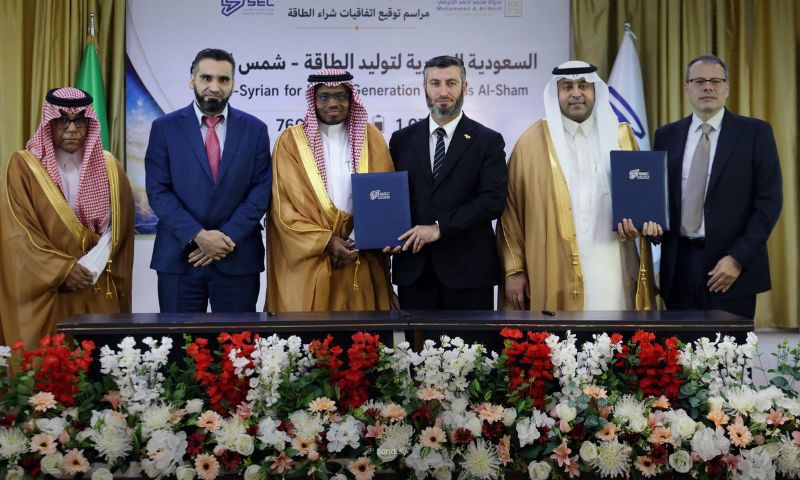

The Syrian Electricity Company, SEC, signed three agreements on Wednesday, August 5, with Saudi Arabia’s Al-Harafi Contracting Company to implement three solar power generation projects worth up to $1 billion.
The new agreements with the Saudi company include:
- Building solar power plants in Wadiyan al-Rabi, Rural Damascus (southwestern Syria).
- Establishing a total generation capacity of 760 megawatts.
- Supporting the plants with battery energy storage systems totaling 1,077 megawatt-hours.
The General Establishment for Electricity Transmission and Distribution in Syria, now the Syrian Electricity Company, announced last February that it had signed a binding memorandum of understanding with Saudi Arabia’s Mohammed Ahmed Al-Harafi Contracting Company to build a solar power plant in Rural Damascus. The plant was planned with a capacity of 210 megawatts of alternating current and a battery energy storage system with a capacity of 827 megawatt-hours.
Ibrahim Amir, deputy general manager of Al-Harafi, said at the time that the project would be built in Rural Damascus. He added that it would cost approximately $250 million and was expected to be completed within 12 months.
Solar Projects With and Without Storage
Osama Abu Zaid, Syria’s assistant energy minister for water and electricity affairs, said in a press statement that the agreements include the construction of solar power systems both with and without storage systems. He said the projects represent an important step toward:
- Improving Syria’s electricity generation capacity.
- Strengthening the stability of the electricity supply.
- Supporting the service and industrial sectors.
Faisal al-Duaij, Saudi Arabia’s deputy energy minister for renewable energy, said the agreements are valued at nearly $1 billion. He added that their scheduled implementation period ranges from four to five years, although efforts will be intensified to complete them within no more than three years.
According to Fuad Mosa, an adviser to the Saudi energy minister, the new energy projects aim to:
- Supply Damascus and its countryside with electricity during the first phase, as they contain the country’s largest population concentration.
- Supply Aleppo city with electricity during the second phase.
Mosa said the projects would help attract investors and strengthen investment opportunities in Syria’s energy sector.
Syrian Energy Minister: A Step to Expand Energy Projects
Syrian Energy Minister Mohammed al-Bashir said through his account on the X platform that the agreements signed between the Syrian Electricity Company and Al-Harafi Contracting represent “an important step toward expanding renewable energy projects in Syria.”
He said the construction of solar power plants with a total capacity of 760 megawatts, supported by battery storage systems with a capacity of 1,077 megawatt-hours, forms part of efforts to develop a more stable and efficient electricity system. The projects are also intended to increase reliance on clean energy sources, support energy security, and contribute to sustainable development.
“These agreements confirm our commitment to encouraging high-quality investments and effective partnerships with specialized companies, supporting the development of Syria’s energy sector,” al-Bashir added.
What Is Saudi Arabia’s Al-Harafi?
Al-Harafi Contracting Company, formerly known as al-Hoshan Establishment, was founded in 1965 and is headquartered in Riyadh, Saudi Arabia.
The company currently focuses on infrastructure projects, including roads, dams, construction, and maintenance projects in both the public and private sectors.
It also seeks to participate in major strategic projects in line with Saudi Arabia’s National Transformation Program and development plans.
The company has carried out major government projects in Saudi Arabia worth hundreds of millions of Saudi riyals. These include a Saudi Ministry of Water and Electricity project with an estimated total cost of 87 million riyals, another project valued at approximately 37 million riyals, projects to build colleges and higher institutes for the Technical and Vocational Training Corporation worth around 311 million riyals, and a project for the Military Industries Corporation valued at 26 million riyals.
The company also has investments in Dubai involving the trade of equipment and machinery.
Syrian Framework Agreement With Saudi PDC
The General Establishment for Electricity Transmission and Distribution, now SEC, also signed a framework agreement last February with Saudi Electricity for Project Development, PDC, to provide specialized technical and engineering services for energy projects.
The Syrian Ministry of Energy said at the time that the framework agreement formed part of its efforts to improve the efficiency and technical readiness of energy projects by drawing on specialized expertise, transferring knowledge, and building capacity. The agreement is intended to:
- Accelerate project implementation.
- Improve the reliability of the electricity system.
- Support the sector’s medium and long-term development plans.
Series of Agreements and Understandings
The new projects are part of a series of agreements concluded in Syria’s electricity sector over recent months. SEC has signed several memoranda of understanding and contracts to expand renewable energy projects, including:
- A cooperation agreement with the Syrian Turkish Energy Company, STE, to build a 100 megawatt photovoltaic power plant in Kafr Buhum (Hama governorate, central Syria).
- A contract to purchase 100 megawatts of solar-generated electricity from the Syrian Turkish Energy Company.
- Two memoranda of understanding with the Saudi companies Al-Harafi and SCLCO to implement photovoltaic and wind energy projects with a total capacity of up to 500 megawatts.
- An agreement with Manarat al-Shahba Renewable Energy Company to build a 100 megawatt solar power plant in Syria’s central region.
- A cooperation agreement with ACWA Power to prepare a comprehensive study on the optimal distribution of energy sources and ways to strengthen the stability of Syria’s electricity system.
- A 700 megawatt wind energy project with MARV Energy.
Agreements With Urbacon
These agreements follow final deals signed by the Syrian Ministry of Energy last November with an international consortium led by Urbacon Holding to build four power generation plants with a combined capacity of 5,000 megawatts, using natural gas and solar energy.
The agreements include plants in northern Aleppo, Deir Ezzor (eastern Syria), Rural Damascus, and Syria’s central region. They also include solar energy projects with a combined capacity of 1,000 megawatts across several locations in Syria, according to an announcement published by the ministry on Facebook on Thursday, November 6.
The Syrian Arab News Agency, SANA, reported at the time that the power plants and energy projects covered by the agreements were distributed as follows:
- A 1,200 megawatt power plant in northern Aleppo.
- Two 1,000 megawatt plants in Deir Ezzor and Zayzoun.
- An 800 megawatt plant in Mahardah (Hama governorate, central Syria).
- Solar renewable energy projects with a combined capacity of 1,000 megawatts across four locations.