


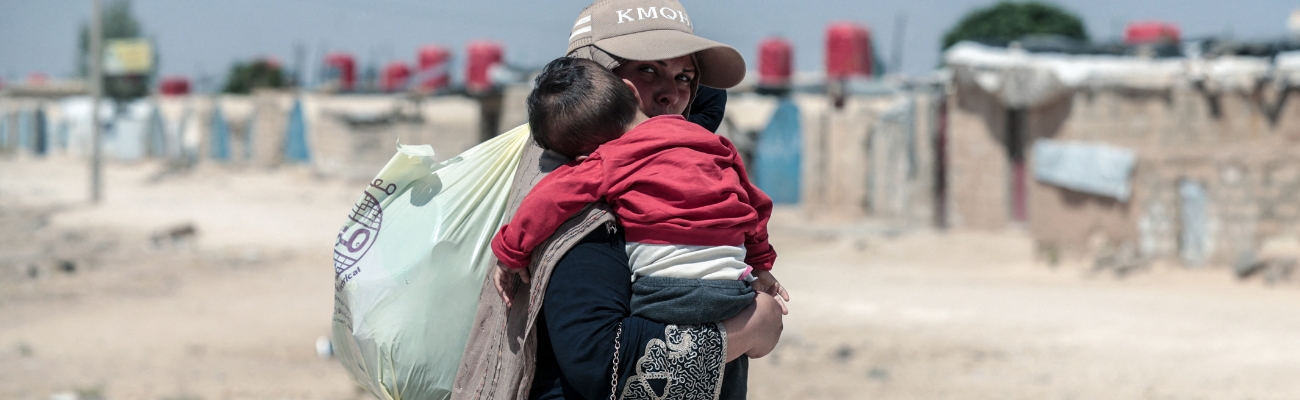
 A woman bathes a child at a camp for displaced people near Sarmada in Idlib governorate, northwestern Syria, June 28, 2024. (AFP)


 A
A
A
A
A
A
Rakan al-Khadr |Mohammed Jaffal| Yazan Kur
Displacement was one of the most significant consequences of military operations in Syria and the deterioration of security and living conditions, which drove millions of Syrians to leave their areas and move to more stable cities and towns.
The United Nations described Syria as having witnessed the world’s largest displacement crisis, with more than 13 million people forced either to flee the country or become displaced within its borders.
As successive waves of displacement continued throughout the years of the Syrian revolution, communities took shape far from their places of origin and faced pressures, difficulties, and changes in ways of life, economic activity, and social customs.
Enab Baladi examines displacement through its social effects on the customs, traditions, and lifestyles of different regions, as well as the pressure it has placed on job opportunities, infrastructure, and services. The report draws on the views of displaced people and members of host communities to identify the most significant changes in their lives resulting from a phenomenon that has affected many Syrian regions over recent years.
Enab Baladi also speaks with a group of sociology experts in an effort to identify the most significant effects of displacement on displaced people and host communities, and to explore appropriate evidence-based approaches for building on its positive aspects and addressing its negative consequences, with the aim of strengthening civil peace and avoiding future conflict that could result from poorly considered social behavior.
Syria’s Largest Displacement Wave: Host Communities Between Integration and Pressure
Since the Syrian revolution began in 2011, the country has experienced the largest wave of displacement in its history and one of the largest worldwide. Its impact has not been limited to those forced to leave their homes, but has extended to the communities that received them, reshaping the demographic composition of many areas and creating new challenges for services, infrastructure, the labor market, and social relations.
A study by The Arab Center for Contemporary Syria Studies divided Syrian displacement into three main waves. The first, between March 2011 and the end of 2012, was described as “scattered and temporary displacement, sought by people fleeing areas of intense protests for nearby cities on a temporary basis.”
The number of internally displaced people reached 1.6 million by the end of 2012.
The second wave occurred during 2013 and 2014 and saw a sharp increase in displacement as military operations escalated. The number of displaced people was estimated at 6.5 million by October 2013, including around 1.8 million displaced people from Aleppo governorate, followed by 770,000 from Rural Damascus and 708,000 from Idlib.
The third wave followed Russia’s military intervention in Syria on September 30, 2015, as the pace of military operations intensified. Around 2.2 million Syrians were displaced as a result of Russian military operations in 2016.
The center’s study did not include other major waves of displacement, particularly in northwestern Syria. A United Nations statement reported that around 900,000 civilians had been displaced from that region between the beginning of December 2019 and mid-February 2020 because of the “continuing military campaign.”
United Nations Secretary-General spokesman Stéphane Dujarric announced in March 2022 that there were around 6.9 million internally displaced people in Syria.
Later, a report issued by the United Nations High Commissioner for Refugees, UNHCR, said that more than 1.03 million displaced people had left displacement camps between December 2024 and February 5, 2026.
A total of 1.5 million returns were also recorded between January and August 2025, bringing the overall number of internally displaced people who had returned to 1,712,744 by early February 2026.

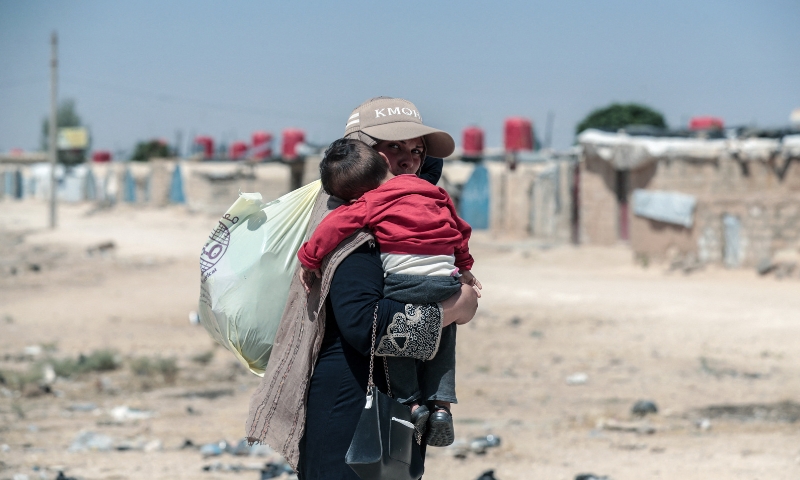
A displaced Syrian woman from Ras al-Ain carries a child while walking through al-Talae camp for displaced people in al-Hasakah, northeastern Syria, July 23, 2026. (AFP)
Idlib and Its Surroundings, The Greatest Hardship
Cities such as Idlib (northwestern Syria), Damascus, Latakia (western Syria), and al-Hasakah (northeastern Syria), because of their relative stability during years of war, became destinations for displaced people from several governorates.
Idlib experienced a major population increase that doubled its number of residents to around four million as a result of voluntary or forced internal displacement.
Statistics from humanitarian organizations operating in northern Syria showed that there were 1,607 camps, including 1,259 formal camps and 348 informal ones.
These camps housed around 1.2 million civilians, while the total number of displaced people living both inside and outside camps exceeded two million, accounting for 49 percent of the population of northwestern Syria across Hama, Aleppo, and Idlib.
Damascus and its surroundings also experienced major changes and pressure because of the movement of residents from neighboring governorates, particularly Quneitra and Daraa, as well as from more distant governorates. The population doubled and some suburbs expanded after becoming new areas of settlement, while the number of homeless and impoverished people increased noticeably in neighborhoods of the capital and its center.
Latakia also saw changes in patterns of daily life after large numbers of displaced people arrived from Aleppo, beginning with pressure on housing and services and extending to the emergence of new professions and markets as displaced people brought trades and expertise with them.
While some displaced people found a place where they could live away from the threat of death and rebuild their lives, host communities faced challenges linked to increased demand for limited resources. This opened a debate over the nature of relations between original residents and newcomers, and whether long-term displacement would lead to broader social integration or leave pressures requiring sustainable development and administrative solutions.
Syrian displacement has also been marked by continuity and repetition, with a single family sometimes forced to move more than once because conditions deteriorated in the area to which it had first fled, driving it to relocate a second time or repeatedly.
Pressure on Services and the Housing Crisis
Years of displacement changed the character of host cities and areas in several ways. Housing and public services were among the sectors most affected, as demand for accommodation increased and population density rose in a number of neighborhoods and regions.
Real estate office owners in Latakia told Enab Baladi that rents had risen to nearly double in some areas over the years of displacement because of increased demand for houses and apartments. They said the arrival of large numbers of displaced families, particularly from Aleppo city and its countryside, created unprecedented activity in the real estate market.
At the same time, this change in the use of residential space increased pressure on services available in some areas, including water, electricity, sanitation, and roads, as the population rose beyond the original capacity for which these areas had been planned.
Alongside the housing crisis, local institutions faced additional challenges in education, healthcare, and municipal services as population growth imposed new demands throughout the years of war, while service providers had limited ability to expand because of economic and administrative conditions.
Economic Activity Moves With the Displaced
Alongside its impact on housing and services, displacement had a clear effect on commercial activity in host communities.
Idlib governorate recorded an increase in unemployment in 2021, with the rate ranging between 78 and 80 percent of the local population, according to figures obtained by Enab Baladi from the Syria Response Coordinators.
Despite relief efforts and the presence of two governments in northern Syria at the time, the Interim Government and the Salvation Government, economic conditions drove many experienced professionals and university graduates out of the labor market, or forced them to work in trades, daily labor, or jobs outside their fields of expertise.
A survey published by the Syria Response Coordinators on February 8, 2020, found that 89 percent of around 3,900 respondents in northern Syria said they were unemployed, while the proportion of those wishing to work for organizations or in freelance jobs ranged between 29 and 33 percent.
Different Conditions in Latakia
In Latakia, the arrival of Aleppo merchants and craftspeople during the years of war helped stimulate some sectors and change the character of several markets.
According to merchants in Latakia who spoke to Enab Baladi, the arrival of traders from Aleppo helped stimulate commercial activity and introduced new approaches to sales and marketing, drawing on the long experience many of them had in commerce and industry, particularly the clothing trade.
The al-Inaba market area became the most prominent hub for merchants arriving from Aleppo, with many opening stores there, particularly clothing shops, changing the market’s appearance within a few years.
Latakia merchants in al-Inaba market told Enab Baladi that the arrival of Aleppo traders changed the nature of commercial activity in the area. The market attracted a new segment of shoppers from inside and outside Latakia and became more active and crowded than it had been before the years of displacement.
They added that the increase in the number of stores and the greater variety of goods helped turn al-Inaba market into one of the city’s most vibrant commercial areas, after commercial activity there had previously been less intense.
From Tension to Coexistence
Conditions of coexistence between displaced people and host communities varied across northern Syria. Displaced and host populations often lived under similar conditions, which helped facilitate accommodation and integration in cities and rural areas, although conditions were different inside camps.
In Latakia, however, relations between the host community and displaced people were not stable from the outset. The first waves of displacement to the city were accompanied by anxiety among many local residents because of the sudden population increase and resulting pressure on public services, higher rents, overcrowded schools and health centers, and increased competition in the labor market.
Several Latakia residents told Enab Baladi that the early years of displacement saw sporadic tensions and disputes fueled by living pressures and rapid changes in the city, as well as a perception among some residents that available services were no longer meeting everyone’s needs at the same level.
These tensions gradually began to decline over time as both sides became accustomed to the new reality and broader social and professional relationships developed between residents and displaced people.
The participation of displaced people in the labor market, their opening of businesses and shops, and the integration of their children into schools and universities increased daily interaction and transformed the relationship from temporary hosting into a form of coexistence.
Those who spoke to Enab Baladi said social ties expanded over the years, with friendships and neighborly relationships developing and, in some cases, marriages taking place between families from the two communities. The view of displaced people as temporary newcomers also declined, while many became part of the city’s economic and social life.
Challenges of Social Coexistence
Researcher and social specialist Ghodran Najm believes the current relationship between local residents and displaced people, or “returnees,” as she prefers to call them, is complex and cannot be described as either complete coexistence or permanent tension. Instead, it moves within a flexible space shaped by economic, service, and social conditions.
Najm told Enab Baladi that Syrian society showed a high level of community and humanitarian solidarity during the first years of displacement, particularly during the war and emergency crises, when local residents and displaced people shared housing and services and reciprocal community initiatives emerged to support those affected.
“The current relationship between local residents and displaced people is complex and dual in nature. It does not follow a single rigid equation, neither complete coexistence nor total tension, but moves within a flexible space influenced by current economic, service, and social conditions.”
Ghodran Najm
Researcher and social specialist
Najm added that continued displacement alongside the worsening economic crisis led to signs of social tension, some of which remained unspoken while others became clearly visible. These resulted from competition over basic services such as water, electricity, and public hospitals, along with a perception among some local workers that displaced workers were competing with them by accepting lower wages, as well as rising property prices and rents, affecting all sides.
According to the researcher, these tensions vary from one area to another. Some rural areas show high levels of cooperation in work and social occasions, while friction is more pronounced in densely populated areas, where competition over services and aid is greater.

A woman bathes a child at a camp for displaced people near Sarmada in Idlib governorate, northwestern Syria, June 28, 2024. (AFP)
Rebuilding the Lives of Millions,
A New Society Emerges Away From Home
Internal displacement in Syria was not merely a geographical movement imposed by war. It became a social experience that reshaped the lives of millions of Syrians, their relationships, and their roles within families and society. As families moved from their cities and villages into new environments, displaced people did not carry only their possessions, but also their customs, dialects, professions, and memories, while confronting a new reality that forced them to rebuild their lives.
As the years of war passed, many displacement areas ceased to function as temporary places of residence and instead became new social spaces where professional relationships, friendships, and marriages emerged. Family roles changed, while some traditional support networks based on extended family and geographic proximity weakened.
Awad al-Aboud, who was displaced from Ras al-Ain (al-Hasakah governorate, northeastern Syria) and has lived in al-Hasakah city for years, said the hardest part of his early displacement was not only losing his home, but feeling that he had to start his life again in a city where he knew no one.
He added, “At first, we thought our presence here was temporary, so our connection to every detail of Ras al-Ain remained strong. But as the years passed, we began building new relationships, we got to know the neighbors, our children started studying with children from al-Hasakah, and then we opened a small shop that supports our family.”
He said work helped him integrate into his new surroundings but did not erase his connection to his original city. “I have a life here now, but my longing for Ras al-Ain has never left me. A person remains attached to the place where they grew up.”
He believes displacement allowed him to meet people from different regions, saying the war brought Syrians together in environments where they had not previously mixed.
Nuhat Mohammad, a teacher displaced from Afrin (Aleppo governorate, northwestern Syria) to Qamishli (al-Hasakah governorate, northeastern Syria), said displacement pushed her to assume new responsibilities she had not expected after she was forced to work to help support her family.
She added, “In Afrin, our life was stable and the roles within the family were clear, but after displacement everything changed. I learned a new profession, and decisions within the family became different.”
She said her children became more open as a result of mixing with children from different areas at school. “They became familiar with different dialects and customs, and they now have friends from backgrounds that were not part of their lives before.”
Social Structure and Patterns of Relationships
Social researcher Mohammad Ali Qasem believes internal displacement represents one of the deepest social transformations Syrian society has experienced in recent decades because it changed not only where people live, but also their relationships with places and with one another.
He said millions of Syrians found themselves living alongside communities with different dialects, customs, and patterns of social relationships, forcing them to build new networks beyond the extended family and neighborhoods in which they had been accustomed to living.
He added that these transformations brought both positive and negative consequences. On one hand, they expanded relationships among Syrians, transferred trades and expertise between governorates, created economic and professional partnerships, and contributed to marriages between families from different areas.
On the other hand, Qasem said displacement weakened some traditional forms of solidarity because when people leave their original environment, they lose part of the support network that surrounded them and need time to build a new one.
He noted that Syrian families also underwent clear changes during the years of displacement. Many women entered the labor market for the first time, while young people were forced to change their educational and professional paths because of economic conditions.
“The concept of belonging to a place is no longer what it was before the war. There are young people who remain connected to their birthplace but at the same time carry experiences and relationships formed in areas of displacement,” he said.
“Internal displacement represents one of the deepest social transformations Syrian society has experienced in recent decades.”
Mohammad Ali Qasem
Social researcher
Psychological Effects, Losing a Place and Trying to Restore Security
The effects of displacement are not limited to social and economic aspects. Psychological support specialist Diala Abdullah, who has worked with displaced people in a number of camps and affected communities in northeastern Syria, believes displacement means losing a sense of security and stability, not merely losing a home.
She added that many displaced people carried experiences involving the loss of property, livelihoods, or family members, and that years of continued uncertainty made the effects of trauma more complicated.
She said people can cope with a difficult event when they know where it ends, but prolonged waiting and uncertainty about the future increase psychological pressure.
She explained that changes in the social environment imposed challenges on many families, forcing members to assume new responsibilities, while some displaced people lost part of the support network previously provided by family and local community.
At the same time, Abdullah warned that ignoring the psychological effects of war and displacement could allow them to pass between generations, particularly among children who grew up in unstable conditions. She stressed the importance of psychological and social support and education during the recovery phase.

Displaced people at a shelter center in the village of Hmeimat al-Dayer, eastern Idlib countryside, April 20, 2026. (Enab Baladi/Iyad Abdul Jawad)
Displacement Changed More Than Where People Live
The experiences of displaced people and the views of specialists indicate that years of displacement have not only created new population concentrations, but have also contributed to new patterns of relationships, belonging, and work.
Many displaced people no longer live in the places where they were born, while at the same time they have not severed their ties with their areas of origin, creating a complex relationship between the first place and the new one.
“Displacement was not an entirely negative experience, as many people were able to develop new abilities to adapt, build different relationships, and acquire skills that had not previously been available to them.”
Diala Abdullah
Psychological support specialist
Displacement and Social Identity, A Generation Living With Contradictions
Years of Syrian displacement during the country’s war produced a generation of children and young people who grew up in areas far from their original communities.
The settlement of this new Syrian generation away from the environments in which their parents and grandparents lived led to changes in some of the social customs that distinguished earlier generations from their home areas.
At the same time, the experience of displacement has not been entirely without positive effects for the younger generation. Exposure to new social cultures raises questions about how displacement will affect Syria’s social structure over the long term and how young people can preserve the community identities that distinguish their regions from others.
Effects of Displacement on Syrian Youth Identity
Social counselor Samia al-Tarsh told Enab Baladi that the most significant negative effects of displacement on the identity of children and young people who grew up in environments far from their home regions include loss of belonging, lack of security and stability, and loss of identity, which can cause profound psychological disturbances and trauma.
She said displacement and disasters in general may also interrupt education, affecting the development of individuals able to contribute to society and reducing their ability to adapt to others in their generation.
Al-Tarsh explained that when children are forced to change where they live, they face challenges and conflicts between their old and new environments, undermining feelings of stability and security and affecting their connection to the social culture of their home region as well as their sense of belonging to it.
Social researcher Rana al-Badawi, meanwhile, said children who have spent most of their lives away from their areas of origin do not experience a return to those areas as a return home, but rather as entry into an unfamiliar and psychologically unsettling environment. This is because children’s attachment to place is formed primarily through direct everyday experience rather than through the abstract cultural or symbolic meaning of a place, as is more often the case with adults. As a result, areas of displacement, despite formally being considered temporary, can become a child’s deepest emotional reference point, while the original region becomes somewhere they are said to be from rather than somewhere to which they feel they belong.
Al-Badawi explained that this contradiction creates confusion in identity. Values are not acquired through direct instruction alone, but through repeated interaction within overlapping systems, beginning with the microsystem represented by the family, school, and immediate peer group, the mesosystem involving relations among these systems, and the exosystem and macrosystem encompassing the broader cultural, religious, and political structure.
According to al-Badawi, a child’s social values develop cumulatively through repeated exposure to the same value messages across these systems rather than through one system in isolation. When a child grows up in a relatively homogeneous environment, the three microsystems, family, school, and peers, generally transmit consistent and similar value messages, including religious and social homogeneity as well as values of survival and collective solidarity associated with emergency conditions. This consistency can produce a strong value structure, but one with a narrow frame of reference if it is not tested through genuine diversity.
When a child is moved into an environment that is more socially, religiously, and economically diverse, what can be described as inconsistency between systems emerges. The family may preserve the original values while the new school or peers expose the child to a partially different value system.
“The most significant negative effects of displacement on children and young people include loss of belonging, lack of security and stability, and loss of identity.”
Samia al-Tarsh
Social counselor
Preserving the Identity of Displaced Youth
Researcher Rana al-Badawi said preserving the community identity of displaced young people begins within the family during displacement itself because early socialization requires continuity over time if it is to take root. This means supporting displaced families in passing on their dialects, trades, and local rituals as everyday practices rather than as a separate heritage to be recovered later, because identity is lived, not stored.
According to al-Badawi, institutionally building “sub-worlds” that integrate multiple regional identities rather than dissolving them into a single framework may also help. This could include curricula that explicitly incorporate Syria’s cultural diversity and extracurricular activities that highlight the distinctiveness of each region instead of subsuming them under an abstract “national identity” that erases differences.
Al-Badawi explained that providing spaces for periodic communal celebrations among people from the same region during displacement is not a luxury, but a structurally necessary mechanism for keeping identity alive rather than allowing it to become merely a memory.
“Preserving the community identity of a displaced young generation begins with the family because early socialization needs continuity over time to become firmly rooted.”
Rana al-Badawi
Social researcher
For her part, social counselor Samia al-Tarsh does not believe every aspect of displacement has negative consequences for Syria’s younger generations. Living alongside communities with different customs and traditions can support cultural and social exchange with host communities, allowing children and young people to learn new skills that make them more flexible in dealing with diverse groups within society.
Al-Tarsh added that interaction with host communities does not undermine the preservation of the cultural identity of a displaced person’s original environment if they maintain contact with family and relatives, continue their education, and participate in religious occasions and practices that reinforce family ties, such as holidays.

Residents of Kobani bid farewell to displaced people from Afrin returning to their homes, May 19, 2026. (Ronahi)
Conflict, Coexistence and Preserving Civil Peace
From Displacement to Social Recovery
Researcher Mohammad Ali Qasem believes the most positive scenario would be for relationships created during years of displacement to become stable social ties, so that the communities that received displaced people become part of their lives even if some eventually return to their areas of origin.
He noted, however, that the success of such a path requires better services, more employment opportunities, and support for host communities to prevent competition over resources from turning into social tensions.
From a psychological perspective, Diala Abdullah believes integration requires addressing the effects of loss and fear carried by many displaced people. She emphasized that supporting children and young people will be essential to building greater capacity for adaptation.
Fragile Coexistence May Continue
According to Qasem, the current situation could continue without full integration if economic and service challenges remain unresolved. Daily relations may remain stable while still being vulnerable to tension caused by competition over jobs, housing, and services.
Abdullah believes continued uncertainty may increase psychological pressure, particularly among families that do not know whether they will return to their areas or settle permanently in the places to which they were displaced.
Intervention Mechanisms, From Managing Displacement to Recovery
Researcher Mohammad Qasem believes dealing with the consequences of displacement requires moving from emergency response toward long-term policies focused on rebuilding relationships between communities, rather than addressing only the immediate needs of displaced people.
He said the success of any intervention depends on development programs that include both displaced people and host residents through support for employment opportunities, improvement of basic services, stronger education, and the creation of shared spaces that help build trust and reduce social divides.
He warned that treating displacement only as a humanitarian aid issue could perpetuate dependency and isolation, while economically and socially empowering individuals can help turn communities that received displaced people into more stable environments.
Diala Abdullah believes the psychological dimension should be an essential part of any recovery plan rather than a later phase. She explained that many displaced people need spaces that help them process experiences of loss and fear and restore a sense of security.
She added that supporting children and young people, particularly through education, social activities, and psychological support programs, could be the most influential factor in preventing the effects of war from being passed on to future generations.
Urgent Measures, Organized Spaces for Communication
Researcher Rana al-Badawi focused on urgent measures requiring institutional government intervention, including transparency in the distribution of humanitarian assistance and expansion of basic services rather than distributing them on a competitive basis, since competition over housing, healthcare, and education is a major driver of tension.
Al-Badawi also pointed to medium-term steps, such as building organized spaces for communication between the two sides because social cohesion does not develop automatically through physical proximity alone, but requires deliberate frameworks for interaction. These could include joint community projects and mixed local committees representing both sides to manage issues affecting neighborhoods or villages.
Long-term measures, according to al-Badawi, involve consciously using shared values and religious commonalities within institutional frameworks. Shared religious teachings such as compassion, patience, and solidarity could be incorporated into educational and community programs as common ground between displaced and host populations, particularly among children, who are more capable of building new relationships that are not burdened by the history of the conflict. She also called for institutional and media discourse that acknowledges multiple identities rather than erasing them, based on an approach that avoids forced assimilation into an abstract national identity and instead explicitly recognizes regional diversity among both displaced and host communities as a source of richness. A sense that one’s original identity is threatened, she said, can fuel rigidity and mutual rejection on either side.
Social counselor Samia al-Tarsh believes several steps are needed to preserve civil peace and promote social recovery between displaced people and host communities. These include strengthening efforts to reject racism through continuous community awareness meetings that emphasize opposition to discrimination and encourage coexistence between displaced people and host communities, with the aim of ending practices that could encourage confrontation or highlight differences between regions, whether in dialects, customs, traditions, or other characteristics that distinguish one area from another.
Resource Management and Balance
According to researcher Ghodran Najm, the future relationship between host communities and displaced people will not be determined simply by the passage of time, but by institutions’ ability to manage resources and crises. She explained that improving economic conditions, creating jobs, stabilizing purchasing power, providing assistance to local residents and displaced people in a balanced way, and improving the quality of public services can all encourage greater social integration. Continued pressure on services and the economy without solutions, however, will raise levels of social friction.
In this context, the social specialist said addressing the consequences of displacement is not only about managing social disputes, but also requires development measures that reduce pressure on host areas. This means moving from emergency relief toward early recovery projects that rehabilitate water networks, maintain health centers, regulate rental markets, support repairs to damaged homes, and encourage joint productive projects between local residents and displaced people.
Najm emphasized that social integration policies have a greater chance of succeeding when they are accompanied by improvements to basic services and employment opportunities because projects that benefit everyone help transform displaced people from being viewed as a source of pressure into partners in local development.
The social researcher also stressed the importance of local authorities managing resources fairly, facilitating administrative procedures, and forming local committees to resolve disputes. She highlighted the role of civil society organizations in strengthening a culture of dialogue and an inclusive national identity, as well as the role of international organizations in moving from relief responses toward support for early recovery and sustainable development projects that serve both host and displaced communities in a balanced way.
“Syria has a long legacy of social solidarity that can be built upon if public policies are accompanied by fairness in the distribution of resources and improvements in services.”
Ghodran Najm
Social researcher
if you think the article contain wrong information or you have additional details Send Correction
النسخة العربية من المقال
-
Follow us :


 More In-Depth
 Most viewed
- Rights Report Documents Decline in Arbitrary Detention in Syria
- Al-Hasakah Protesters Call for Full Government Control
- Lebanon Extends Residency Waiver for Syrian Students to Enroll in School
- Regional Signals and Calculated Escalation: What Is Behind Attacks on Syria’s Energy Infrastructure?
- Syria Completes Final 186-Km Section of Arab Gas Pipeline