


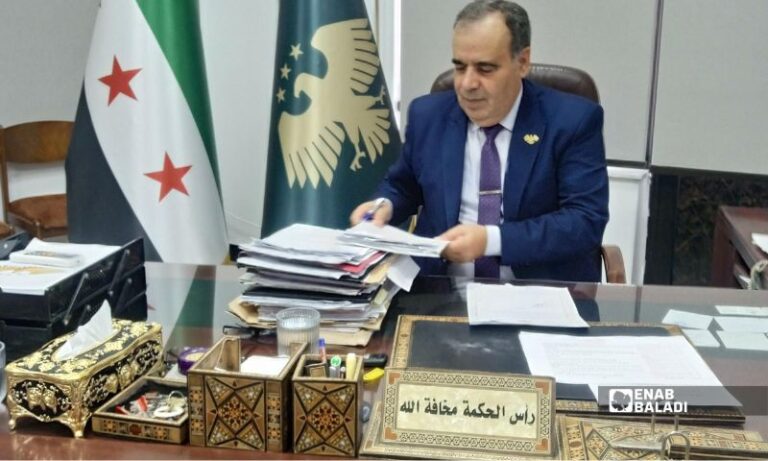
 Adnan Al-Qasim, director general of the General Authority for the Management and Protection of Syrian State Property, during an interview with Enab Baladi, August 2, 2026. (Enab Baladi/Wasim al-Adawi)
Adnan Al-Qasim, director general of the General Authority for the Management and Protection of Syrian State Property, during an interview with Enab Baladi, August 2, 2026. (Enab Baladi/Wasim al-Adawi)
Adnan Al-Qasim, director general of the General Authority for the Management and Protection of State Property, said on Sunday, August 2, that preliminary investigations had uncovered widespread seizures of hundreds of dunums of state land and property by members of the former Syrian regime’s inner circle and prominent figures, at nominal prices.
Al-Qasim told Enab Baladi that preliminary audit and investigation results, produced jointly by the authority and the Commission for Combating Illicit Gains, showed that hundreds of government properties and plots of land had been taken under various investment arrangements, including “lease,” “fair rental value,” and “twice the fair rental value” contracts.
He said the authority and the Commission for Combating Illicit Gains had recently taken control of 11 chalets in Latakia belonging to figures associated with the former regime.
Responding to a question from Enab Baladi, Al-Qasim said the Ministry of Finance’s Property Directorate manages and collects revenues from several investments belonging to the State Property Authority. He added that work is underway, under the supervision of the General Secretariat of the Presidency, to determine the ownership and administrative affiliation of these properties.
He also stressed that the authority’s property is entirely separate from religious endowment property administered by Syria’s Ministry of Religious Endowments.
According to Al-Qasim, the “seized” investments were awarded at unlawfully low prices for the benefit of families that formed the former regime’s central core. These included the Assad, Makhlouf, Shalish, al-Hassan, Huwija, and al-Dalla families, along with thousands of additional dunums seized by beneficiaries and affiliates who formed the outer layer of the network.
The seized properties were concentrated primarily in Rural Damascus and Latakia governorates, while the remaining areas were distributed across other Syrian governorates. Al-Qasim said the authority’s initial documented inventory of state property totals 60,000 properties.
He announced that the authority, working with the Ministry of Finance and under the supervision and monitoring of the Commission for Combating Illicit Gains, launched a nationwide campaign on Sunday to review state property investments and contracts in every governorate.
The campaign is based on three areas of work:
Al-Qasim told Enab Baladi that preliminary investigations had uncovered methods and practices indicating extensive collusion and administrative and financial corruption. He said these practices had been concealed through a collection of outdated and rigid laws and decisions used to legitimize the theft of public funds under the labels of development, investment, and reform.
The authority and the Commission for Combating Illicit Gains consequently identified several measures that must be followed:
Al-Qasim said that just as the state, under its new leadership, had worked to restore the rights of victims’ families, it would “act with an iron fist to recover seized property and assets.”
He added that the campaign was “a clear message that the era of waste and corruption has ended permanently, and that the new state is determined to recover every particle of the Syrian people’s rights with strength, resolve, and without compromise.”
Enab Baladi obtained a copy of a decision issued by the director general of the State Property Authority, at the direction of Commission for Combating Illicit Gains chairman Basel al-Suwaidan, ordering the formation of committees at authority branches in Damascus, Rural Damascus, Homs, Hama, Tartous, Latakia, Idlib, Aleppo, the al-Ghab region in northwestern Syria, Deir Ezzor, Daraa, Suwayda, Quneitra, and Raqqa.
The branch committees’ duties are limited to the following:
The branch committees are required to submit the results of their work to the authority’s central committee at the end of every week.
The central committee, whose members were named in the same decision, is responsible for examining and auditing the findings of the branch committees, proposing the necessary action under applicable laws and regulations, and submitting the proposals to the minister of agriculture for approval.
Earlier on Sunday, the Commission for Combating Illicit Gains announced a comprehensive nationwide campaign to review state property contracts and investments in every governorate. The campaign aims to protect public funds and recover rights affected by corruption or illicit enrichment practices over previous decades.
In a statement obtained by Enab Baladi, the commission said the campaign includes:
The commission said preliminary audits had revealed several indicators requiring investigation, including:
All these files will undergo financial and legal investigation by the commission under its approved procedures. The commission stressed that responsibility will not be established until investigations are completed and the necessary legal measures are taken.
It added that the campaign will review a broad database of state property files across the governorates, describing it as one of the largest auditing operations involving these records. The review is intended to protect the rights of the state and the Syrian people and ensure the proper management of public assets.
The commission called on anyone who previously benefited from state-owned property, real estate, or land in a manner that may have violated the law or involved suspected illicit gains to use the “voluntary disclosure” program before the announced deadline, allowing their legal status to be settled under established frameworks.
The commission said the campaign:
The commission said disclosure requests may be submitted directly to the commission or through the official electronic portal on its website.
if you think the article contain wrong information or you have additional details Send Correction


 A
A
A
A
A
A



 More Economic Reports