


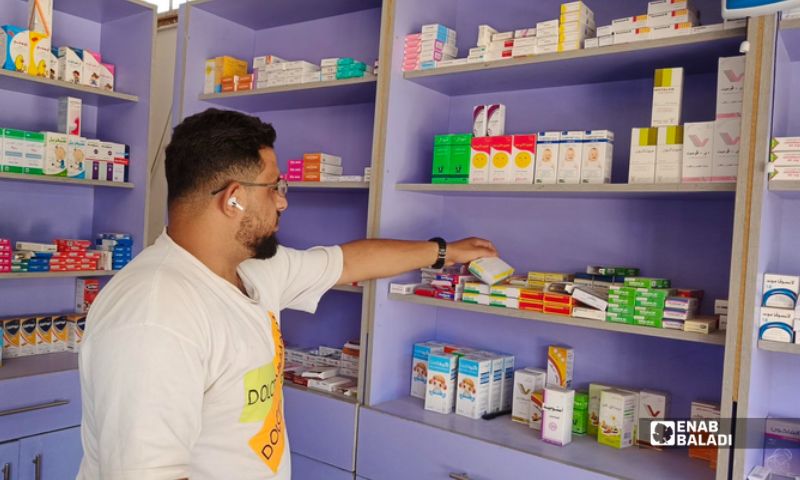
 A pharmacist in the town of Tal Shihab, Daraa countryside (southern Syria), August 18, 2026. (Enab Baladi)
A pharmacist in the town of Tal Shihab, Daraa countryside (southern Syria), August 18, 2026. (Enab Baladi)
While Syrian pharmaceutical products reach markets in 23 countries, some residents inside Syria are forced to buy their medicines on credit, as low wages and pensions are insufficient to cover living and treatment costs.
Deputy Health Minister for Pharmaceutical Affairs Hani Baghdadi told Enab Baladi that Syria locally manufactures about 80% of the medicines it needs and exports more than 1,200 pharmaceutical products to 23 countries, including Yemen, Somalia, Ghana, Armenia, and Nigeria.
Baghdadi explained that a single pharmaceutical product may be manufactured by one company or several companies. He said the main exported products include essential medicines used to treat chronic diseases, such as high blood pressure and diabetes, as well as painkillers.
Imported medicines, according to Baghdadi, include specialty, biological, chemical, and immunological drugs that are not manufactured locally.
Baghdadi said the Ministry of Health is seeking to expand Syrian pharmaceutical exports by working to establish a “Syrian Drug Authority,” which would operate according to international standards and seek recognition from the World Health Organization.
In a previous statement to Enab Baladi, Baghdadi said the ministry was working to establish a “drug authority” modeled on the Jordan Food and Drug Administration, in a step aimed at regulating the pharmaceutical sector and strengthening oversight in accordance with international standards.
He explained that the authority’s work would not be limited to its internal regulations, but would follow specific standards aligned with World Health Organization requirements.
According to Baghdadi, September 2026 is expected to provide an opportunity to advance the initiative through agreements with more than one party, allowing financial support to be secured for establishing the authority.
Asked about the possibility of manufacturing specialty medicines locally, Baghdadi said the ministry is working on a program to localize these industries and encourage investors to produce them inside Syria.
He added that the program would require investors seeking to establish pharmaceutical factories in Syria to operate a production line for specialty medicines in exchange for approval to establish lines producing non-specialty or conventional medicines.
As the government moves to increase exports of locally manufactured medicines, questions are emerging over the extent to which exports could affect the availability and prices of medicines in the Syrian market.
A survey conducted by Enab Baladi at several pharmacies, along with interviews with residents, found that medicine prices have not changed significantly in recent months, although residents differed in their views on whether they could afford them.
Prices of some medicines monitored by Enab Baladi ranged from 100 to 1,000 Syrian pounds, depending on the medicine, while other products cost more.
Some residents surveyed by Enab Baladi said medicine prices were high, while others said the main problem was not the price of medicine itself, but low incomes and the failure of wages and pensions to keep pace with the cost of basic needs.
Retiree Ayman al-Jundi told Enab Baladi that he needs two packs of high blood pressure medicine each month, costing about 500 Syrian pounds, in addition to diabetes medication that costs about 400 pounds.
He added that a dose of insulin can cost more than 800 Syrian pounds, while his pension does not exceed 10,000 pounds.
Al-Jundi said the main problem was the low value of his pension, which could not cover the cost of medicine and basic living expenses.
Several people said they have been forced to buy medicines on credit from pharmacies, particularly medication for chronic conditions, and pay for them later.
Others said medicine prices were generally acceptable, but noted that not all pharmacies adhere to standardized prices, with the price of the same medicine differing by around 50 Syrian pounds or more from one pharmacy to another.
The deputy health minister confirmed that some pharmacies do not comply with official pricing. He added that any pharmacy found to have sold medicines at inflated prices would be cited if an investigation confirmed the violation.
Some residents also pointed to high prices for certain medicines, particularly those used to treat joint problems, with some costing more than 1,000 Syrian pounds.
Deputy Health Minister for Pharmaceutical Affairs Hani Baghdadi attributed the high prices of some locally manufactured medicines to several factors, particularly rising production costs and higher raw material costs.
He added that the Ministry of Health is working through its pharmaceutical affairs department to regulate pricing procedures so that prices remain appropriate.
Health Minister Musab al-Ali said in April that the ministry was continuing to review medical pricing in the private sector in an effort to balance the rights of citizens with those of medical service providers.
Al-Ali said the ministry had reached an agreement not to raise medicine prices, despite demands for increases, with the aim of maintaining stability in the pharmaceutical market.
The minister also noted shortages of some specialty medicines, saying partial progress had been made in addressing the issue while work continued toward a complete solution.
if you think the article contain wrong information or you have additional details Send Correction


 A
A
A
A
A
A







 More Society