


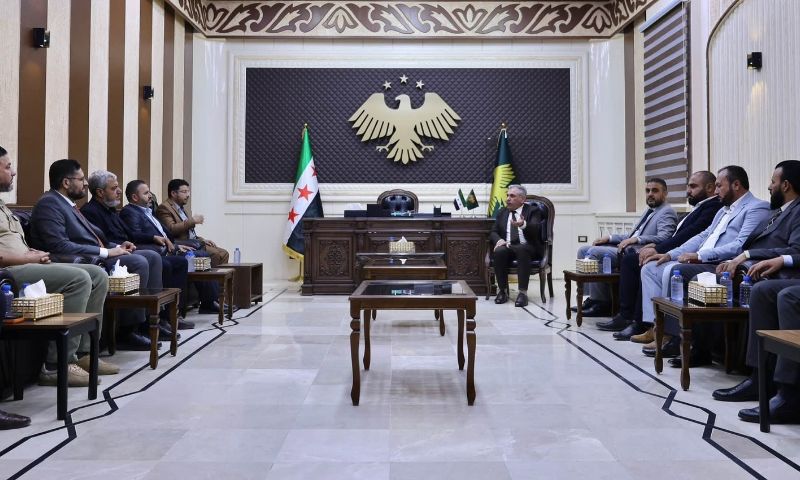
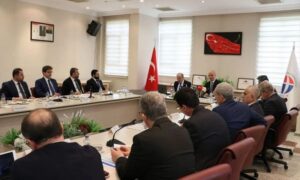
 al-Hasakah governor meets with several district and subdistrict directors in the governorate, September 29, 2026. (al-Hasakah Governorate)
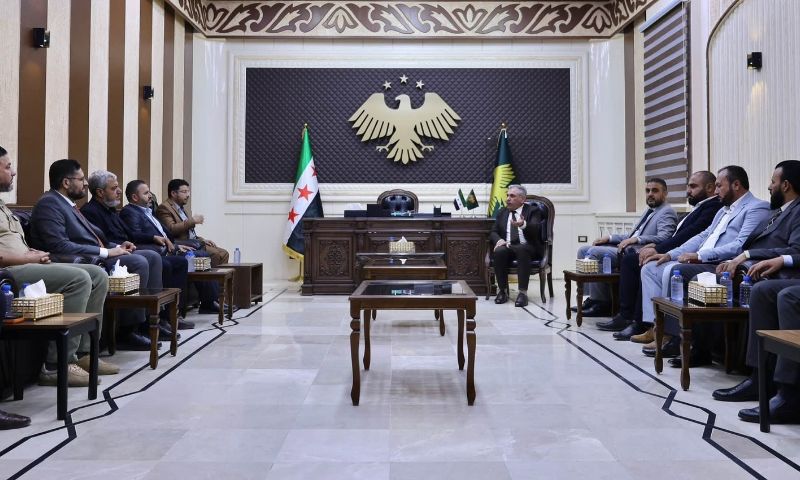
al-Hasakah governor meets with several district and subdistrict directors in the governorate, September 29, 2026. (al-Hasakah Governorate)
The governor of al-Hasakah (northeastern Syria), Nour al-Din Ahmed, continues to issue decisions establishing temporary executive offices across the governorate. The latest decisions formed a city council in Amuda and executive offices for 18 towns and municipalities, with the aim of reactivating local councils and organizing their administrative and service responsibilities within their respective areas.
According to decisions issued by the governorate today, Thursday, October 1, the temporary executive offices include the Amuda City Council, the town of Bir al-Hilu al-Wardiya, and 17 municipalities across the northern and southern countryside of al-Hasakah.
The municipalities covered by the decisions are Abu Duwail, al-Saada, Tal Awda, al-Shamsaniyah, Dashisha al-Arabiya, Jarmuz Gharbi, Umm Rukayba Sharqiya, al-Rashidiyah al-Gharbiya, Rahiyah, Haddaj, al-Hajiyah, al-Fadghami, al-Hanna al-Sharqiya, Habis, Khuwaytila al-Jawwala, Khirbet Ammo, and al-Ahsa.
Under the decisions, the temporary executive offices are responsible for managing the affairs of local councils and exercising the powers granted to them under applicable laws and regulations, particularly the Local Administration Law issued under Legislative Decree No. 107 of 2011.
According to the decisions, these offices will continue operating until new elections are held for local councils and administrative units.
The new decisions follow measures taken by the al-Hasakah Governorate during September to reorganize the work of administrative units in different parts of the governorate.
During the previous month, the governor of al-Hasakah issued decisions establishing temporary executive offices for four cities, al-Malikiyah, Qamishli, al-Darbasiyah, and Ras al-Ain, in addition to eight towns: Maabada, al-Qahtaniyah, al-Jawadiyah, al-Muthanna, Barqa, al-Anadiyah, Tal Hamdi, al-Haniyah, and al-Suwaydiyah Fawqani.
The previous decisions also covered 36 municipalities in the al-Hasakah countryside. The new decisions add one city council and 18 towns and municipalities.
The restructuring of the executive offices comes amid field and administrative changes in al-Hasakah Governorate since the beginning of 2026, as shifts in territorial control have affected the administration of institutions and service sectors.
At the beginning of the year, the Syrian army took control of the southern and eastern countryside and part of the western countryside of al-Hasakah, while the Syrian Democratic Forces (SDF) withdrew to the main cities, including al-Hasakah and Qamishli. This led to a division in the administration of institutions and services across the governorate.
On January 29, the Syrian government and the SDF reached an agreement to begin integrating military, security, and service institutions in the governorate into state structures and government ministries. Implementation of the agreement began gradually in February.
On August 25, SDF commander Mazloum Abdi announced the dissolution of the SDF and its affiliated formations. Two days later, on August 27, Syrian President Ahmed al-Sharaa issued a decree appointing Abdi as an adviser to the Presidency of the Republic.
The decisions to establish temporary executive offices come within this context, as steps continue to reorganize institutions and local administrations in al-Hasakah Governorate and redistribute administrative and service responsibilities among the governorate’s local units.
Residents who previously spoke to Enab Baladi said that issuing appointment decisions does not necessarily resolve accumulated problems unless the councils are granted clear powers, budgets that enable them to carry out their responsibilities, and effective coordination with government directorates and institutions.
Residents’ comments indicate that the new councils face a dual test. The first is rebuilding local institutions after years of multiple administrative systems, while the second is demonstrating their ability to provide services whose effects residents can directly feel.
As decisions continue to establish executive offices in other cities, towns, and municipalities, attention will focus on how these councils operate, the powers granted to them, and their ability to address the service gap that has accumulated over recent years, as well as the extent to which they represent local communities and their diversity.
if you think the article contain wrong information or you have additional details Send Correction


 A
A
A
A
A
A



 More Society