

The Central Bank of Syria announced on Tuesday, August 18, that it had approved an electronic payment and digital transformation system to expand payment and money transfer options in Syria.
In a statement published on its official accounts on Tuesday evening, the bank said that Decision No. 1124, issued by the General Secretariat of the Syrian Presidency, aims to develop and activate a modern national payment system and to expand payment and transfer options for citizens and businesses.
The statement said the system would help facilitate and improve the efficiency of money transfers, without eliminating cash transactions or imposing a specific payment method.
The system also establishes the regulatory and technical foundations for developing and connecting payment services among financial entities and institutions. It provides a framework for licensing and regulating three main types of entities operating within the system:
- Payment service providers.
- Electronic money service providers.
- Payment system operators.
This would allow the development of diverse payment services and solutions within a clear regulatory and supervisory environment.
According to the statement, adopting the electronic payment and digital transformation system also opens the door to innovation, competition, and investment in financial and technology services. Innovative financial activities and solutions will be able to undergo testing in a regulatory sandbox, allowing them to be evaluated in a supervised environment before being introduced on a wider scale.
The bank said the decision establishes requirements for governance, supervision, risk management, cybersecurity, and user protection, strengthening the security of financial transactions and confidence in digital services.
The system also lays the groundwork for the Syrian financial infrastructure to eventually integrate with regional and international payment systems in accordance with applicable legal, technical, and commercial requirements. The bank stressed that this does not mean international transfers or connectivity will become immediately available.
The adoption of the system is a key step toward modernizing Syria’s financial infrastructure and providing citizens and businesses with easier, more efficient, and more secure payment options alongside cash transactions.
Transactions With Global Payment Companies Allowed
The Central Bank issued a decision on May 4 allowing banks and local electronic payment companies to deal with global payment companies such as Visa and Mastercard.
At the time, the bank said the decision allowed licensed banking institutions and electronic payment companies operating in Syria to deal with international electronic payment companies. According to the Central Bank, the move represented an important step toward modernizing Syria’s financial sector, opening a new phase in payment system development, and strengthening the Syrian market’s integration into the global financial system after years of reliance on traditional and limited tools.
The decision also allows local banks and payment companies to broaden their services to include more advanced and secure payment solutions for both individuals and businesses.
Network Connection With Mastercard and Visa
The process began as the Central Bank of Syria announced in recent months that it had completed the settlement of several foreign banking relationships, most recently with Austrian and French banks, while working to reactivate the SWIFT system and preparing to reconnect with global financial networks.
A banking manager familiar with the matter, who asked not to be named for administrative reasons, previously told Enab Baladi that the Central Bank was continuing work on network connectivity with Mastercard and Visa. The goal is to enable international cards to operate through Syrian banks and allow electronic payment and foreign transfer services to function more regularly.
The manager said the connection with the two companies would become operational by the end of the following May, describing it as an important step toward reintegrating Syria’s banking sector into the global financial system.
According to the same source, successful connectivity would facilitate payments for traders and importers, improve transfer services for Syrians abroad, and reduce reliance on direct cash transactions. It would also give operating banks new tools to expand their electronic services as the government seeks to ease pressure on traditional cash circulation.
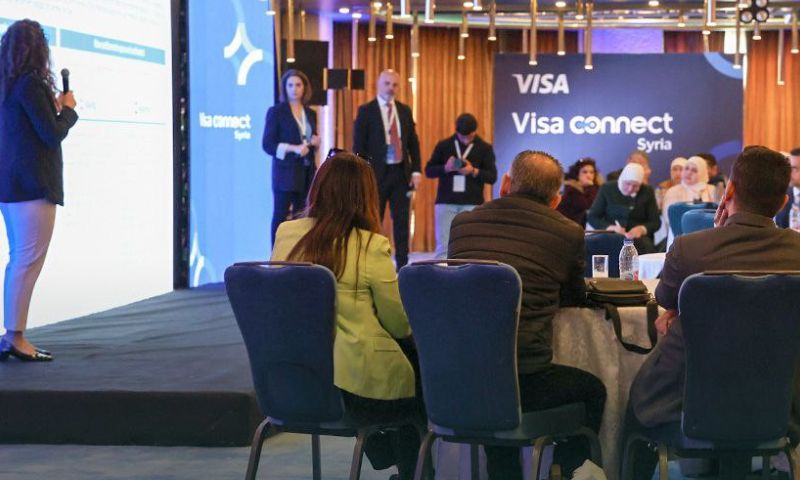
In December 2025, the Central Bank of Syria announced an agreement with Visa on a roadmap to build a modern digital payments system and strengthen financial inclusion in Syria.
The Central Bank also signed a memorandum of understanding with Mastercard in September 2025 to cooperate on developing Syria’s digital payments system. The agreement aimed to improve digital payment infrastructure, exchange expertise, strengthen financial inclusion, and explore opportunities to expand access to basic financial services for millions of people.