
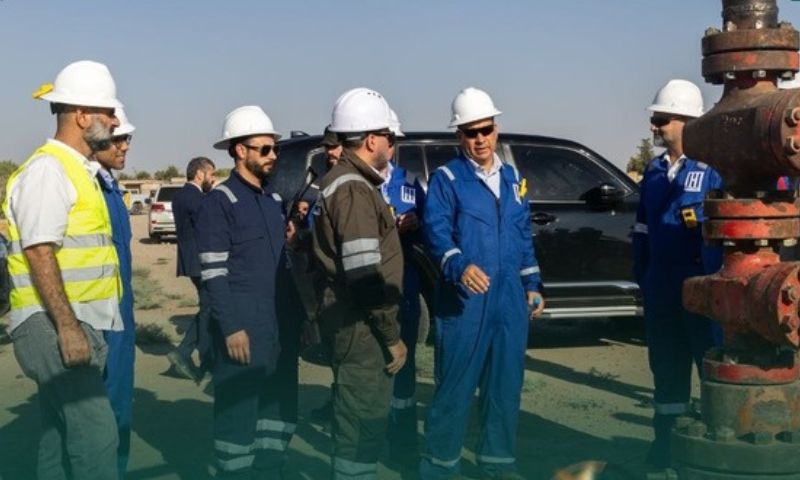

Syria’s Ministry of Energy said the country’s oil and gas sector continued to regain its role in supporting the national economy and strengthening energy security during the first half of 2026, through increased production, infrastructure development, facility rehabilitation, and new avenues for investment and partnerships.
According to data published by the Syrian Ministry of Energy on its official Facebook page, crude oil production reached 14.8 million barrels, while raw natural gas production reached 1.429 billion cubic meters.
Production of clean natural gas totaled 1.252 billion cubic meters, in addition to 35,500 tons of liquefied petroleum gas for household use.
The total amount of crude oil refined during the same period reached approximately two million tons.
To meet market demand and the needs of power plants, electricity generation facilities were supplied with about 2.059 billion cubic meters of gas and 859,251 tons of fuel oil, while 3.5 million tons of petroleum products were distributed in the domestic market.
Meanwhile, Syria imported about 1.016 billion cubic meters of natural gas, 1.5 million tons of crude oil, 598,000 tons of diesel, 283,000 tons of gasoline, 196,000 tons of liquefied petroleum gas for household use, and 32,000 tons of fuel oil during the same period.
Development, Rehabilitation and Investment
In drilling and production, drilling operations reached a depth of 3,460 meters, two drilling rigs were rehabilitated, 152 wells were brought back into operation, 10 new wells entered production, and 21 wells were repaired.
Development work also increased production at several fields. Output at the Diro field reached 2,500 barrels per day following development work, while production at the Jbessa field reached 4,500 barrels per day, alongside the operation of gas turbines at the field.
The main pumping unit in Homs (central Syria) was also restarted after being out of service for 12 years, while the Amrit offshore drilling rig was returned to service.
In infrastructure, five kilometers of the Conoco gas pipeline were rehabilitated, along with the al-Thawra Petroleum Center and al-Bushra station. The al-Dabousiya gas station was also prepared for the planned transfer of gas to Lebanon, while makeshift oil burners were removed in four governorates.
As part of efforts to develop the sector and attract investment, seven memoranda of understanding were signed with international companies, along with three contracts to develop the petroleum sector, reflecting a drive to rehabilitate the industry, increase its production capacity, and strengthen energy security.
Agreements Move Into Implementation
Regarding previously announced agreements in the oil and gas sector, Ayman al-Marai, director of the Oil Fields Administration at the Syrian Petroleum Company, said one of the most prominent partnerships to have actually begun is with Saudi company ADES.
Al-Marai told Enab Baladi that the company had taken over some areas in Abu Rabah (eastern Homs, central Syria) and begun the maintenance phase, in preparation for moving later to the development stage.
He also said a consortium comprising Conico, Novitera, and UCC had begun work on gas wells in the central region, within the governorates of Raqqa and Homs and northern Damascus.
According to al-Marai, these partnerships are expected to contribute to developing infrastructure related to gas production, helping reduce the amount of gas Syria imports.
He expected Syria to see a “qualitative leap” in gas production within two to three years.