


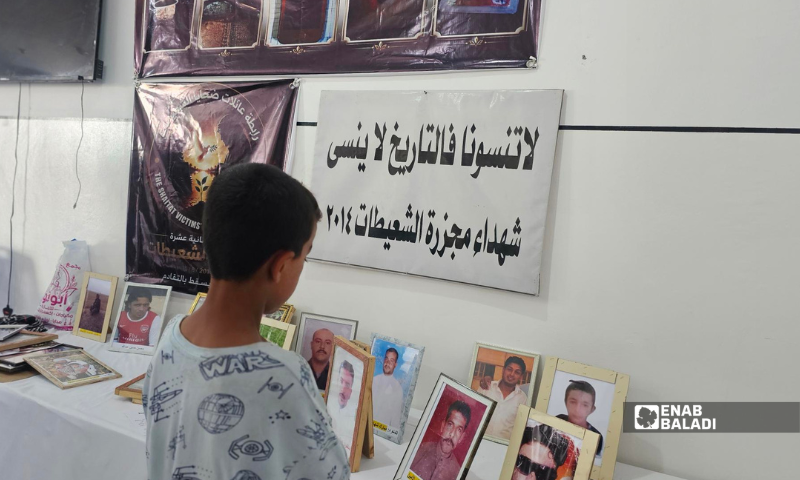
 An event in Abu Hamam, eastern Deir Ezzor, marking the anniversary of the Shaitat Massacre, August 15, 2026 (Enab Baladi).
An event in Abu Hamam, eastern Deir Ezzor, marking the anniversary of the Shaitat Massacre, August 15, 2026 (Enab Baladi).
Residents and relatives of victims of the Shaitat Massacre marked its 12th anniversary on August 15 in Abu Hamam, in the eastern countryside of Deir Ezzor. The Islamic State group carried out the massacre against members of the Shaitat tribe in the summer of 2014. The community event sought to raise awareness of the massacre, commemorate its victims, and demand accountability for those responsible for crimes committed by the group.
Relatives of the victims and local residents took part in the event, recalling the massacre that began in late July 2014 and continued through August of the same year, including killings, executions, arrests, disappearances, and displacement affecting residents of Abu Hamam, Kishkiyya, and Gharanij, as well as areas to which members of the tribe had fled.
The event comes as the massacre remains an unresolved issue for victims’ families, whether in the search for missing relatives, the documentation of mass graves, or demands to pursue those responsible for the violations.
According to a study prepared by the ISIS Prisons Museum in cooperation with the Shaitat Victims’ Families Association, the association documented at least 814 members of the tribe killed by ISIS in different circumstances between the beginning of 2014 and August 15, 2021, a period broader than the days of the massacre itself.

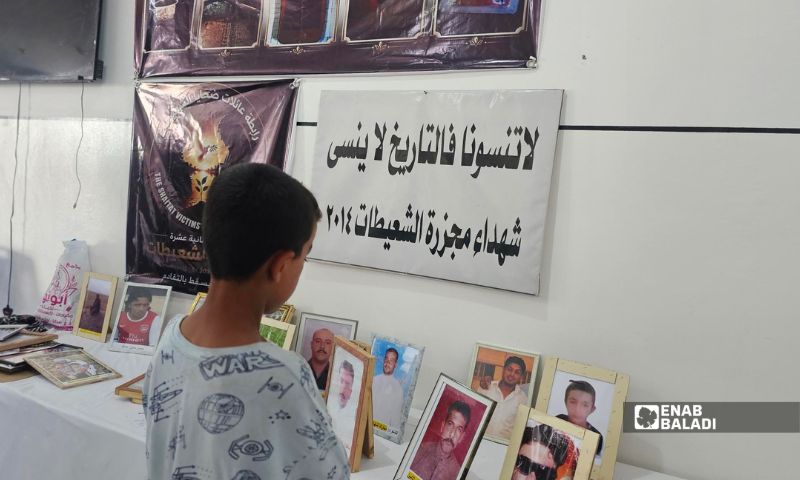
An event in the town of Abu Hamam, eastern Deir Ezzor, marking the anniversary of the Shaitat Massacre, August 15, 2026 (Enab Baladi).
Confrontations between ISIS and members of the Shaitat tribe began in the eastern Deir Ezzor countryside in the summer of 2014, after tensions between the two sides escalated and members of the tribe refused to submit to the group’s control.
Shaitat communities are concentrated in Abu Hamam, Kishkiyya, and Gharanij, strategic areas in the eastern Deir Ezzor countryside because of their location and proximity to oil fields.
According to documentation by the Shaitat Victims’ Families Association, the conflict resumed on July 30, 2014, when armed members of the tribe headed toward a military headquarters established by ISIS in the Kishkiyya municipality building, leading to clashes and the arrest of 26 civilian employees from the tribe who worked at the Tanak oil field.
On the same day, ISIS issued a fatwa classifying members of Shaitat as “violators of the covenant and apostates from Sharia rule,” which it used to justify killing members of the tribe and pursuing those who fled, according to the documentation.
The confrontation developed into a 12-day military operation involving shelling, clashes, and the gradual retreat of Shaitat fighters, before ISIS entered Kishkiyya and Abu Hamam on August 11.
The association said ISIS published images during the fighting showing the execution of the 26 employees it had detained at the Tanak oil field. Shaitat villages also gradually emptied of residents as the military operations intensified.
After the tribal fighters withdrew, ISIS members entered Kishkiyya and Abu Hamam and began sweeping the area and searching homes, while most residents had already left.
The Independent International Commission of Inquiry on the Syrian Arab Republic also documented killings and arrests carried out by ISIS during its attack on Shaitat areas in reports addressing violations committed in Syria during 2014.

An event in the town of Abu Hamam, eastern Deir Ezzor, marking the anniversary of the Shaitat Massacre, August 15, 2026 (Enab Baladi).
The number of victims of the Shaitat Massacre varies among organizations that documented the events, depending on the period covered and the methodology used by each.
The Shaitat Victims’ Families Association counted 814 victims between the beginning of 2014 and August 15, 2021, noting that the figure represents cases it was able to document and is not necessarily the final death toll.
The association’s documented figures were divided across several periods. It recorded 44 victims between the beginning of 2014 and the Kishkiyya municipality incident on July 30, followed by 558 victims between that incident and the return and amnesty agreement on October 1, 2014.
It then documented 90 victims between the amnesty agreement and the return of the last group of displaced residents on September 17, 2015, while another 86 victims were documented between the return of displaced residents and the group’s withdrawal from the area in January 2018. The association also documented 36 victims between the group’s withdrawal and August 15, 2021.
The association explained that these figures include victims killed in different circumstances connected to ISIS and are not all limited to the period of the massacre in the summer of 2014.
At the height of the massacre, the data indicate that 558 victims were documented, the figure that can be used when referring specifically to the period from the outbreak of fighting in late July until the amnesty agreement in October 2014.
At the same time, the association said the actual number may be higher than the documented figures because of incomplete information and difficulties in reaching every case, particularly missing persons and victims whose names remain unknown.
The violations did not end when ISIS took control of Shaitat towns, but extended to areas where residents sought refuge after leaving their villages.
Documentation indicates that large-scale arrest campaigns targeted displaced members of the tribe, particularly men and young men, in Hajeen, Bahra, and Shafa, in eastern Deir Ezzor, which became major gathering points for displaced residents because of their proximity to Shaitat towns.
According to the Shaitat Victims’ Families Association, ISIS conducted raids in the days after entering Shaitat towns and detained hundreds of civilians on the basis of their tribal affiliation, while others were summarily executed before being transferred to detention sites.
Arrests continued over the following weeks. ISIS used several schools and other locations as temporary detention centers before transferring detainees to its prisons in different areas.
The issue of the missing remains among the most complicated for Shaitat families. Some families are still unable to determine what happened to their relatives, amid the discovery of mass graves containing remains of victims who have not all been identified.

An event in the town of Abu Hamam, eastern Deir Ezzor, marking the anniversary of the Shaitat Massacre, August 15, 2026 (Enab Baladi).
The discovery of mass graves became one of the clearest indications of the scale of the killings suffered by members of the tribe.
A database published by the Shaitat Victims’ Families Association lists multiple mass grave sites in tribal areas. Some were discovered in the months following the massacre, while others emerged in subsequent years.
The association documents, for example, a grave in the Maadan neighborhood east of Gharanij that was discovered between November 25 and December 10, 2014. Seven bodies were found there, according to its published data, along with photographs and testimonies connected to the killings.
It also points to other sites containing the remains of victims killed in different ways, while efforts are still needed to identify the bodies and match them with records of missing persons.
Human rights groups and media reports said soon after the massacre that mass graves containing hundreds of bodies had been found in the eastern Deir Ezzor countryside. The figures, however, varied from one source to another depending on when the documentation took place and how victims were counted.
For this reason, treating a single number as the final death toll of the massacre remains inaccurate while people are still missing and not all remains recovered from mass graves have been identified.
The impact of the massacre was not limited to those killed or missing, as the killings and displacement also caused widespread social losses among members of the tribe.
The Shaitat Victims’ Families Association said the massacre left hundreds of families who had lost relatives, including children and widows, while killings and arrests continued even after residents returned to their towns.
According to the documentation, representatives of ISIS and Shaitat sheikhs reached an agreement in September 2014 concerning the return of displaced residents. The agreement included several conditions, among them surrendering weapons, signing declarations of repentance, and allowing residents to return.
Residents began returning gradually in October 2014, but their return did not mean the end of the violations. Individual arrests and executions of members of the tribe continued in subsequent years, according to the documentation.
ISIS remained present in Shaitat areas until 2018, before losing control during military operations led by the Syrian Democratic Forces with support from the international coalition.
The 12th anniversary of the massacre renewed calls for accountability at a time when victims’ families continue to demand information about the fate of the missing and the identification of those responsible for killings, arrests, and displacement.
In March 2026, the Syrian Center for Media and Freedom of Expression published a study titled “Twelve Years Since the Shaitat Massacre: Justice is Still Within Reach,” examining the massacre and violations committed by ISIS against members of the tribe, and linking documentation of the crimes to transitional justice, truth-seeking, and reparations.
The center stressed the importance of documenting violations affecting the various components of Syrian society to ensure that justice processes are not limited to one side of the conflict.
The Independent International Commission of Inquiry on the Syrian Arab Republic also documented violations committed by ISIS against members of Shaitat in its reports on violations that occurred in Syria during that period.
The number of documentation efforts, and the differing figures reported by various organizations, reflect the difficulty of reaching a final death toll for the massacre, particularly as people remain missing and the identities of all those buried in mass graves have not been established.
On the 12th anniversary, victims’ families are demanding not only that those killed be remembered, but also that the truth be uncovered, names documented, and the fate of the missing established, with the ultimate goal of holding those involved in killings, arrests, and enforced disappearances accountable.
For members of Shaitat, Abu Hamam, Kishkiyya, and Gharanij remain witnesses to one of the largest mass killings committed by ISIS in Deir Ezzor, while families continue searching for answers about relatives whose fate remains unknown to this day.
if you think the article contain wrong information or you have additional details Send Correction


 A
A
A
A
A
A





 More Politics