


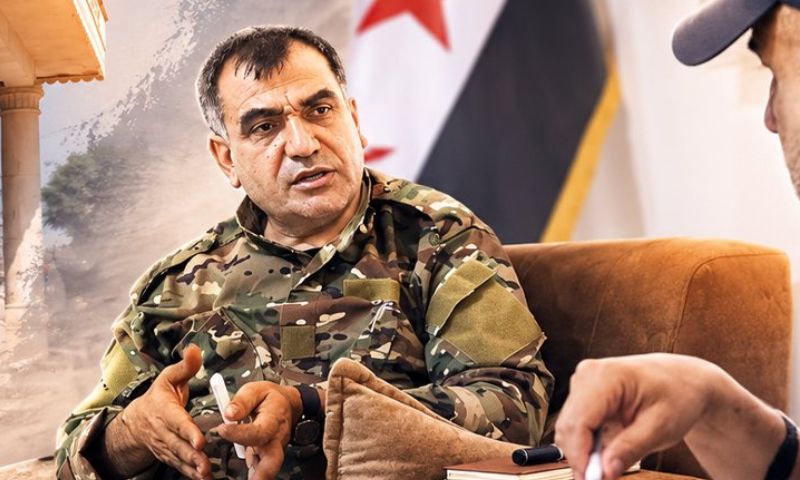
 Mahmoud Barkhodan, commander of the Ayn al-Arab Brigade, during an interview with a Turkish newspaper, Aug. 16, 2026 (Türkiye Gazetesi).
Mahmoud Barkhodan, commander of the Ayn al-Arab Brigade, during an interview with a Turkish newspaper, Aug. 16, 2026 (Türkiye Gazetesi).
Mahmoud Barkhodan, commander of the Ayn al-Arab Brigade in the Syrian army and an official with the Syrian Democratic Forces (SDF) in Ayn al-Arab (Aleppo governorate, northern Syria), said the dissolution of the People’s Protection Units (YPG) and the SDF, along with the end of the Autonomous Administration’s structure, will be announced within the next few days.
He added that the process of integrating the forces into the Syrian army has been completed “in theory,” while some outstanding issues remain under discussion.
Barkhodan made the remarks in an interview conducted by journalist Yılmaz Bilgen in Ayn al-Arab and published today, Aug. 16, by the Turkish newspaper Türkiye Gazetesi.
Barkhodan said the integration process between the SDF and the Syrian army has, by his estimate, overcome more than 99% of the obstacles. He said the dissolution of the YPG and SDF would be announced within the “next few days,” alongside the dissolution of the Autonomous Administration’s structure.
He added that the next phase should be based on “one army, one state, one flag, and one common homeland,” stressing, “We are not demanding a separate state.”
Barkhodan’s remarks come as relations between the Syrian government and the SDF are moving rapidly toward implementing agreements signed by the two sides, particularly the Jan. 29 agreement, which includes steps to integrate the Autonomous Administration’s civilian and military institutions into Syrian state institutions.
Barkhodan said the decision to move toward integration with Syrian state institutions is “final,” stressing that “there is no going back,” in reference to the end of the period in which SDF forces operated as a military formation separate from state institutions.
He said they had “buried their weapons,” an expression he used to describe the end of the previous phase, explaining that their presence in the next stage would be as part of Syria and within the institutions of the state and the Syrian army.
He added that Kurds would continue to live in Syria within a framework of “unity and solidarity,” under the Syrian flag and based on shared values and goals with other Syrians.
Barkhodan linked his current position to the history of the YPG, saying he believed in the Syrian flag even when the units were established in 2012 and that the flag was present when their formation was announced, according to the Turkish newspaper.
At the same time, he called for the military integration process to be accompanied by a political and constitutional process, arguing that Syria needs an “inclusive and fair” constitution that guarantees the rights of its different communities.
He said the next constitution should include Kurds, Arabs, Turkmen, Assyrians, Yazidis, Armenians, Druze, and others. He argued that the period of Baath Party rule has ended and that “that mentality” should end with it.
Barkhodan also reaffirmed his commitment to the Jan. 29 agreement between the Syrian government and the SDF, describing it as the framework governing the current phase between the two sides.
Despite saying the integration process has been completed “in theory,” Barkhodan acknowledged that some issues have yet to be definitively resolved.
He said the status of the Women’s Protection Units remains under discussion, along with that of fighters who hold Turkish citizenship, but argued that these issues do not constitute obstacles that cannot be resolved.
Barkhodan did not provide further details on how these issues would be addressed or on their specific timeline, saying only that integration has become a final decision for his forces.
Speaking about SDF personnel numbers, Barkhodan said around 10,000 fighters have so far been integrated into the Syrian army, estimating that the number could rise to around 12,000 once the process is completed.
He rejected figures circulated in previous years suggesting that the SDF had a military force of between 70,000 and 100,000 fighters, saying those estimates did not reflect the force’s actual size.
He said the total number does not exceed 35,000 personnel, adding that there are no longer fighters of Arab origin within SDF formations, except possibly a very limited number in Qamishli and the al-Jazira region of northeastern Syria.
Barkhodan said the transition is not limited to the military sphere, noting that the transfer of public institutions and oil fields has also reached an advanced stage alongside the integration of the forces.
He added that the “foundations of coexistence” among Syrians are gradually taking shape, arguing that the continued Kurdish presence in Syria should be within state institutions and a single national army.
The remarks come after steps taken in Hasakah governorate in recent months, including the transfer of several institutions to the Syrian government, the handover of sites and checkpoints, and the appointment of new administrative officials as part of the gradual implementation of agreements between the two sides.
On the political front, Barkhodan denied that the SDF has a project to establish an independent Kurdish state in Syria. He said Syrian Kurds are part of Syrian society and that establishing a separate state in Ayn al-Arab or elsewhere is not their goal.
He added that Kurds are spread across different areas of Syria and are part of Syrian society linguistically, culturally, and religiously.
Barkhodan called for removing barriers separating Syrian Kurds from their relatives in Turkey, referring to longstanding social ties among Kurds on both sides of the border.
He said he has relatives in different parts of Turkey and wants to remove the “barriers” preventing communication between them.
Barkhodan linked this to the history of borders that divided areas inhabited by Kurds in Syria and Turkey, arguing that the current phase offers an opportunity to close that chapter and move toward a period of peace.
He also addressed the displacement from Ayn al-Arab during the Islamic State group’s 2014 offensive, noting that residents fled to Turkey and saying that what Turkey provided to them during that period “cannot be forgotten.”
Barkhodan said mistakes had been made over the past years and called for moving beyond them to focus on peace, unity, and building a shared future.
Barkhodan’s remarks came in the context of implementing an agreement between the Syrian government and the SDF announced on Jan. 29, 2026, aimed at ending the military and administrative division in northeastern Syria.
The understandings included a ceasefire and the start of a phased process to integrate civilian and military institutions, as well as the transfer of several government institutions, border crossings, and oil and gas fields to Syrian state administration.
The understandings also stipulated the integration of SDF military and security personnel into the Ministries of Defense and Interior under arrangements to be agreed upon by the two sides.
Arrangements concerning al-Hasakah governorate and Ayn al-Arab included integrating civilian institutions into state institutions, reducing the heavy military presence in Ayn al-Arab, and establishing a security force made up of local residents that would be administratively linked to the Syrian Ministry of Interior.
Among the main issues that remained under discussion were the form of the fighters’ integration, the mechanisms for implementing the provisions, and the timelines needed to complete the integration process.
if you think the article contain wrong information or you have additional details Send Correction


 A
A
A
A
A
A





 More Politics