


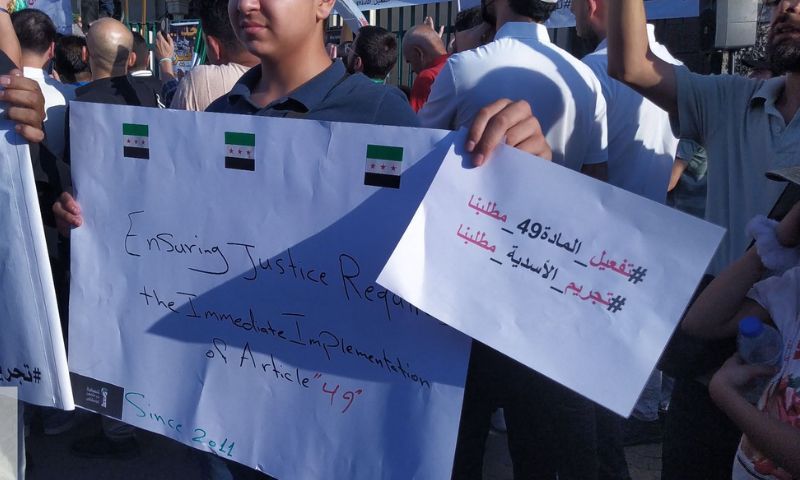
 A demonstration in the Syrian capital Damascus calling for enforcement of laws criminalizing Assadism, June 20, 2026. (Syrian Revolution Coordination Committee in al-Qaymariyya and Surrounding Areas)
A demonstration in the Syrian capital Damascus calling for enforcement of laws criminalizing Assadism, June 20, 2026. (Syrian Revolution Coordination Committee in al-Qaymariyya and Surrounding Areas)
Lebanon’s judiciary has decided to extradite former Syrian army Major General Adel Issa to Syria, around ten days after he was detained in Lebanon over allegations of murder and crimes against humanity.
Lebanon’s National News Agency reported today, Tuesday, August 18, that Lebanon’s Public Prosecutor at the Court of Cassation, Judge Ahmad Rami al-Hajj, decided to extradite Issa to Syria to stand trial for the crimes attributed to him, which he is accused of committing on Syrian territory.
The extradition decision was based on the Syrian-Lebanese judicial agreement signed in 1951, after the Lebanese judiciary determined that the conditions for extradition had been met from all legal and judicial aspects, according to the National News Agency.
Judge al-Hajj instructed the Central Criminal Investigation Department to transfer Issa from detention at Beirut’s Palace of Justice to the General Directorate of General Security, in preparation for transporting him to the Lebanese-Syrian border. He is to be handed over there to a Syrian security committee on the Syrian side of the border, the agency reported.
Lebanon Debate confirmed that Issa had been handed over to Lebanese General Security and was on his way to Syria, where Syrian authorities were expected to take custody of him.
Lebanese media had reported that the Lebanese judiciary questioned Issa on August 14, days after his detention, amid reports that authorities intended to extradite him to Syria.
Lebanon Debate said the Public Prosecutor at the Court of Cassation questioned Issa for around two hours in connection with the extradition request received by the Lebanese judiciary.
After the questioning, Judge al-Hajj issued an arrest warrant against Issa on charges of intentional and premeditated murder, torture resulting in death, inciting sectarian strife, and internal fighting.
LBCI reported at the time that Judge al-Hajj had decided to extradite Issa to the Syrian judiciary under the judicial cooperation agreement between the two countries, which requires the return and extradition of wanted nationals of each country.
Lebanon Debate said in an earlier report that Damascus had pushed for Issa’s extradition through Iyad al-Hazzaa, chargé d’affaires at the Syrian Embassy in Lebanon and head of Syria’s diplomatic mission in Beirut.
Issa’s defense lawyer, meanwhile, requested political asylum for the former major general in an effort to prevent his extradition, according to the same outlet.
Mohammad Sablouh, director of the Cedar Center for Legal Studies and Migration Affairs, previously told Enab Baladi that following Issa’s arrest, the Syrian judiciary was expected to send an official request regarding his detention, accompanied by allegations supporting accusations that he had committed torture.
The Lebanese judiciary would then have to investigate those allegations, as Lebanon is a signatory to the Convention Against Torture, Sablouh said.
He said Lebanon had two options, either extradite Issa to Syria under an agreement between the two sides, where the question of his innocence would be determined, or extradite him on the basis of a Cabinet decision.
The second option would be to try him on Lebanese territory based on claims filed by victims’ families.
After questioning Issa, the public prosecutor would provide a legal assessment of the case and refer it to the Cabinet, which would issue a decree approving or rejecting the extradition, Sablouh said.
Once an extradition decree is issued, it is published in the Official Gazette, and the defendant’s lawyer has the right to challenge it before Lebanon’s State Council.
Finally, the president signs the extradition order, according to Sablouh.
Lebanese authorities detained Issa, a former major general under the Assad regime, on August 8 under an arrest warrant issued in absentia by the Syrian judiciary, which accused him of murder and crimes against humanity.
Agence France-Presse cited an unnamed Lebanese judicial source as saying that the judiciary would examine Issa’s case with a view to extraditing him.
The judicial source added that the former officer had gone to his country’s embassy to complete administrative paperwork, where it emerged that he was wanted under an arrest warrant issued in absentia by the Syrian judiciary and was accused of murder and crimes against humanity committed during his service in the Syrian army.
The source said Lebanese security forces subsequently arrested Issa at the embassy after informing the Lebanese judiciary, which took custody of him and placed him in detention.
Issa, 67, held prominent military positions during the years of the Syrian revolution, most notably commanding the 17th Division in Raqqa (northeastern Syria). He also held military responsibilities connected to al-Tabqa Military Airport in Raqqa.
In March 2015, Issa was appointed commander of the Assad regime’s ground forces in Deir Ezzor (eastern Syria), succeeding Major General Muwaffaq al-Asaad.
if you think the article contain wrong information or you have additional details Send Correction


 A
A
A
A
A
A




 More Politics