


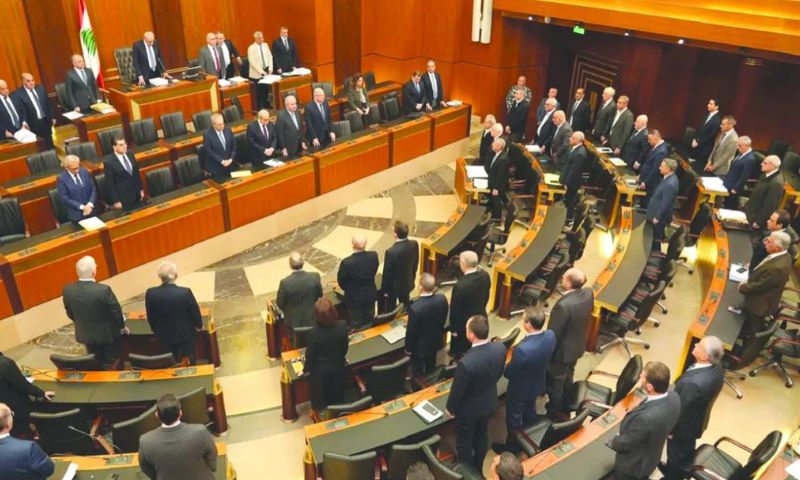
 A session of the Lebanese Parliament to approve the general amnesty law, Aug. 12, 2026 (National News Agency)
A session of the Lebanese Parliament to approve the general amnesty law, Aug. 12, 2026 (National News Agency)
The Lebanese Parliament passed a law on Wednesday, Aug. 12, granting a general amnesty and exceptionally reducing some prison sentences, following years of demands for the legislation and months of political and legal debate over the crimes it covers and the groups eligible to benefit.
The law comes as Lebanese prisons face severe overcrowding. The prison population stood at 6,268 as of March 30, according to statistics from the Prisons Directorate, while overcrowding reached about 300%, according to the National Human Rights Commission’s 2025 report.
According to Lebanese sources, the law is primarily intended to ease pressure on prisons, particularly given the presence of detainees who have spent years behind bars without judgments being issued against them.
Parliament Speaker’s office announced in a statement the passage of an amended law granting a general amnesty and exceptionally reducing the duration of some sentences, after amendments were introduced to the text during the legislative session.
The law is the first of its kind since Lebanon’s 1991 amnesty law, passed a year after the end of the civil war that lasted from 1975 to 1990. That law closed files related to war crimes without a comprehensive accountability process, genuine reconciliation among the parties to the conflict, or justice for victims and their families.
The general amnesty issue returned to the forefront in recent years, particularly among Sunni lawmakers, against the backdrop of the case of Islamist detainees. They include people arrested over events linked to the war in Syria, some of whom remained for years without trial.
A large number of them are from the northern Lebanese city of Tripoli. They are detained or convicted in cases involving various crimes, including fighting and attacking the Lebanese army and carrying out bombings.
Demands for an amnesty were not limited to this group. Hezbollah also called for the law to cover a number of Shiite detainees and wanted individuals in the Baalbek and Hermel areas of eastern Lebanon, most of whom are accused in cases involving drugs and car theft.
Christian political forces and parties also called for provisions benefiting Lebanese citizens who left for Israel after Israeli forces withdrew from southern Lebanon in 2000. Their families have expressed fears that they could face reprisals because some relatives had ties to the South Lebanon Army, which collaborated with Israel during the years of occupation.
According to parliamentary estimates made before the law was passed, around 3,300 people were expected to potentially benefit. They included people convicted of less serious crimes, detainees held for years without judgments, and people who had completed their prison terms but remained detained because of unpaid financial fines. Lebanese authorities have not yet announced the final number of beneficiaries.
Under the version discussed by parliamentary committees before it was referred to the full chamber, the amnesty covers crimes committed before March 1, 2026. In cases covered by the legislation, prosecutions and penalties are dropped, while preserving the right of those harmed to seek civil compensation.
The law, however, excludes a broad range of crimes, including premeditated murder, terrorism against civilians and military personnel, serious attacks on the army, espionage and collaboration with Israel, as well as corruption, illicit enrichment, and offenses involving public funds.
It also excludes money laundering, crimes involving depositors’ funds and banks, rape, human trafficking, domestic violence, torture, and enforced disappearance, along with antiquities theft, environmental crimes, and certain repeat offenses involving theft and drugs.
Under the text, some drug users who are not repeat offenders, cannabis farmers, and people convicted of weapons offenses not connected to murder or terrorism may benefit. Some Lebanese noncombatants who left for Israel following its withdrawal from southern Lebanon may also benefit, while those who collaborated with Israel are excluded.
The law also provides for reduced sentences. The text had proposed converting life sentences with hard labor into 17 years’ imprisonment and reducing other sentences by one third. The move came as part of a broader reorganization of sentencing terms after Parliament passed a law abolishing the death penalty on Tuesday.
The legislation also includes a provision concerning detainees who have spent lengthy periods in custody without judgments being issued. Parliamentary committees had previously proposed releasing detainees who had spent more than 14 years in custody without a judgment while allowing their trials to continue outside prison, before amendments were proposed reducing that period to 12 years.
Under the amendments approved by Parliament, the threshold for release was reduced from 14 years to 12 years. The word “final” was also removed from the article concerning judgments, meaning release is now limited to those against whom no judgment of any kind has been issued, rather than only those without a final judgment.
Sheikh Ahmed al-Assir emerged prominently in political and media discussions surrounding the law because of his convictions in cases related to the 2013 Abra clashes with the Lebanese army.
Passage of the amnesty law does not mean he will automatically leave prison, as the text excludes crimes involving the killing of military personnel and terrorism from the full amnesty. However, sentence reductions or provisions concerning people held for long periods could affect some cases, depending on the final legal classification of each file.
MP Nabil Badr said after the law was passed that efforts would now turn to the Military Court to reduce al-Assir’s life sentence to a lesser term, allowing him to benefit from reductions in the number of years to be served. He added that, in his assessment, the process could lead to al-Assir’s release after a short period, depending on judicial decisions issued later.
Regarding Islamist detainees, MP Imad al-Hout said 79 of 146 Islamist detainees would be released from prison under the law, arguing that continuing to detain people after they have exceeded the legal limit for pretrial detention is no longer acceptable.
Singer Fadel Shaker, whose name is also associated with the Abra events, is not among those who will be released from prison under the law. He had already been released on bail before the legislation was passed, and his trials remain ongoing, according to information contained in texts addressing the law.
The name of Nouh Zaiter , who has been linked to drug and weapons cases in the Bekaa region and was arrested by the Lebanese army in November 2025, was also raised. The extent to which he may benefit from the law depends on the nature of his cases and the judgments issued against him, in light of the legislation’s exclusions.
The law did not pass without disagreements inside Parliament. Tuesday’s session lost its quorum following a dispute over comments submitted by the army command regarding the amnesty proposal.
Defense Minister Michel Menassa had requested that the army command’s comments be read to lawmakers, but Prime Minister Nawaf Salam objected, arguing that the government is represented by its prime minister and that the army command had already submitted its observations in writing.
The dispute prompted protests from Hezbollah and Free Patriotic Movement lawmakers. Several deputies then left the chamber, causing the session to lose quorum and postponing discussion of the law until Wednesday.
During Wednesday’s session, the Free Patriotic Movement and Hezbollah parliamentary blocs, along with several other lawmakers, withdrew over the absence of Defense Minister Michel Menassa, who also left the session.
MP Hussein Hajj Hassan said preventing a minister from speaking inside or outside Parliament represented a precedent. MP Salim Aoun, meanwhile, said the Free Patriotic Movement withdrew in protest at the defense minister not being allowed to present the Lebanese army’s position to lawmakers.
Deputy Speaker Elias Bou Saab, by contrast, said the law was something “we agreed on politically to turn the page,” adding that the government was responsible for remedying injustice and could work to reopen trials and correct what he described as discrimination.
Before the law was passed, Prime Minister Nawaf Salam wrote on X, “Toward restorative, not retaliatory, justice,” while also welcoming Parliament’s passage on Tuesday of legislation abolishing the death penalty.
The new amnesty law is not unprecedented in Lebanon’s history. Parliament has passed dozens of amnesty laws since the 1920s, although most were linked to specific crimes or categories of people.
The most prominent was the 1991 law passed after the civil war. It covered crimes committed before March of that year, closed thousands of files connected to the conflict, and benefited militia leaders and fighters.
In 1997, an amnesty covering earlier drug offenses benefited thousands of defendants. In 2005, Lebanon passed two notable amnesty laws. One enabled the release of Lebanese Forces leader Samir Geagea after about 11 years in prison, while the other covered detainees in the Dinnieh and Majdal Anjar cases.
The current law comes more than three decades after Lebanon’s last broad general amnesty, amid continued political divisions over which cases should be covered and differing positions between families of detainees and families of military personnel killed during security confrontations.
While the government and supporters of the law focus on reducing prison overcrowding and addressing the situation of detainees held for extended periods, opponents insist that people involved in killing or attacking military personnel should not benefit from the amnesty.
Lebanon is therefore entering a new phase in its handling of prisons and detainees after Parliament resolved on Wednesday one of the country’s most contentious legal and political files. The law’s practical impact will become clearer once its provisions begin to be implemented and the cases of potential beneficiaries are examined according to each person’s legal and judicial status.
if you think the article contain wrong information or you have additional details Send Correction


 A
A
A
A
A
A






 More Politics