


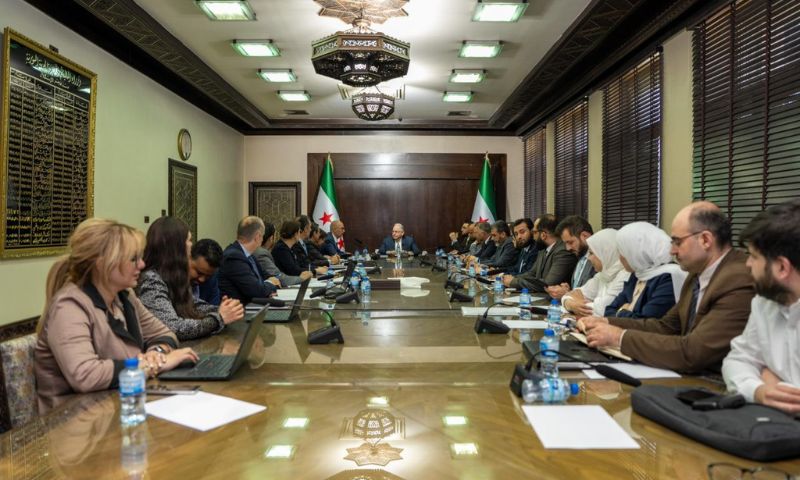
 Finance Minister Mohammed Yisr Barnieh meets with an International Monetary Fund delegation to discuss economic recovery indicators and fiscal reforms, July 26, 2026 (Ministry of Finance)
Finance Minister Mohammed Yisr Barnieh meets with an International Monetary Fund delegation to discuss economic recovery indicators and fiscal reforms, July 26, 2026 (Ministry of Finance)
The International Monetary Fund said Syria’s economic recovery is accelerating, forecasting growth of more than 10% in 2026 and continued strong expansion in 2027. The projected recovery is being supported by improvements in agriculture, oil and gas production, electricity supplies, trade, and services. The IMF also cited the return of refugees, a rise in visitor numbers, and government spending as factors contributing to economic activity.
The assessment was included in a statement issued on Tuesday, August 4, by IMF mission chief Ron van Rooden following a visit by a team of IMF experts to Damascus from July 19 to 23. During the visit, the delegation met Finance Minister Mohammed Yisr Barnieh, Central Bank of Syria Governor Safwat Raslan, and other senior officials to discuss economic conditions, reform priorities, and future technical assistance.
Van Rooden said in the statement that the Syrian economy’s recovery is accelerating. In 2025, the economy began to recover, supported by improved consumer and investor confidence following the political change, the return of around 1.5 million refugees, and Syria’s gradual reintegration into the regional and global economies.
He explained that the high growth expected in 2026, despite the continuing regional conflict, is due to a strong recovery in the agricultural sector following improved rainfall, expanded oil and gas production, better electricity supplies, and continued growth in trade and services.
Economic activity is also being supported by the continued return of refugees, a significant increase in visitor numbers, and reform policies pursued by the authorities to restore macroeconomic stability.
However, the statement warned that growth remains uneven across regions and that poverty is still widespread, despite declining to some extent.
Regarding inflation, the statement said that after slowing significantly in 2025 to the lower end of double-digit levels, it rose sharply again in 2026. The increase resulted from higher import prices, particularly for fuel and food, due to the regional conflict, as well as stronger domestic demand, public sector wage increases, higher public service prices, and rising housing costs.
The IMF expects inflation to decline in 2027, provided that pressures related to import prices ease and sound fiscal and monetary policies continue.
Regarding public finances, the statement said the 2025 central government budget ended with a small surplus after expenditure was kept within the limits of available resources and focused on meeting essential needs.
Revenue is expected to rise significantly in 2026, after tax and customs revenues recorded a substantial increase during the first half of the year. Oil and gas revenues also increased, along with some exceptional revenues, including telecommunications licensing fees and fuel transit charges.
The IMF called for sound fiscal policies to be maintained in 2027, including preparing the central government budget based on conservative assumptions regarding revenue and financing and limiting current expenditure. It also stressed the importance of improving revenue and rationalizing spending priorities to create the fiscal space needed for development spending and to strengthen the social safety net.
Regarding monetary policy, the statement said the Central Bank of Syria had successfully managed the introduction of the new currency. However, monetary policy continues to face severe constraints due to major problems in the banking sector’s performance and the absence of monetary policy instruments.
The IMF stressed that accelerating the rehabilitation of the banking sector is critical to enabling it to perform its role in financial intermediation and facilitating domestic and international payments.
Urgent priorities include preparing and adopting a new central bank law and a new banking law, conducting a comprehensive assessment of banks’ financial health in accordance with international best practices, and strengthening the framework for combating money laundering and terrorist financing. These measures would contribute to removing Syria from the Financial Action Task Force’s grey list.
Van Rooden announced that an extensive technical assistance program had been agreed upon for the coming period. In the area of fiscal reforms, the program will cover public financial management, revenue mobilization, public debt management, and the development of domestic capital markets.
In the area of financial sector reform, activities will focus on preparing new banking legislation and regulations, rehabilitating the banking sector, strengthening banking supervision, improving the framework for combating money laundering and terrorist financing, and supporting the central bank in developing an appropriate monetary policy framework.
The statement also noted progress in preparing a debt sustainability analysis. However, it said gaps remain in the availability and quality of essential economic data, limiting the possibility of conducting a more detailed assessment of economic developments.
Capacity building activities will continue to focus on improving statistics related to national accounts, prices, the balance of payments, public finances, and monetary indicators.
The IMF team’s visit to Damascus comes as part of the resumption of cooperation between Syria and international financial institutions following a yearslong interruption during the former regime.
Syria had requested the resumption of Article IV consultations with the IMF. The final statement confirmed the request, while making the resumption of consultations conditional on progress in improving the quality and availability of data.
Article IV consultations are one of the IMF’s main tools for assessing the economic conditions of member states and providing necessary recommendations.
if you think the article contain wrong information or you have additional details Send Correction


 A
A
A
A
A
A


 More Economic Reports