


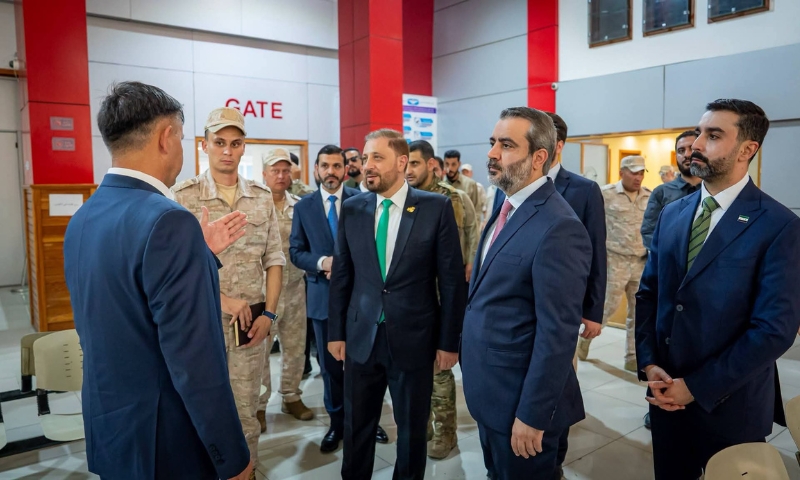
 Syrian Foreign Minister Asaad al-Shaibani visits Latakia International Airport after it was handed over by Russian forces in Syria, Aug. 9, 2026 (Syrian Foreign Ministry)
Syrian Foreign Minister Asaad al-Shaibani visits Latakia International Airport after it was handed over by Russian forces in Syria, Aug. 9, 2026 (Syrian Foreign Ministry)
Enab Baladi, Yazan Kur
The Syrian-Russian memorandum of understanding on Hmeimim and Tartus marks a shift in the form of Russia’s presence in Syria, after years in which direct military deployment was one of Moscow’s main pillars in the country.
The new arrangement does not end the Russian presence entirely. Instead, it reorganizes it by transferring civilian facilities to Syrian state administration while maintaining a Russian military presence in a different form through joint training and qualification centers.
The move is significant because of the two bases’ place in Russia’s strategic calculations. Since Russia’s military intervention in Syria in 2015, Hmeimim, in Latakia governorate in western Syria, has served as a key center for Russian air operations, while Tartus, on Syria’s Mediterranean coast, has provided Moscow with a naval foothold in the Mediterranean.
The shift from military bases to joint training centers, combined with Damascus regaining management of Hmeimim airport and commercial facilities in Tartus, reflects a change in the nature of the relationship compared with the previous phase.
The memorandum follows about 18 months of negotiations and comes at a new stage in which Damascus is seeking to reorganize its foreign relations and sovereign institutions, while Moscow is trying to maintain a position inside Syria despite the changed circumstances that had underpinned its previous presence.
Dmitry Bridzhe, a researcher on Russian and Middle Eastern affairs, told Enab Baladi that the Syrian-Russian memorandum requires careful interpretation. He said what was announced is a “memorandum of understanding,” not a treaty or an agreement ratified by parliament, the People’s Assembly. The publicly announced provisions are specific and measurable, he added, and this designation helps explain both what the document contains and what it leaves out.
Bridzhe said the undisclosed part of the understanding is likely far more extensive. There is no clear figure for the number of Russian military personnel who will work at the centers, no statement about the types of units and equipment that will remain, and no clarification of the status of air defense systems.
According to Bridzhe, the memorandum also contains no details on docking rights, maintenance, refueling and ammunition supplies for Russian vessels, or the use of runways to transport personnel and equipment toward Libya and Africa. Nor is there an announced duration for the new arrangement or a mechanism for ending it.
More importantly, he said, the 2015 agreement governing the deployment of the Russian aviation group at Hmeimim and the Tartus agreement signed on Jan. 18, 2017, for a term of 49 years have not been formally announced as canceled or legally amended.
Bridzhe views this ambiguity as part of the arrangement itself rather than necessarily a flaw, saying the two sides reached a formula that allows each to present the agreement to its own public in the way it prefers.
According to Bridzhe, Damascus can say that independent Russian bases have ended, while Moscow can say that its presence in Syria continues in a new form. He described “both formulations as true at the same time,” which, in his view, helps explain why negotiations lasted about 18 months.
He added that the direction of the asymmetry between the two sides has reversed, although it has not disappeared entirely. He noted that the memorandum’s most significant political meaning is the shift in relations between Damascus and Moscow from a protection-based relationship to a contractual one, after Russia’s presence for an entire decade had been tied to the survival of a specific political regime. Today, he said, the Syrian government determines the form of the Russian presence.
“The most significant political meaning of the memorandum is the shift in relations between Damascus and Moscow from a protection-based relationship to a contractual one, after Russia’s presence for an entire decade had been tied to the survival of a specific political regime.”
Dmitry Bridzhe
Researcher on Russian and Middle Eastern Affairs
Regarding Russia’s acceptance of this formula, Ali Fawzi, a researcher on Arab and African affairs, said it comes in the context of the transformations Syria has undergone and the need, in this new phase, to redefine relations between Damascus and Moscow. He added that Russia also wants to preserve a strategic foothold in Syria, particularly on the Mediterranean coast, but at a lower political and military cost than the traditional model of military bases.
He said that under the new arrangements, Moscow is not abandoning its interests in Syria, but redefining the nature of its presence in a way that suits the new political phase. Its presence becomes less tied to direct military deployment and more connected to cooperation, training, and qualification, allowing it to retain part of its influence without necessarily preserving the previous model of military bases.
“Under the new arrangements, Moscow is not abandoning its interests in Syria, but redefining the nature of its presence in a way that suits the new political phase. Its presence becomes less tied to direct military deployment and more connected to cooperation, training, and qualification, allowing it to retain part of its influence without necessarily preserving the previous model of military bases.”
Ali Fawzi
Researcher on Arab and African Affairs
Damascus regaining administration of Hmeimim Airport and some commercial facilities at the Port of Tartus represents an important political and economic gain for the Syrian government, according to Fawzi. He said it gives the government greater scope to manage its civilian and commercial facilities and strengthens its ability to present the agreement as a step toward restoring national sovereignty.
He noted that the return of these facilities to Syrian administration is significant not only operationally or economically, but also gives the government political leverage as it redefines its relations with international powers. It also demonstrates its ability to negotiate arrangements inherited from the previous period and reshape them in line with the interests of the new Syrian state.
Regarding international reactions, Fawzi said the United States and European countries will examine the agreement in terms of whether Russia retains the ability to use the Syrian coast as a military foothold in the eastern Mediterranean. Turkey, meanwhile, is likely to view the development as part of the reshaping of Syria’s security balance.
Israel will primarily assess the agreement through the lens of its regional security and the scale of Russian and Iranian military capabilities inside Syria, Fawzi said. The nature of the new Russian military presence will therefore be an important factor in determining how Israel interprets the agreement.
“The international position will not be determined solely by the announcement that the bases are being converted into training centers, but by the nature of the role these centers will play, the size of the Russian forces that will remain there, and whether the new presence will be limited to training and qualification or retain broader military and logistical capabilities.”
Ali Fawzi
Researcher on Arab and African Affairs
if you think the article contain wrong information or you have additional details Send Correction


 A
A
A
A
A
A





 More Politics