


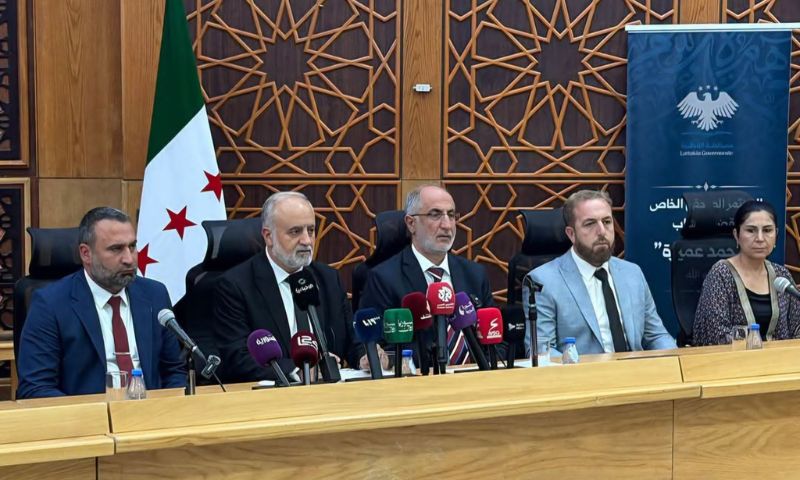
 The ministerial committee tasked with following up on the death of Muhammad Ghamira in al-Haffah, Latakia countryside, August 20, 2026 (Al-Watan newspaper)
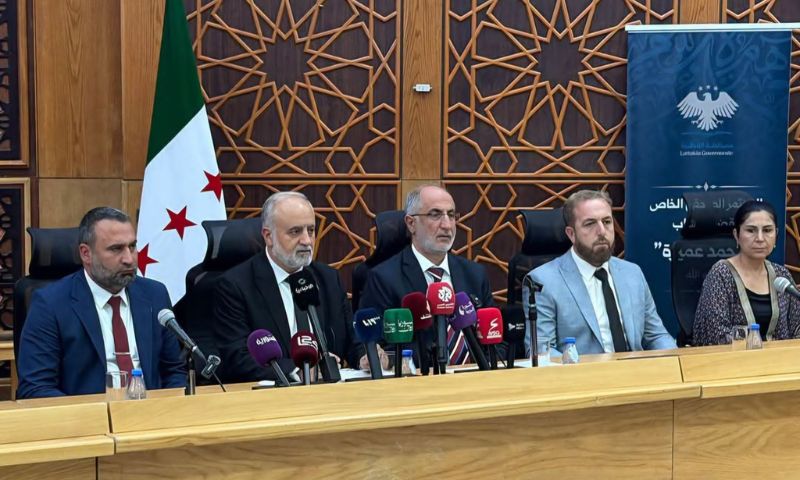
The ministerial committee tasked with following up on the death of Muhammad Ghamira in al-Haffah, Latakia countryside, August 20, 2026 (Al-Watan newspaper)
Maj. Gen. Ahmed Latouf, head of the committee tasked with investigating the circumstances surrounding the death of young man Muhammad Ghamira, said Thursday, August 20, that medical experts found the cause of death was complications from a cerebral hemorrhage in Ghamira, who had hemophilia. He added that the forensic examination found no visible signs that Ghamira had been subjected to violence or physical force.
Latouf, who serves as assistant interior minister for police affairs, said during a press conference that the committee met with the governor of Latakia before reviewing the investigations conducted by Internal Security and completing its own investigation into the case.
He explained that the injuries identified during the initial examination of Ghamira’s body did not indicate that he had been subjected to violence. He said a wound on the upper right side of his forehead and an adjacent puncture wound resulted from a medical procedure carried out at Latakia University Hospital.
Latouf added that skin fissures on Ghamira’s abdomen were associated with long-term cortisone treatment, while a small bruise on his right forehead and another on his left foot were found to be pathological hemorrhagic bruises linked to his medical condition.
According to Latouf, experts confirmed that the forensic examination showed no visible signs of violence or physical force. It also found no skull fractures or traumatic wounds.
He said that when experts were asked about the bleeding that led to Ghamira’s death, they confirmed that the cause was complications from a cerebral hemorrhage in Ghamira, who had hemophilia.
In the same context, Latouf said the committee expanded its investigation into al-Haffah Police Station and reviewed the procedures followed with Ghamira during his detention.
According to the committee chairman, the investigation found that Ghamira had informed Internal Security personnel that he had hemophilia.
Although the forensic examination did not establish that Ghamira had injuries caused by violence, Latouf said the investigation confirmed that investigator Ahmed Jawad slapped Ghamira with his hand on the neck.
In his public statements, Latouf did not clarify whether the act was found to have been connected to Ghamira’s subsequent health deterioration or death. He said procedures related to the case would continue in accordance with the investigation’s findings.
The committee decided to refer investigator Ahmed Jawad to the Public Prosecution in Latakia based on the findings of the investigation. It also instructed the Interior Ministry’s Department of Cases and Disciplinary Proceedings to expand its disciplinary investigation into Capt. Ahmed Shaker al-Masri and investigator Omar Youssef.
The committee requested that it be informed of the results of the disciplinary investigation “as quickly as possible,” as part of the measures taken concerning personnel at al-Haffah Police Station in connection with Ghamira’s case.
For his part, Latakia Governorate Attorney General Osama Shannaq said the Public Prosecution would pursue the case of Muhammad Ghamira’s death “with full firmness,” pledging to expedite legal proceedings against anyone proven to have been involved in the case.
Shannaq said anyone found responsible for negligence or dereliction of duty that led to Ghamira’s death would receive “just punishment,” stressing that the judicial process would continue alongside the measures taken by the investigation committee and the Interior Ministry.
At the conclusion of the committee’s work, it was announced that the case files and medical treatment records would be returned to the hospitals and secured. Muhammad Ghamira’s body was also handed over to his family in preparation for burial in accordance with established procedures.
Muhammad Husam al-Din Ghamira, a young man from al-Haffah (Latakia countryside, western Syria), died on August 16 after spending several days in intensive care following a deterioration in his health after leaving al-Haffah Police Station.
Ghamira’s case began after he was detained at al-Haffah Police Station for about three days over a complaint alleging the theft of a sum of money, according to his brother, Mustafa Ghamira, who spoke to Enab Baladi.
Muhammad, a former Civil Defense volunteer and the son of Husam Ghamira, who was killed in battles in Ghouta against the Assad regime, had hemophilia, a disorder that affects the blood’s ability to clot.
According to his two brothers, Muhammad was summoned to al-Haffah Police Station over the financial complaint before being detained there for about three days.
Mustafa said the family informed personnel at the police station about Muhammad’s sensitive medical condition and asked that he not be beaten. The family, however, alleges that personnel at the station severely beat him during his detention.
According to Mustafa’s account, Muhammad left the police station after a judicial order was issued for his release, but he was in critical condition and suffering from internal bleeding and a cerebral hemorrhage.
Mustafa added that Muhammad’s heart stopped three times before he was resuscitated after being transferred to Tishreen University Hospital in Latakia, where he remained unconscious in intensive care in an extremely critical condition.
Social media users circulated photographs of Muhammad before his detention showing him in normal condition, alongside photographs taken after he was transferred to the hospital showing the deterioration in his health.
if you think the article contain wrong information or you have additional details Send Correction


 A
A
A
A
A
A


 More Politics