


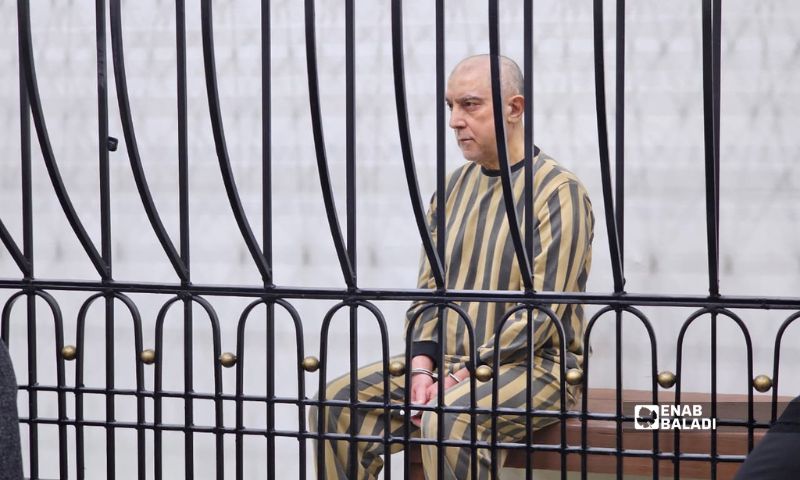
 Atef Najib inside the defendants’ dock during the first session of his trial, April 26, 2026. (Enab Baladi/Ahmad Maslamani)
Atef Najib inside the defendants’ dock during the first session of his trial, April 26, 2026. (Enab Baladi/Ahmad Maslamani)
The Fourth Criminal Court in Damascus sentenced Atef Najib to death on Tuesday, August 11, and issued the same sentence in absentia against ousted Syrian President Bashar al-Assad, his brother Maher al-Assad, and others accused of crimes against civilians.
Najib received multiple sentences ranging from two to six years, along with fines. However, the judge ordered that the most severe sentence, the death penalty, be carried out, the death sentence, while also requiring him to pay the fines.
Judge Fakhr al-Din al-Aryan cited charges of intentional killing of several people on multiple occasions, incitement to kill them, torture, and torture resulting in death, describing the offenses as war crimes and crimes against humanity.
In addition to Bashar and Maher al-Assad and Najib, the rulings included Fahd al-Freij, Louay al-Ali, Qusay al-Mahyoub, Wafiq Nasser, and Talal al-Aismy. The public prosecution case against Ayman Ayoush was dismissed because of his death.
The judge said the arrest warrants issued in absentia against the defendants would remain in force and be circulated to all relevant authorities. He also ordered that the competent authority be contacted to take the necessary measures to pursue them internationally.
The judge confirmed the provisional seizure of the convicted defendants’ movable and immovable assets, placed their funds under administration, and ordered them to compensate the civil claimants. The ruling also preserved the rights of those harmed who had not filed personal claims, as well as the rights of victims’ families and the families of missing persons.
Regarding Atef Najib, the judge said he repeated his statements from previous sessions, denying the charges against him and objecting to the witnesses’ allegations, arguments the court rejected.
Brig. Gen. Abdul Basit Abdul Latif, head of the National Commission for Transitional Justice, said on his X account that “this is not the end of the road, but it is an important milestone on the path toward justice, redress for victims, and strengthening the rule of law.”
Human rights lawyer and transitional justice specialist Mansour al-Omari said Najib’s trial and death sentence were “a first step and a central element in justice and transitional justice measures,” adding that these measures would not be complete unless followed by several further steps:
Speaking to Enab Baladi, al-Omari emphasized the responsibility of states that shelter wanted individuals and their assets, saying they undermine justice for millions of Syrians. He noted that international legal obligations require states to extradite wanted individuals.
He explained that Syrians can pursue such states and hold them accountable for violating their international obligations, including obligations under the Convention against Torture and those related to enforced disappearance, among others.
Al-Omari added that delays in handing over individuals or assets cause harm to victims and their families, and may create an obligation for the states themselves to provide compensation for that harm, in addition to responsibility arising from violations of their international obligations.
The ruling is the first of its kind in the context of transitional justice against defendants linked to the former Syrian regime since its fall on December 8, 2024.
The sentences were issued during the ninth session in a series of hearings that began on April 26, with Najib attending while the other defendants were absent.
Other defendants are still awaiting trial, most notably former Grand Mufti of the Republic Ahmad Hassoun, whose sentencing hearing is scheduled for August 24.
Trials are also underway for Wassim al-Assad, a relative of the ousted president, Ibrahim Huwija, and Mohammad al-Shaar, in addition to thousands of officers and personnel who served in the former regime’s military and security institutions.
During previous sessions, the public prosecution representative had requested that the maximum penalties allowed by law be imposed on Najib, including the death penalty.
At the previous hearing, the court panel asked Atef Najib to deliver his final statement before announcing the end of the session.
Atef Najib is Bashar al-Assad’s maternal cousin. He served in several Political Security branches in Damascus and Tartous before becoming head of the Political Security branch in Daraa (southern Syria) before the uprising began.
Najib became widely known in 2011 after protests erupted in Daraa, helping ignite the Syrian uprising that continued for around 14 years. The protests followed the arrest of a group of children for writing slogans on walls about Bashar al-Assad and suggesting that political change would also reach Syria, including the phrase, “Your turn has come, Doctor.”
if you think the article contain wrong information or you have additional details Send Correction


 A
A
A
A
A
A





 More Politics