


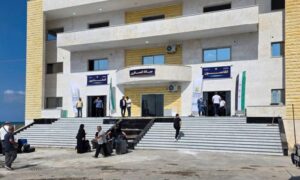
 The Aleppo Information Directorate holds a session to discuss drafting the media law, July 21, 2026. (Enab Baladi)
The Aleppo Information Directorate holds a session to discuss drafting the media law, July 21, 2026. (Enab Baladi)
Syria’s Ministry of Information and its provincial directorates began holding sessions across the country on Tuesday, July 21, to discuss proposals for drafting a new media law. The proposed law is intended to replace legislation adopted under the former Syrian regime before being presented to members of the People’s Assembly for approval.
Information directorates in several Syrian governorates held sessions with journalists and media workers. Enab Baladi correspondents attended the meetings in Damascus, Aleppo, Hama, and Raqqa.
According to Enab Baladi’s correspondents, the provincial directorates organized the discussions around three areas:
According to a document circulated by the ministry to the directorates and session organizers, a copy of which was obtained by Enab Baladi, the sessions aim to produce a regulatory law that protects and frees the media rather than restricting it. The organizers said the law should guarantee three principles:
According to Enab Baladi’s correspondent in Damascus, participants discussed media workers who had promoted the former regime but had not yet been held accountable.
Some media workers who operated in Rural Damascus during the Syrian revolution also called on the state to officially recognize them, including those who had been unable to obtain formal academic qualifications.
Participants discussed the need to quickly establish legal rules governing the release of information, particularly during unfolding events, as well as ensuring fairness when inviting media outlets to attend public events.
According to Enab Baladi’s correspondent, participants also discussed influencers active on social media and called for their work to be regulated. They also requested the establishment of official communication with Meta, which operates Facebook and Instagram.
In Aleppo, the discussions were similar to those held in Damascus, according to Enab Baladi’s correspondent. Journalists called for the legal recognition of the right to access information, stronger protections for journalists, and greater operating space for unions and nongovernmental organizations.
Participants submitted their proposals and recommendations in writing so they could be sent to the Ministry of Information, which is drafting the law, the correspondent in Aleppo said.
Abdul Karim Laila, director of the Aleppo Information Directorate, said the law would pass through several stages and workshops before being presented to the People’s Assembly after the drafting process is completed.
Laila added during the session that the ministry was working on a plan to develop the work of the information directorates and make it easier for media workers to perform their jobs.
The Aleppo Information Directorate director also explained the difference between a code of conduct and a media law. He said the media law is legally binding and includes penalties, while a code of conduct is limited to internal institutional procedures and is not legally binding.
In Hama, discussions focused on defining media work and presenting proposals and recommendations related to drafting the media law, according to Enab Baladi’s correspondent.
In Raqqa, participants called for the protection of journalists, an end to government bodies’ monopoly over information, and measures to combat hate speech and defamation against media workers. They also emphasized the media’s role in guiding society and called for financial penalties to be used when media workers are held accountable.
Omar Haj Ahmad, director of the Press Affairs and Licensing Department at the Syrian Ministry of Information, previously told Enab Baladi that a specialized ministry committee had begun drafting the first version of the media law. The draft would then be presented for public discussion before being referred to the People’s Assembly for deliberation.
Regarding the most significant proposed amendments, Haj Ahmad said preliminary discussions had focused on:
However, Haj Ahmad said the sessions and discussions concerning the new media law remained at an early stage.
The Ministry of Information published a video through its official accounts stating that six categories of publication and media content are prohibited.
The six prohibited categories are:
The ministry told Enab Baladi at the time that the widely circulated video about restrictions on media work in Syria was an informational and advisory video outlining the main prohibitions contained in the current media law and the code of conduct adopted by the ministry.
Haj Ahmad said the Ministry of Information had based its legal and professional approach on the media law, the code of conduct, and several other laws containing provisions related to media work.
if you think the article contain wrong information or you have additional details Send Correction




 A
A
A
A
A
A


 More Politics