


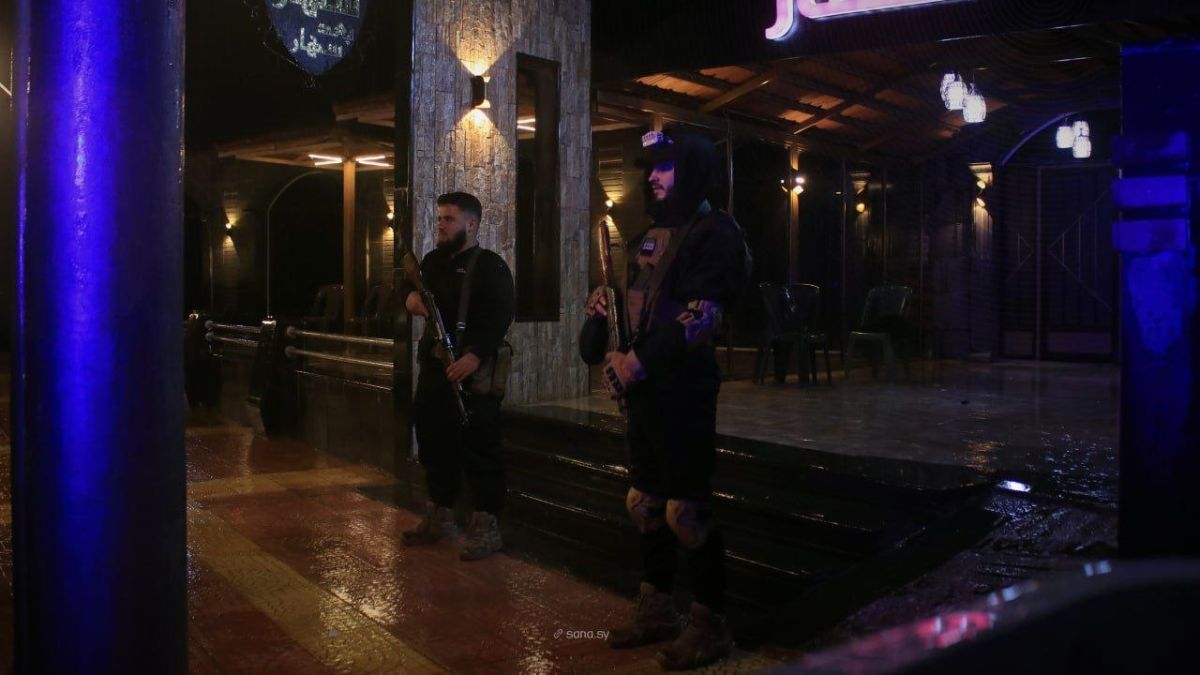
 Internal Security forces deployed in Salamiyah to secure New Year celebrations. (SANA)
Internal Security forces deployed in Salamiyah to secure New Year celebrations. (SANA)
Security authorities in Hama announced that Ghazal al-Haj, who had been reported missing from Salamiyah (Hama governorate, central Syria), was found through coordination with the Internal Security Command in Rif Dimashq (southern Syria). The announcement followed widespread controversy over a video circulated on social media that was allegedly fabricated.
Enab Baladi’s correspondent in Salamiyah reported that al-Haj was placed under the protection of security authorities after surveillance camera footage was reviewed and the necessary inquiries were conducted. The investigation found that she had left Salamiyah for Damascus on the day of her disappearance, accompanied by a young man from Rif Dimashq.
The correspondent added that al-Haj and the young man were brought in together. The man was held at the Kafr Batna police station in Rif Dimashq, while al-Haj was transferred to Salamiyah for questioning.
Her family later took her home and informed the Supreme Ismaili Council that she had returned.
A video circulated on Saturday, July 11, showing a girl who claimed to be Ghazal al-Haj. She said she was safe and staying with another family, adding that she had fled because her family was forcing her to marry her cousin.
The video was widely shared on social media and divided public opinion between those who believed the girl’s account and those who questioned its authenticity. Some users claimed that the recording had been fabricated using artificial intelligence.
Enab Baladi’s correspondent in Salamiyah contacted al-Haj’s father about the video. He categorically denied that the girl shown in the recording was his daughter, saying that her appearance, voice, and manner of speaking were clearly different from Ghazal’s.
The Internal Security Command in Hama said in an official statement, “Following reports circulated on social media claiming that Ghazal al-Haj had been abducted, the relevant units immediately began search and investigation operations and collected evidence to determine the circumstances of the incident.”
The statement added, “Technical investigations and inquiries showed that the girl had left the Salamiyah area with a person residing in Rif Dimashq. After surveillance camera footage from the area was reviewed, his identity was established.”
Internal Security continued, “Through coordination between the Internal Security commands in Hama and Rif Dimashq, the locations of the girl and the young man were identified. They were brought in together, and their statements were taken to complete the investigation and undertake the necessary legal procedures.”
The case of Ghazal al-Haj drew comparisons with that of Batoul Alloush, a young woman whose disappearance prompted widespread controversy in May. Videos circulated in which her family discussed her disappearance before she later appeared in a recording saying that she had “migrated for the sake of God.” Her appearance triggered extensive debate and reactions on social media.
As the controversy grew, Alloush appeared at a press conference on May 11, where she confirmed that she had voluntarily left her family’s home and refused to return. Her family, however, continued to question the circumstances surrounding her appearance.
The Latakia Media Directorate later issued a statement quoting the governorate’s public prosecutor as saying that Alloush was free and was not being held against her will. The statement said no kidnapping had occurred and that preliminary investigations showed she had left her family’s home of her own free will.
According to the statement, the public prosecution ordered her immediate release after arranging a face-to-face meeting between her and her family.
The case prompted criticism from rights advocates, who warned against turning such incidents into platforms for polarization and incitement. The public debate was also accompanied by sharp religious and sectarian rhetoric.
if you think the article contain wrong information or you have additional details Send Correction


 A
A
A
A
A
A






 More Society