
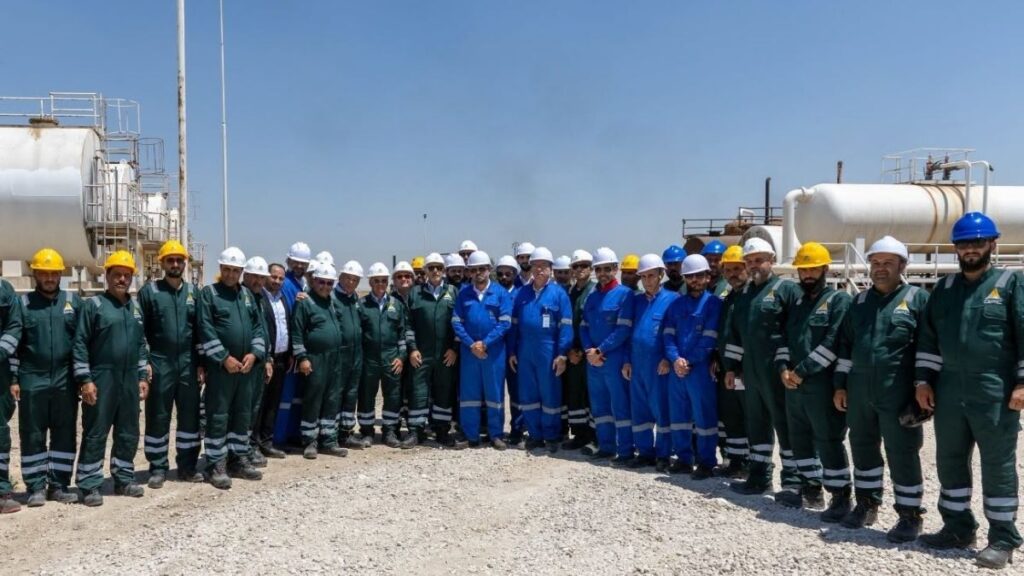

British company Gulfsands Petroleum has resumed efforts to return to Syria’s oil sector after suspending operations for more than 14 years. Company officials conducted a field tour of production sites operated by the Dijla Petroleum Company in Hasakah governorate (northeastern Syria), and announced an investment plan to rehabilitate existing wells and drill new ones to increase production.
The Syrian Petroleum Company said on Tuesday, July 14, that its chief executive, Youssef Qablawi, conducted a field tour with Gulfsands Petroleum chief executive John Bell and vice presidents from both companies. The delegation reviewed production operations, current output levels, and technical and operational work at sites operated by the Dijla Petroleum Company.
The company added that the tour included a presentation of the investment plan developed by Gulfsands after the force majeure status was lifted. This would make it one of the first companies to resume operations in Syria. The plan includes rehabilitating several existing wells and drilling new ones to increase the fields’ production capacity and improve operational efficiency.
Qablawi stressed the importance of implementing development plans according to the specified schedules and using modern technology and specialized expertise to improve production efficiency. He said the British company’s return represented a step reflecting “growing confidence in the Syrian oil and gas sector” and supported plans to develop fields, increase production, and strengthen partnerships with international companies.
He also referred to the resumption of investment in Block 26 at the Dijla field, noting that the field contains light crude oil. He said the Syrian Petroleum Company and Gulfsands had developed a joint plan to resume investment in the field by rehabilitating existing wells and drilling new ones.
Gulfsands Petroleum chief executive John Bell expressed his satisfaction with the formation of a team bringing together the Syrian Petroleum Company and Gulfsands to focus on ways to develop the Dijla field and increase its production.
“Today, we are more committed and enthusiastic than ever to move forward with our full development plan for Block 26,” Bell said.
More Than a Decade Since Operations Stopped
Gulfsands’ relationship with the Syrian market dates to before 2011. The British company was among the foreign firms granted development and production rights in Block 26 in northeastern Syria, one of the country’s largest oil concession areas.
The company says its strategy during the years of suspended operations was to “protect its rights” and prepare to return to Syria when circumstances allowed. It said its operations had remained suspended for more than 14 years because of the declaration of force majeure.
The company’s rights in Block 26 are governed by a production sharing agreement. Gulfsands serves as the operator and holds a 50% working interest, while China’s Sinochem owns the remaining share, according to Gulfsands data.
Force majeure is a legal measure used by companies when exceptional circumstances beyond their control prevent them from fulfilling contractual obligations. It allows certain obligations to be suspended until the circumstances that caused the disruption have ended.
Return Through Dijla Petroleum
Gulfsands’ operations in Syria are connected to the Dijla Petroleum Company, the joint operating company responsible for managing activities in the concession area.
Gulfsands said the joint company was reconstituted after steps toward resuming operations began. This followed the Syrian Petroleum Company’s assumption of control and oversight of oil fields in northeastern Syria in 2026, under what Gulfsands described as arrangements linked to the January agreement between the Syrian government and the Syrian Democratic Forces, known as the SDF.
In March, the British company announced that it had made its first official visit to Block 26 in nearly 15 years, accompanied by representatives of the Syrian Petroleum Company and the Dijla Petroleum Company.
The visit included the Khurbet East and Yousefieh fields, as well as production facilities. Gulfsands said at the time that its teams had begun technical, security, and environmental assessments of the wells and facilities with the aim of restoring the fields to full and safe operations.
What Does the Investment Plan Include?
According to company statements, Gulfsands’ current plan focuses on two main phases. The first involves rehabilitating existing fields and infrastructure, while the second aims to expand production by developing discoveries and drilling additional wells.
The company said its technical teams had conducted studies that included analyzing available data on Block 26, reassessing existing discoveries, and identifying new exploration opportunities.
Gulfsands said it had identified nine priority locations for drilling new exploration wells as part of a plan to develop the concession’s existing resources and increase future production.
The company also announced plans to introduce investment, expertise, and modern technology to rehabilitate the fields, increase production, and reduce environmental damage. It said its plans would also create jobs, provide training programs, and stimulate economic activity in the areas where it operates.
Target Exceeds 100,000 Barrels a Day
The British company says Block 26 has significant production potential and that it aims, over the medium term, to increase output to more than 100,000 barrels of oil equivalent per day, provided suitable technical and investment conditions are available.
Gulfsands says developing Syria’s oil and gas sector could provide a major source of revenue to finance the economy, particularly given the extensive rehabilitation needed for oil infrastructure damaged during the years of war.
Reaching these production levels, however, would require lengthy stages of rehabilitation and investment, according to the company. Many facilities and wells need maintenance and development before they can return to high production levels.
International Interest in Syria’s Energy Sector
Gulfsands’ return comes as international energy companies have begun reconsidering investment opportunities in Syria following political and economic changes and the lifting or easing of sanctions imposed on the country.
Energy Intelligence said in a report published on July 9 that Syria had become a “new strategic destination” for some international oil companies. It noted that several companies had expressed interest in the Syrian energy sector.
The report said Gulfsands had become active again in Block 26 in northeastern Syria. It also noted that HKN Energy had entered into arrangements to develop other oil fields through an agreement with the Syrian Petroleum Company.
According to the report, Syria currently produces about 120,000 barrels of oil per day. Syrian authorities aim to raise production to approximately 180,000 barrels per day during the next year, compared with levels of about 380,000 barrels per day before 2011.